How AI Is Impacting the Communications Field, and How You Can Get the Most Out of It: An Exclusive Interview with Chief Product and Technology Officer Jeff Hicks
AI is changing how people discover brands, take in information and make decisions, which means that AI has already had an outsized impact on communications professionals. As AI continues to evolve, communications professionals must change their approaches. Search engine optimization (SEO) rules don’t always compete in a world dominated by answer engine optimization (AEO) and generative engine optimization (GEO).
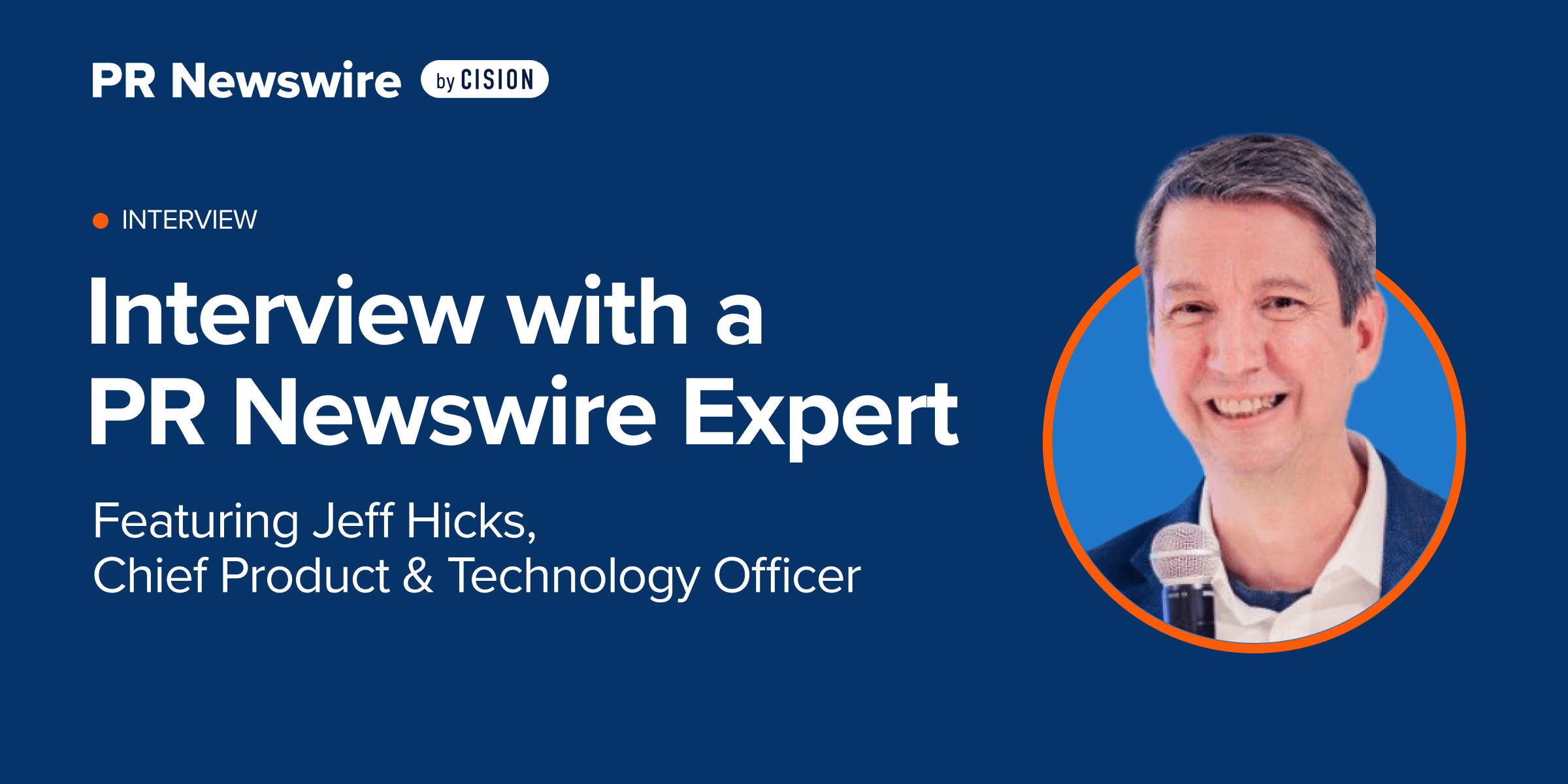
Jeff Hicks, the Chief Product and Technology Officer at PR Newswire, sat down with us to talk about this ever-changing landscape. In his chat, he discussed how AI is reshaping PR, why press releases remain an important source of truth, and how communicators can use GEO, AEO and multichannel strategies to build stronger brand visibility in an AI-driven world.
The following interview has been edited for clarity.
Thank you for taking the time to talk with us. First of all, why don’t you tell us a little about your background?
Hi, my name is Jeff Hicks. I’m the Chief Product and Technology Officer at PR Newswire. I lead the product and technology team, building out our suite of products and solutions. I’ve been with PR Newswire for a little bit over five years now. I have a long history in product and software development at large companies as well as several startups.
Now let’s start with a big picture question – how do you see AI search impacting the comms profession, and how do you believe it will continue to change the field?
AI search is reshaping communications right now. It’s now about how AI represents brands. Someone goes to ask a question to an AI search engine, and they get an answer back. That answer might mention a brand; it might mention multiple brands, and in some cases, AI search might now make recommendations about brands and products.
From a communication perspective, communicators are now looking at how they can shape inputs to AI, so that AI will represent their brand in a positive way. It’s creating an urgency for organizations to rethink their approach to PR and communications and how they build their narrative to support the input to AI.
What are the greatest benefits and greatest risks of AI in comms as you see it today?
The benefits of AI include having your own personal communications assistant. We built the PR Newswire Amplify™ platform for PR professionals to provide an AI assistant for them. We've seen cases where our clients are more productive leveraging the AI capabilities of Amplify to produce content, and it’s allowed them to do that faster and quicker, with higher quality and better performance. That’s just an example of the benefits of leveraging AI for communications.
Some of the risks are that, if you’re not careful, AI can produce what they call slop, which is hastily created content that’s not very well written – it’s really not great quality. There may be a large quantity of it, but it is low in quality.
So again, I think from a benefit perspective, you have higher-quality content and your own personal communications assistant. And from a risk perspective, you have lower-quality slop if you’re not careful and not using AI that’s been trained to communicate for PR professionals.
How can current SEO “best practices” help AEO and GEO efforts, and what are most communicators missing when it comes to GEO/AEO tactics?
SEO is still important. And some of the standard SEO best practices also work for AEO and GEO. Google introduced a standard called E-E-A-T, which stands for “Experience,” “Expertise,” “Authoritativeness” and “Trustworthiness.” So, E-E-A-T content creation principles are still very valid for AEO and GEO. In fact, they’re even more important because leveraging your experience, leveraging your expertise, leveraging your authority and being a trustworthy source are all signals that AI search engines are looking for.
As for the second part of your question, there are two things when it comes to what communicators are missing right now. First, I encourage all communicators to think about the types of questions they want their brand to be the answer to. And not only that their brand is mentioned in the answer, but that it’s mentioned in the right way. You should monitor if that sentiment is positive, neutral or negative.
So thinking about those questions is very important. What are the types of questions that are going to be asked? Then, how are you measuring the impact of those questions in the AI search engines?
And then there’s a whole set of important new metrics, like mentions - is your brand showing up, is it being mentioned in the AI answers? Another one is citations - is your content being cited by AI as an authority in a certain space? Those are important. So there are a number of new metrics that are additive to traditional SEO metrics and measurements that are more and more important today, and a lot of brands are only just now starting to look at those.
What is one piece of advice you’d give to a communications specialist about how to develop a GEO strategy?
My advice would be to start simple; don’t try to do everything all at once. Continue to build your narrative with authority. Produce thought leadership pieces; produce content that is high quality, that tells your story, that tells your narrative.
Because one of the things we see with GEO is that the brands that are consistently telling their story, sharing their narrative, telling it through multiple channels – those can be traditional trusted sources like a press release, earned media, social content, their own website – consistently across those channels helps the brand to show up and become visible. It helps them be the answer to AI search questions.
So, for GEO, and particularly if you are looking to have content cited in the answers for GEO, with AI search recognizing your content as a source of authority and citing you in the answer, then I would say the best advice I could give you would be to continuously publish that kind of quality content through multiple channels in an authoritative way.
That’s a great piece of advice! Now, can you talk about Multichannel Amplification™ and how it can help with messaging in a post-AI world?
Multichannel Amplification™ is the approach of reaching your audience where they are through different comms channels. For example, we built the PR Newswire Amplify™ platform to allow our customers to easily create content across multiple channels in a consistent brand voice.
The multiple channels include traditional channels, like a press release and earned media, but they also include social channels, YouTube, LinkedIn and others, and your own properties, such as your website or your own newsroom.
When you produce content and distribute it across those channels, that content is reinforced across these different pieces, making any AI search engine more likely to view you with strong authority.
That’s what we mean by Multichannel Amplification™ and something we’ve built into PR Newswire Amplify™ to make it easy for our customers to be able to create a campaign, plan it out, create content and distribute that content through those channels.
What is one thing that comms professionals should be using AI for, and one thing they should never use AI for?
That’s a great question. I think leveraging AI for the campaign planning process is crucial. You can use AI to come up with ideas or to provide a series of options for different types of campaigns, all of which can then be leveraged through AI for creating the content.
When we created PR Newswire Amplify™, we built in decades of best practices and PR performance, as well as press release performance data and our other information essential for communication professionals to allow our AI product to generate high-performing content that is optimized for SEO, AEO and GEO. I think the ability to use an AI-powered platform like Amplify to leverage all of that information for content creation is a great use of AI.
As for what to avoid, I would say this – don’t think of AI as a way to just get a high volume of content out, because that ends up creating AI content slop. You should think about quality over quantity in the new AI world.
Do you have any tips or “tricks” when it comes to making your content more likely to be cited by LLMs?
My advice would be not to try to trick LLMs into citing your content. Instead, take an approach where you are building your narrative through trusted multichannel sources. As for tips, the press release is a very valuable source in the AI world. We see press releases as a way to improve visibility through AI search engines, to build brand trust through authoritative timestamped sources of truth and to deliver information in an AI-friendly format. The structure and content of press releases are very valuable to AI engines and drive earned media.
I would say to continue to do those things, to build your narrative consistently and don’t try to trick LLMs because they’re going to change and over time that will not be a good strategy.
I know you’ve touched on this already, but how important do you feel press releases are to the present and future of AI search discovery?
Very important. I’ll tell you why – when a fact enters the world from a company or organization announcement, the press release is the content source of truth for that. So, if you think about it, that is a trusted, authoritative source that is known to come from the company or organization making the announcement.
It becomes a source of truth that AI has no substitute for. AI cannot substitute any other content for that. That makes it a very important part of the story, and we’ve seen the best-performing content in press releases is content that:
- Answers questions that solve problems
- Provides data
- Is dynamically structured
- Is formatted well
- Has FAQs (Frequently Asked Questions)
A lot of clients have been including FAQs in their content to answer a lot of those questions that AI wouldn’t previously know, so AI can pick that question out from the press release and use that for answers and will often cite that press release as a result. I think those are some of the ways that the press release is becoming even more important in the world of AI search.
You also talked a bit about PR Newswire Amplify™. Of all the tools and platforms used to build comms around the new AI landscape, what makes Amplify the tool that stands out?
I would recommend Amplify because its AI is purpose-built for PR comms professionals. It’s trained with decades of editorial best practices as well as press release performance information, and it provides a secure and compliant environment so that you know your data is secure, trusted and not going to be shared or used to train any other models.
So, the Amplify platform will allow you to plan your campaigns, to create your content faster than ever before, to distribute that content through the industry’s leading network, and then report on the ROI to allow you to optimize future campaigns for maximum results.
That’s why Amplify is a complete built-in solution that helps make your brand and content visible for traditional SEO, AI Search, AEO and GEO.
Is there one final lesson you’d like all communicators and marketers to take to heart when it comes to best AI practices?
It’s an exciting time to be a communicator right now! There’s a lot of new technology, a lot of change and a lot of excitement around the potential for AI. AI gives you, as a PR comms professional, a way to build your narrative, to build a story for your brand or for your company, and in doing that, you can make your narrative even more important to AI search agents, which actually makes that narrative even more important to the people you’re trying to reach.
Final Takeaways
- AI search is changing brand discovery. Not only is it important for you to be discovered by AI, but you also want the right messaging discovered as well.
- E-E-A-T is just as, if not more, important for AEO and GEO as it was for SEO. Authoritative, trustworthy sources are essential for AI Search success.
- Quality over quantity. When used properly, AI can serve as a powerful assistant to help create high-quality, highly visible content. When used brashly, with the focus on creating massive content libraries, you get slop.
- Build consistently across channels. Press releases, earned media, social platforms, websites and other owned channels can all reinforce a brand’s story and visibility across AI search. Tools like PR Newswire Amplify™ can help you share the same story across multiple channels.
- SEO metrics have their place, but you need more. Brand mentions and citations in AI-generated answers are increasingly important goals for communication teams, and understanding AI visibility is key.
- Press releases remain a source of truth. When new facts enter the public record, press releases are authoritative, timestamped sources that are incredibly valuable to AI systems.
- The future is multichannel. Consistently telling a brand’s story across multiple trusted channels is key in an AI-driven search environment.
Has your interest in PR Newswire Amplify™ been piqued? Request a demo of our powerful press release campaign tool, powered by AI, that can help guide you in constructing your content for AI search visibility.