'Science, Design and Trust Central to a Smoke-Free Future,' Say Global Business Leaders and Experts
PMI leaders and independent experts set out the company's smoke-free aim, the investment and science behind it, and the safeguards needed to protect young people
NEW DELHI, Nov. 27, 2026 /PRNewswire/ -- Philip Morris International (PMI) aims to move the world's one billion adult smokers away from cigarettes, by encouraging them to quit or, if they do not, to switch to smoke-free alternatives, the company's leaders said at Technovation, PMI's international forum on technology and innovation, held in Dubai.
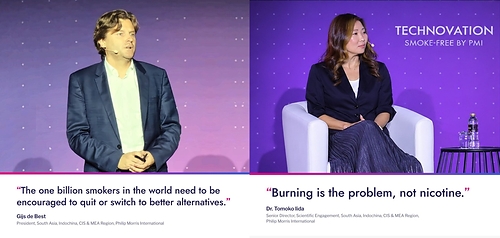
PMI set out this aim in 2016, a decision that meant moving away from its own flagship cigarette business. "We entered a completely new era of innovation and science. But even more so, it was bold because we are cannibalising our own products," said Gijs de Best, President, South Asia, Indochina, CIS & MEA Region, Philip Morris International. "The one billion smokers in the world need to be encouraged to quit or switch to better alternatives."
The company has backed that aim with sustained investment. Since 2008, PMI has invested more than US$16 billion in developing, scientifically assessing and commercialising smoke-free products, including a research centre in Neuchâtel, Switzerland, where more than 1,500 scientists, engineers and medical experts work. In 2025, smoke-free products accounted for 41.5% of PMI's net revenues. They are available in 110 markets, with an estimated 43 million adult users, and the company aims to earn more than two-thirds of its net revenues from them by 2030.
At the heart of this shift is the difference between nicotine and smoke. When tobacco burns, it produces more than 6,000 chemicals, around 100 of which public health authorities have identified as harmful or potentially harmful. It is this burning, not nicotine, that is the primary cause of smoking-related diseases such as cancer, heart disease and lung disease. Nicotine is addictive and not risk-free, but it is not on the International Agency for Research on Cancer's list of carcinogens. "Burning is the problem, not nicotine," said Dr. Tomoko Iida, Senior Director Scientific Engagement, PMI. Yet the misconception runs deep: she noted that more than 80% of physicians in the United States believe nicotine causes cancer.
Smoke-free products, which heat tobacco or deliver nicotine without burning, are designed to remove that combustion. PMI said its science has been reviewed by regulators and public health bodies including the US Food and Drug Administration, Public Health England, Germany's Federal Institute for Risk Assessment (BfR) and the Netherlands' National Institute for Public Health and the Environment (RIVM). Speakers pointed to Japan, where the smoking rate fell from around 20% to around 10% in a decade as adult smokers moved to smoke-free alternatives.
Speakers were equally clear about responsibility. Quitting tobacco and nicotine altogether remains the best choice, and the products are meant only for adults who would otherwise continue to smoke. Dr. Iida said PMI follows a zero-tolerance policy on sales to minors and uses AI-based age estimation at its Tokyo store, flagging anyone who appears under 25. In Japan, she said, heated tobacco use among high-school students has stayed below 0.2% for eight to nine years.
Accurate information is what allows adults to make informed choices. "If you are not smoking, please don't smoke. If you smoke, please look for an alternative," said Dr. Mohammed Eltaweel, Consultant Psychiatrist and Medical Director, Hedoa Psychiatric Hospital, adding that less harmful does not mean harmless. Wassim Kari, Cofounder and CEO of health platform Sohati, said credible information has to be explained in a way people relate to: "Even if science is universal, the understanding is local."
A better product alone does not change a long-held habit, said Fred de Wilde, CEO, PMI International. Adult smokers also need clear information, the chance to try alternatives and support along the way, and products that fit into their daily lives. "Don't fall in love with the solution; fall in love with the real problem and the consumer need," said Christos Kiritsis, Vice President Smoke-Free Products Category, SA, Indochina, CIS & MEA Region, PMI.
For PMI, Fred de Wilde said, the change goes beyond commercial interest. "We had sold cigarettes in a totally legitimate fashion for decades, but having the solution for us was going way beyond the business, and this is why we went all in."
PMI's smoke-free products are not risk-free and contain nicotine, which is addictive. They are intended for adults who would otherwise continue to smoke. Quitting tobacco and nicotine altogether remains the best choice.
About Technovation
Technovation is an international forum, convened by Philip Morris International, that brings together businesses, regulators, civil society, scientists, medical professionals and media to discuss how technology and innovation can contribute to economic and social development. Its latest edition was held at W Dubai – The Palm, United Arab Emirates.
About Philip Morris India Trading Private Limited
Philip Morris India Trading Private Limited (formerly IPM India Wholesale Trading Private Limited) is a joint venture between Philip Morris Brands SARL of Switzerland and two Indian entities, Godfrey Phillips India Limited and K.K. Modi Investment & Financial Services Private Limited.



Share this article