SAN FRANCISCO, Oct. 19, 2026 /PRNewswire/ -- On October 13, 2026, ACROBiosystems hosted ACRO Innovation Day x AI at The Hangar in South San Francisco, California, bringing together biotech founders, industry leaders and scientists to explore how experimental validation can advance AI-driven drug discovery and biologics development. Following opening remarks by Mike Chen, Founder, Chairman and CEO of ACROBiosystems, three presentations from ACROBiosystems and two panel discussions examined how to translate AI-generated designs into experimentally validated candidates. The event connected perspectives across the discovery workflow, highlighting the importance of reliable biological tools and usable experimental evidence in turning advances in AI into better-informed drug development decisions.
Mike Chen, Founder, Chairman and CEO of ACROBiosystems, delivers opening remarks at the ACRO Innovation Day x AI event in South San Francisco on October 13, 2026.
ACROBiosystems speakers present at the ACRO Innovation Day x AI event in South San Francisco on October 13, 2026. Left to right: Ting Wu, Vice President of Business Development; Dr. Yu Sun, Vice President of Product Development; and John Yuan, Vice President of Digital Solution.
Panel 1 of the ACRO Innovation Day x AI event
Panelists discuss AI-driven drug discovery during the second panel session at ACRO Innovation Day x AI in South San Francisco.
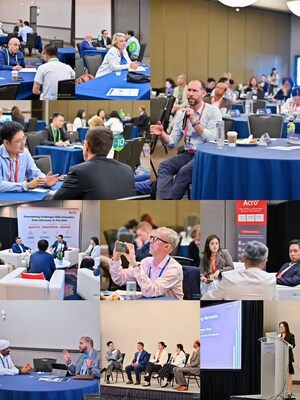
Attendees network and engage in discussions during the ACRO Innovation Day x AI event held at The Hangar in South San Francisco on October 13, 2026.
The event opened with remarks from Mike Chen, Founder, Chairman and CEO of ACROBiosystems, who briefly introduced the company and noted that its customer base has grown to 13,000. Turning to the purpose of the gathering, he emphasized that innovation is crucial to the industry and highlighted the growing momentum behind AI-driven drug discovery, reflected in rising investor interest and broader market recognition. From this spring's Innovation Day held in Zurich, Switzerland, to the ACRO Innovation Forum held in Shanghai in May, and the Fall Innovation Launch Event held in September, ACROBiosystems has remained committed to creating platforms for industry-wide innovation and exchange. This time we brought ACRO Innovation Day × AI to Silicon Valley, especially South San Francisco, where vibrant innovation community provides an ideal setting to discuss these developments. In the future, we will continue to deliver innovative products and solutions and promote innovation discussion and collaboration.
In a joint scientific session, three ACROBiosystems speakers outlined the company's approach to AI-driven discovery through validation services, biological products and structured data delivery.
Ting Wu, Vice President of Business Development at ACROBiosystems, opened the scientific session by outlining the company's role in providing experimental infrastructure for AI-driven discovery. She presented CHO-Direct™, a 4-day rapid sequence-to-affinity screening service utilizing Acro's protein and antibody CHO expression system, along with in-depth developability and characterization that closes the wet lab loop as fast as 7 days. With supernatant screening available in as few as four days, the platform helps researchers evaluate expression and binding early, then advance selected candidates for functional and developability assessment, using the same expression system with more accurate and consistent data delivery. Wu emphasized a modular approach that allows teams to select the validation depth their research requires, supported by traceable data that retain negative findings alongside successful results. This approach is designed to shorten experimental feedback cycles while giving researchers a broader basis for candidate selection.
Dr. Yu Sun, Vice President of Product Development at ACROBiosystems, then introduced the AIDD-Ready product portfolio, showing how the choice of biological materials shapes the value of experimental evidence. Her presentation connected target proteins with screening assays and functional models, including membrane proteins, TR-FRET solutions and cell-based systems. These tools support a progression from confirming molecular binding to evaluating activity in a relevant biological context. By presenting complementary validation formats for the same target, Dr. Sun illustrated how researchers can investigate whether a candidate recognizes the appropriate protein conformation, modulates the intended interaction and produces a functional cellular response, building a more complete picture of its potential.
John Yuan, Vice President of Digital Solution and General Manager at ACROBiosystems, presented ACRO Direct, a platform designed to make experimental data easier for AIDD teams to trust, integrate and reuse. He highlighted four customer benefits: (1) More reliable training data: distinguishing confirmed negatives from untested or unevaluable candidates helps prevent incorrect labeling; (2) Traceable results: linking measurements to supporting curves, records and batch quality information helps researchers verify and interpret findings; (3) Less manual data preparation: structured data and API access support integration with customers' research systems; (4) Better collaboration and faster iteration: shared reports and evidence help experimental and computational teams work from the same results and inform the next design cycle.
Panel 1: Beyond Prediction: Turning AI Designs into Biologics That Work
The first panel, "Beyond Prediction: Turning AI Designs into Biologics That Work," brought together Dr. Puwanat Sangkhapreecha, the founding scientist from Onava, Dauken Seitkali, the Co-Founder & CTO from ARLAN Biotech, Dr. Grace Zhao, the Co-Founder from Triant Biosciences and Dr. Fatih Semerci, the Founding member from DeepAdapt, moderated by Ting Wu, the VP of Business Development from ACROBiosystems. The session examined the gap between AI predictions and candidates suitable for further development.
Panelists highlighted gaps in standardized training data, including scarce antigen–antibody complex structures and discarded negative results. Measuring multiple properties of the same molecule, with repeat testing and calibration across laboratories, can reveal trade-offs among affinity, specificity and developability.
The discussion emphasized combining data-driven design with biological understanding to assess off-target binding, toxicity and developability earlier. Success should extend beyond binding hit rates to more reliable discovery and stronger clinical outcomes.
Key Takeaways:
Retaining negative results and measuring multiple properties of the same molecule can improve the evidence available for model training.
Standardized assays and calibration across laboratories are essential for reproducible, comparable training data.
Combining data with biological mechanisms can guide designs toward functional activity, developability and earlier identification of risk.
Panel 2: From AI Prediction to Experimental Proof: Closing the Loop in Biologic Discovery
The second panel, "From AI Prediction to Experimental Proof: Closing the Loop in Biologic Discovery," explored how experimental feedback can improve subsequent designs. Moderated by Larry Yu, Senior Director of Sales from ACROBiosystems, the session featured Chris Silva, Vice President, Marketing and Product from Carterra, Dr. Hong Tan, Co-Founder & CEO from Gator Bio, David Sheehan, Founder, President & CEO from Nucleus Biologics and Dr. Yu Sun, VP of Product Development from ACROBiosystems.
Dr. Sun emphasized biologically relevant reference proteins and validation beyond binding, noting that unreliable results can misdirect model learning. Silva highlighted multi-parameter measurements and control of assay artifacts. Tan stressed that reliable data must also be organized for model use, with analysis and interpretation remaining potential bottlenecks.
Sheehan highlighted reproducible culture and manufacturing conditions and AI's potential to anticipate production failures. Looking ahead, Tan envisioned autonomous laboratories, while Silva emphasized scientists' roles in hypotheses and interpretation and Sheehan saw automation expanding into manufacturing.
Key Takeaways:
Closing the loop requires reproducible, machine-usable feedback and validation that extends from binding to biological function.
Autonomous laboratories could shorten feedback cycles, with scientists focusing on hypotheses, interpretation and critical decisions.
ACRO Innovation Day x AI reinforced the value of connecting AI developers with the scientists and technology providers who generate the evidence behind discovery. As computational design expands the range of molecules researchers can explore, progress will depend on how effectively the industry validates those possibilities and learns from each experiment. ACROBiosystems will continue to build on its expertise in biological products and experimental validation, advancing structured data delivery and collaboration across the discovery ecosystem. Through these efforts, the company aims to help researchers make more confident development decisions and translate the promise of AI into meaningful progress toward new therapies. Through its Innovation Day series held across different locations, ACROBiosystems brings together diverse perspectives and creates opportunities for dialogue and collaboration, helping new ideas take root and grow.
About ACROBiosystems:
ACROBiosystems Group, founded in 2010 and listed in 2021, is a biotechnology company aimed at being a cornerstone of the global biopharmaceutical and healthcare industries by providing innovative products and business models. The company spans across the globe and maintains offices, R&D centers, and production bases in more than 15 different cities within the United States, Switzerland, the United Kingdom and Germany. ACROBiosystems Group has established numerous long-term and stable partnerships with the world's top pharmaceutical enterprises, including Pfizer, Novartis, and Johnson & Johnson, and numerous well-known academic institutes. The company comprises several subsidiaries such as ACROBiosystems, bioSeedin, Condense Capital, and ACRODiagnostics.
ACROBiosystems' brands include Resilient Supply, CytoPak, SAFENSURE, FLAG, Star Staining, Aneuro, ComboX, GENPower and many others. Its main products and services are recombinant proteins, kits, antibodies, scientific services, and other related products. ACROBiosystems employs a strict quality control system for its products that are used in biopharmaceutical research and development, production, and clinical application. This includes targeted discovery and validation, candidate drug screening/optimization, CMC development and pilot production, preclinical research, clinical trials, commercial production, and clinical application of companion diagnostics.
Through the continuous development of new technologies and products, ACROBiosystems Group creates value for the global pharmaceutical industry and actively empowers our partners. The company is dedicated to accelerating the drug development process, including targeted therapies, immunotherapeutic drugs, and their clinical applications, and contributes to global health.






Share this article