AI Can Help Asset Managers Do More Than Fix Problems Faster
WASHINGTON, Oct. 29, 2026 /PRNewswire/ -- The Investment Company Institute released the following viewpoint:
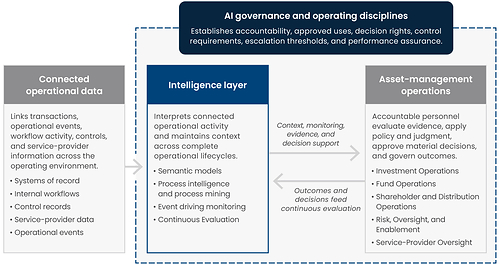
AI is creating new opportunities for asset managers to improve operational efficiency. In a new paper, ICI introduces an Intelligent Operating Model that connects information across systems, identifies emerging risks, and frees experienced professionals to focus on higher-value work requiring human judgment.
SEC Division of Investment Management Director Brian Daly recently challenged investment advisers and fund sponsors to "enthusiastically innovate in a responsible and thoughtful manner" rather than wait for regulators to lead the way.
The industry should take him up on it. Imagine identifying and correcting a settlement problem before sending the trade details out the door or giving fund professionals a clearer picture of emerging risks while there's still time to act. Or flagging a potential valuation issue before a fund begins calculating its daily net asset value.
AI could make that possible, giving experienced professionals more time and better information to tackle complex challenges and exercise the judgment that is essential to serving investors.
From Reacting to Preventing
The need is clear. Asset managers are launching more products and serving investors through increasingly complex networks of systems and service providers. Meanwhile, developments like T+1 settlement, extended trading hours, and growing expectations for near real-time information shorten operating timelines.
Technology has helped firms manage this complexity, but operational departments often must still piece together information from disconnected systems to understand and resolve problems. That approach becomes increasingly difficult to sustain as operations grow more complex.
Consider a large shareholder redemption. The resulting liquidity decisions can depend on information scattered across trading and shareholder-servicing teams. Instead of requiring operational departments to assemble that picture themselves, AI could connect the information as events unfold and provide decisionmakers with the context they need.
A New Way to Operate
A new paper from ICI's Financial Innovation Advisory Committee (FIAC), AI and the Future of Asset Management Operations: Considerations for an Intelligent Operating Model, offers a framework for making that vision a reality. It offers a practical way for firms to manage growing complexity without a corresponding increase in costs and operational effort.
The model is built around three objectives: preventing recurring problems before they occur, maintaining a more complete picture of activity across the business, and identifying potential risks earlier so employees have more time to act. For example, if the same type of error keeps disrupting trades, AI could help identify the causes so employees can address the problem at its source. Or if a security's price looks questionable, AI could gather the relevant information before the fund calculates its daily net asset value, giving specialists more time to assess the issue and make a decision.
With that support, experienced professionals could spend less time reconstructing events and more time exercising judgment on consequential decisions.
Turning Ambition Into Action
The measure of AI's success won't be how many tasks it performs. It will be how many problems firms can prevent by enabling better understanding of and governance over the operating environment.
That vision is ambitious, and putting it into practice can feel daunting. But meaningful change doesn't have to happen all at once. In fact, it often shouldn't. The paper offers a practical starting point: Choose a recurring operational problem and test whether AI can improve on today's results.
Success might mean fewer settlement exceptions or less time spent investigating them. It could also mean supporting growth without a proportional increase in operating costs. Each improvement offers an opportunity to demonstrate results and build confidence. Over time, these incremental advances can lay the groundwork for more sophisticated capabilities, including agentic AI.
Firms can adapt the Intelligent Operating Model to their own operations, building on successful applications as they gain experience. Connected information, clear governance, and human accountability remain essential throughout that process.
Director Daly has challenged the industry to lead. We should answer that challenge with a fundamentally better way to operate.
Contact: [email protected]
SOURCE Investment Company Institute






Share this article