AI data centre investors are carrying the risk of power that arrives years late, IQ-EQ study warns
'Powering intelligence', launched in London on 3 November with the Sustainable Real Estate Forum, sets out a new governance framework for funds investing in AI infrastructure
LONDON, Nov. 4, 2026 /PRNewswire/ -- Investors in AI data centres may be valuing assets as 'power secured' when that can mean anything from a submitted connection request to a live, tested grid connection, according to a new study published by IQ-EQ, the global investor services group, in partnership with the Sustainable Real Estate Forum (SREF). In Europe's main hubs a new data centre can wait seven to ten years for a grid connection (Ember, 2025), while the facility itself can be built in two to three years (IEA, 2025).
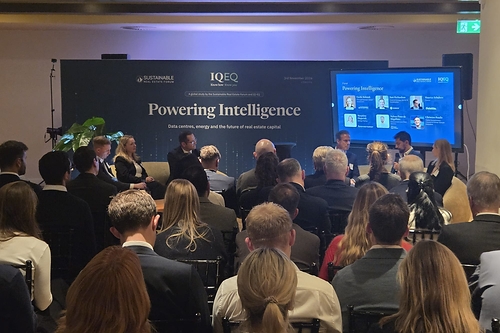
'Powering intelligence: Can data centres and the energy transition coexist?' was launched on 3 November at the SREF x IQ-EQ Powering Intelligence Summit in London, where it was debated before an invitation-only audience of around 150 institutional investors and advisers by a panel including Deloitte, Zurich Resilience Solutions, Start Campus, Norton Rose Fulbright and former Google executive Christian Baudis.
The study warns that each of these stages carries different execution risk, and that investors can end up valuing AI infrastructure on the strength of demand before the power to serve it is secured.
"If power is the constraint, energy geography becomes part of the investment thesis. A site having fibre, land, tax efficiency or customer demand is no longer enough; it must also be confirmed that the site can be powered on the required timetable. Energy due diligence should act as an investment gate."
Tamas Mark, Global Head of Real Assets, IQ-EQ
Grid access is being rationed
Norton Rose Fulbright's chapter highlights that the rules governing grid access are changing quickly, and that capacity, once secured, is no longer guaranteed. In Great Britain, data centres accounted for around 73 GW of contracted demand in the connections queue by mid-2025, and reforms now test project readiness. In the Netherlands, contracted capacity left unused for around two years may be withdrawn. In the EU, the proposed Cloud and AI Development Act aims to triple data-centre capacity within five to seven years and, for the first time, links the designation of acceleration zones to available grid capacity, storage and clean generation, although it does not yet bind grid operators to comparable timelines. For investors, a queue position is increasingly an asset that may need to be actively defended. The chapter also points to a timing gap that no single contract closes: a hyperscale tenant's expected capacity date is fixed in its lease, the date the grid connects the site is not, and whatever falls between the two is ultimately borne by the project.
Zurich Insurance's chapter highlights that the growing scale of projects narrows the margin for error, so a delayed grid connection can affect not only a single building but a wider development programme and the capital structure behind it.
"The average value of data centre projects we insure has risen from $150 million to $3 billion in five years. The earlier risk and resilience insight is applied, the greater its value."
Roger Baumann, COO Global Real Estate and Head Product Development, Zurich Insurance Company Ltd
A governance framework for AI infrastructure funds
The study outlines a five-layer governance framework for AI infrastructure funds, covering capital and ownership, energisation, contractual dependency, resource and resilience performance, and investor transparency. In practice, this means:
- Energy written into fund documents: minimum thresholds for secured grid access and maximum tolerances for energisation delay.
- Investor notification triggers: limited partners informed when energisation timelines exceed agreed thresholds or contracted grid capacity is not secured.
- Valuation that reflects power status: net asset value processes that distinguish energised assets from those awaiting energisation or still in the connection queue.
SREF also outlines a regional delivery statement to sit alongside each asset business plan, so that a project's external dependencies are as visible as its construction programme.
"AI demand is a technology thesis; converting it into durable cash flow is an infrastructure-delivery thesis."
Peter Panayi, Founder and CEO, Sustainable Real Estate Forum
The study includes chapters from SREF, IQ-EQ, Zurich Insurance, Norton Rose Fulbright, and the Royal Institution of Chartered Surveyors (RICS) with Start Campus, and a foreword by Christian Baudis. The RICS and Start Campus chapter includes the example of the SINES Data Campus in Portugal, where the first building, SIN01, continued operating without disruption during the Iberian grid outage of 28 April 2025.
It concludes that coexistence between data centres and the energy transition is possible, but only if it is carefully engineered, financed, governed and delivered.
The full study is available at https://iqeq.com/insights/powering-intelligence-can-data-centres-and-the-energy-transition-coexist/ and https://www.sustainablerealestateforum.com/insights#download-powering-intelligence.
Tamas Mark and Peter Panayi are available for interview.
Images from the summit are available on request.
Notes to editors
About IQ-EQ
IQ-EQ is a global investor services group with deep expertise in private markets. Its more than 6,500 professionals across 25 jurisdictions provide administration, compliance, governance, data and reporting services to investment managers, asset owners and global businesses, with more than $950 billion in assets under administration.
About the Sustainable Real Estate Forum
The Sustainable Real Estate Forum (SREF) is a leading events and thought leadership ecosystem for sustainable real estate investment. It brings together institutional investors and LPs, asset managers and GPs, policymakers and innovators to share intelligence, debate ideas and drive the sector forward through validated case studies, whitepapers, events and global partnerships.
www.sustainablerealestateforum.com
Contributor views are their own and do not necessarily reflect those of IQ-EQ, SREF or other contributors. The study is for general information only and is not investment advice.
SOURCE The Sustainable Real Estate Forum





Share this article