Artist Dustin Newman (Unangax̂) Wins $10,000 Núhi Grant from Walker Youngbird Foundation to Revive Traditional Qayaatx̂ux-Making
With the grant, Newman will recover the nearly lost technique for carving and bending Unangax̂ Chief visors, create visors for cultural leaders, and teach the method to the next generation
NEW YORK, Nov. 19, 2026 /PRNewswire/ -- The Walker Youngbird Foundation today named artist Dustin Newman (Unangax̂/Deg Hit'an Athabascan) as the recipient of its Núhi Grant, which supports Native artists whose work serves and sustains their home communities. With the grant, Newman will work to recover the carving and bending process behind the Qayaatx̂ux, or Chief visors. He will study historic visors, build prototypes, and create a small series of finished visors to be gifted to the region's cultural leaders, then teach the technique to community members.
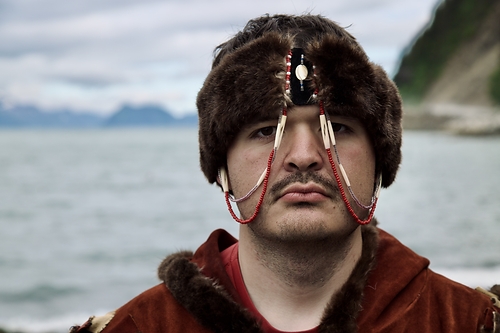
Newman is the second recipient of the Núhi Grant, named after the Hidatsa word núhi, meaning to "uplift." The annual grant provides resources to a Native artist whose project is not only rooted in their culture, but actively serves the communities that shape them, through ceremony, education, documentation, or intergenerational transmission of cultural knowledge. Newman will receive a $10,000 grant to carry out the project.
"I'm incredibly honored to receive the Núhi Grant. This funding allows for artists like myself to explore and expand within our mediums. I'm excited to spend some time creating my people's closed crown visors and exploring bending techniques for the visors themselves. Qaĝaasakung to all those who came before me and to all those who continue to support me," said artist Dustin Newman.
The Qayaatx̂ux is one of the most complex flat art forms of the Unangax̂. Associated with leaders and whaling captains responsible for providing for their communities and defending their ways of life, it's known for intricate ivory carvings and symmetrical painted patterns. Yet, as Newman describes it, the knowledge of how to make them has largely "fallen asleep." By the turn of the 20th century, as Western colonization advanced and the pressure to assimilate grew, the visors came to be seen as impractical and fell out of use, along with much of the region's traditional clothing and transportation.
Newman's project will begin with research. He will collaborate with regional hat-makers who are also trying to recover the technique, meet with staff at the Anchorage Museum to study the historic Qayaatx̂ux, and seek access to additional examples in museum collections and archives. From there, he'll begin a series of prototypes to test his ideas about how the visors were carved and bent into shape. That work will culminate in a small series of finished visors, embellished with ivory and sea lion whiskers.
Newman will also ensure that this knowledge is passed on beyond his own practice. He will document the research, testing, and recovery process through written notes, graphic design, photography, and video, with the materials to be preserved in the Museum of the Aleutians in Unalaska as a lasting community resource. Once he has refined the technique, he'll teach it to community members through the Agdaagux Culture Camp and Camp Qungaayux in Unalaska. The finished visors will be gifted to high-ranking cultural leaders, supporting the reestablishment and recognition of the House leader role. Newman sees this as a starting point to reawaken these carving methods and open the door for other cultural objects to resurface.
"The knowledge Dustin is recovering was never meant to stay behind museum glass," said Reid Walker, founder of the Walker Youngbird Foundation. "Through this project, it will return to the hands of Unangax̂ makers and cultural leaders and pass on to the next generation. That progression from recovery to use to transmission is precisely what the Núhi grant was created to support."
ABOUT DUSTIN NEWMAN
Dustin is an Unangax̂ / Deg Hit'an Athabascan Alaska Native artist whose work is grounded in cultural revitalization, Indigenous continuity, and contemporary Indigenous presence. Raised in King Cove, Alaska, his practice draws from Unangax̂ visual language, traditional motifs, and place-based knowledge, created from locally sourced materials. His work explores what it means to live and create as Unangax̂ today—bridging ancestral knowledge and modern experience while affirming Indigenous identity as active, evolving, and sovereign rather than historical.
PRESS CONTACT
Ali Rigo
[email protected]
SOURCE Walker Youngbird Foundation




Share this article