Beko Puts the Home at the Centre of COP31's Electrification Debate
As electricity demand rises, Beko CEO Can Dinçer makes the case at COP31 for efficient, connected appliances that do more than consume power; they help manage demand.
ANTALYA, Türkiye, Nov. 12, 2026 /PRNewswire/ -- Beko CEO Can Dinçer argued at COP31 that the energy transition has to electrify smarter as well as faster, and that much of that work happens at home. Speaking on the panel, 'From Efficiency to Resilience: The Role of the Home-Appliance Industry in the Energy Transition', at the pavilion of Beko's parent company, Koç Holding, Dinçer set out the role energy-efficient home appliances can play in meeting growing electricity demand while reducing emissions and household energy costs.
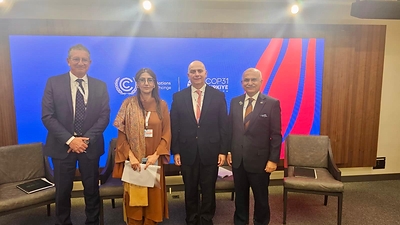
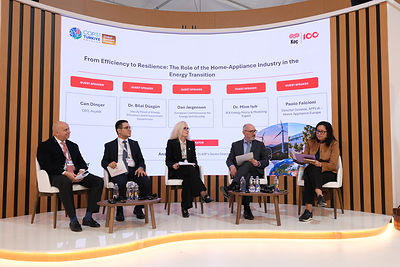
The panel brought together Dr. Bilal Düzgün, Deputy Head of Energy Efficiency and Environment Department at the Turkish Ministry of Energy and Natural Resources; Paolo Falcioni, Director General of APPLiA; Dr. Mine Işık, IEA Energy Policy & Modeling Expert; and Can Dinçer, and was moderated by Ana Maria Carreno, Senior Director of Climate at CLASP.
Global electricity demand grew 3% in 2025 and is forecast to grow 3.6% in 2026, according to the International Energy Agency's Electricity Mid-Year Update. Rising appliance ownership, air conditioning and heat pumps are among the drivers, alongside industrial growth, electric vehicles and data centres. Affordability is under pressure too: the same report finds that average spot wholesale electricity prices in the European Union were more than 30% higher year on year in the second quarter of 2026.
Türkiye's COP31 Presidency has introduced the '35 by 35' Global Electrification Pledge, which aims to raise electricity's share of global final energy consumption from just over 20% to 35% by 2035. It sits alongside the COP28 commitment to double the global average annual rate of energy efficiency improvements by 2030.
Meeting both goals means generating more clean power and using it more efficiently. Buildings are central to that: they account for more than half of global electricity consumption, and electrical appliances represent 45% of the electricity used in them, according to the International Energy Agency. Scope 3 value-chain emissions - the indirect emissions which occur through upstream and downstream operations - account for 99% of Beko's total emissions, and more than 80% of those come from the use of products in people's homes. Making appliances more energy efficient in everyday use is Beko's biggest opportunity to reduce the Scope 3 emissions.
"Every kilowatt-hour saved at home can help reduce pressure on the electricity system and lowers household energy use and costs. That is why efficiency sits at the heart of how we design our products, and why we are glad to bring that experience to COP31 in Türkiye, where Beko was founded. Climate change is a global problem, and the answers will come from sharing what works, so it can be repeated at scale. We are here to be part of that," said Can Dinçer, CEO of Beko.
On the ground at COP31
Earlier in the day, Can Dinçer also spoke on 'Cooling a Warming World: Energy Access and Climate Change in Emerging Markets' at the Türkiye Pavilion in the Blue Zone, alongside Dr Shezra Mansab Ali Khan Kharal, Pakistan's Minister of State for Climate Change and Environmental Coordination, and Umar Ahsan Khan, CEO of Dawlance, with Michel Frédeau, Senior Partner at BCG, moderating. Drawing on Beko's experience with Dawlance in Pakistan and Defy in South Africa, he argued that the markets where cooling demand is growing fastest are often those where efficiency standards are still developing, and that high-efficiency products should reach them before regulation requires it.
Beko is at COP31 alongside Koç Holding, COP31 Global Business Partner, as part of the 'From Commitments to Action' programme at Koç Holding's pavilion in the Green Zone.
ABOUT BEKO
Beko is an international home appliance company with a strong global presence, operating through subsidiaries in more than 55 countries with a workforce of around 45,000 employees and production facilities spanning multiple regions—including Europe, Asia, Africa, and the Middle East. Beko has 22 brands owned or used with a limited license (Arçelik, Beko, Whirlpool*, Grundig, Hotpoint, Arctic, Ariston*, Leisure, Indesit, Blomberg, Defy, Dawlance, Hitachi*, Voltas Beko, Singer*, ElektraBregenz, Flavel, Bauknecht, Privileg, Altus, Ignis, Polar). Beko is the largest white goods company in Europe with its market share (based on volumes) and reached a consolidated turnover of 10.7 billion Euros in 2025. Beko's 28 R&D and Design Centers & Offices across the globe are home to over 2,000 R&D employees and hold more than 4,500 international registered patent applications to date. The company has achieved the highest score in the S&P Global Corporate Sustainability Assessment (CSA) in the DHP Household Durables industry for the seventh consecutive year (based on the results dated 16 October 2025).** The company has been recognized as the 89th most sustainable company on TIME Magazine and Statista's 2026 list of the World's Most Sustainable Companies and has been the sector leader for three consecutive years. Beko's vision is 'Respecting the World, Respected Worldwide.'
*Licensee limited to certain jurisdictions.
**The data presented belongs to Arçelik A.Ş., a parent company of Beko.
SOURCE Beko





Share this article