Beyond the Prescription: New Milken Institute Report Finds Pharmacies Play a Pivotal Role in GLP-1 Patient Success Over Time, Outlines Path to Make That Role Sustainable
Supported by NACDS, the report outlines recommendations for policymakers, payers, prescribers, pharmacies, and patients, and companion research shows GLP-1 users overwhelmingly see pharmacists as a trusted resource
ARLINGTON, Va., Nov. 11, 2026 /PRNewswire/ -- For the millions of Americans turning to GLP-1 medications, filling the prescription is just the first step. Staying on the medication, using it correctly, and turning it into improved health outcomes that last are the real challenge. A new Milken Institute report, released today during the Milken Institute's Future of Health Summit in Washington, D.C., finds that neighborhood pharmacies already perform key elements of that work, from side-effect management to adherence support. The report lays out a roadmap to make that role more consistent and better supported as part of a durable model of care that outlasts any single coverage pathway.
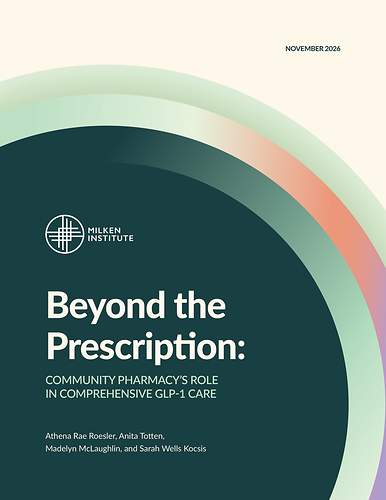
The report, Beyond the Prescription: Community Pharmacy's Role in Comprehensive GLP-1 Care, was supported by the National Association of Chain Drug Stores (NACDS). The report notes that because obesity and related cardiometabolic conditions are chronic, GLP-1 care requires sustained management rather than a single point of intervention, and that neighborhood pharmacies, as the most accessible and frequently visited point of contact in healthcare, are already positioned and trusted to support people throughout the GLP-1 care journey.
The report's roadmap is organized around who is best positioned to act on each recommendation. For policymakers, the report calls for reimbursement pathways for pharmacist wraparound GLP-1 care, including counseling, medication management, and nutrition referral services, noting that pharmacies can already perform much of this work, but are without a mechanism to bill for it. It also asks policymakers to assess federal and state legislation that would expand Medicare and Medicaid coverage of GLP-1s for obesity treatment, with particular attention to the pharmacist's role in healthcare delivery.
For pharmacies, the report proposes a standardized menu of GLP-1 services. Prescribers are encouraged to resolve coverage issues before patients reach the pharmacy counter and to adopt shared protocols and closed-loop communication with pharmacists. Payers are asked to build pharmacy-based wraparound support into coverage expansion, use pharmacy dispensing data to better understand adherence patterns and intervention opportunities, and treat Medicare's temporary GLP-1 Bridge demonstration as an opportunity to build the evidence base for broader coverage. Patients are encouraged to talk with their pharmacists about side effects, lifestyle changes, and supportive care, and to let a local pharmacist know when they obtain GLP-1s through telehealth or online platforms.
"A prescription is a beginning, not a finish line," said NACDS President and CEO Steven C. Anderson, FASAE, CAE, IOM. "From H1N1 to COVID-19, pharmacies have shown that expertise, accessibility, trust, and scale can move the health of a nation. GLP-1 medications are the next frontier, and patients are telling us that more access to their pharmacist means more success with these treatments. A medication becomes a health outcome when a trusted professional is there for the whole journey."
As the report notes, pharmacists see people monthly at refill, while other healthcare professionals typically do not, and the most common reasons people stop taking a GLP-1, difficult side effects and affordability issues, frequently surface at the pharmacy counter. That is also where GLP-1 users are ready to turn for answers. Opinion research NACDS commissioned from Public Opinion Strategies to complement the report, including a national survey of 1,200 adults, found that confidence in pharmacists as a resource for GLP-1 questions runs high: 83 percent among adults nationally and 93 percent among GLP-1 users (current, former, and likely users). That confidence among GLP-1 users is on par with their confidence in physicians (97 percent) and well above their confidence in telehealth (70 percent). Nearly three in four GLP-1 users (74 percent) said that more opportunities to work with a pharmacist would improve their experience and success with the medication.
The services GLP-1 users ranked as most valuable are the practical ones: navigating coverage and out-of-pocket costs, managing side effects, and explaining how to use and store the medication. Majorities of users also said they would find valuable or somewhat valuable pharmacists' efforts to connect them with, or direct them to, resources and information related to lifestyle services. Such services include resources on physical activity (91 percent), starter kits with helpful products and educational materials (89 percent), and connections to dietitians or other qualified nutrition professionals (85 percent).
"Pharmacies can play a pivotal role in helping consumers use GLP-1 treatments safely and successfully over time," said Athena Rae Roesler, director at the Milken Institute, where she leads the Public Health Chronic Disease Prevention portfolio. "These are accessible, trusted touchpoints already woven into people's lives. The opportunity now is to make that role more consistent — through consumer awareness, sustainable reimbursement, stronger infrastructure, and coordinated action across pharmacies, payers, prescribers, and policymakers."
This report marks the third formal collaboration between the Milken Institute and NACDS, following earlier work on Food Is Medicine and on chronic disease and broader health challenges.
Beyond the Prescription: Community Pharmacy's Role in Comprehensive GLP-1 Care is available to download from the Milken Institute here.
NACDS represents stand-alone drug stores, supermarkets and mass merchants with pharmacies. Chains operate approximately 32,000 pharmacies, and NACDS' member companies include regional chains, with a minimum of four stores, and national companies. As the most accessible healthcare destinations, and among the most trusted, pharmacies help patients use medicines correctly and safely, while offering innovative services that improve patient health and healthcare affordability. NACDS members also include supplier partners that help to meet Americans' expectations by leveraging the total store for the total person. Please visit NACDS.org.
SOURCE National Association of Chain Drug Stores





Share this article