


Blood Cancer Survival Has Improved Substantially, but Outcomes Vary Widely by Disease; Males Account for Nearly 56% of Diagnoses
News provided by
Blood Cancer United® formerly The Leukemia & Lymphoma SocietyOct 06, 2026, 09:03 ET
New data provide the latest national and state-level statistics on blood cancer incidence, prevalence, survival and mortality
WASHINGTON, Oct. 6, 2026 /PRNewswire/ -- Blood Cancer United released Facts 2025-2026: Updated Data on Blood Cancers, a comprehensive look at who is affected by blood cancer and how incidence and outcomes vary across diseases and populations. From 2018 to 2022, 55.8% of blood cancer diagnoses were in males, compared with 44.2% among females.
The new data also estimate that 1.8 million people in the United States are living with or in remission from leukemia, lymphoma, myeloma, myelodysplastic syndromes (MDS) or myeloproliferative neoplasms (MPN). In 2026, an estimated 192,030 people will be diagnosed with leukemia, lymphoma, or myeloma, equivalent to one person approximately every three minutes.
Five-year relative survival has improved substantially for several major blood cancers, although outcomes vary by disease and subtype. From 1975-1977 to 2015-2021, five-year relative survival increased:
- From 34% to 71% for leukemia
- From 46% to 77% for non-Hodgkin lymphoma
- From 72% to 92% for Hodgkin lymphoma
- From 24% to 64% for myeloma
Despite these gains, survival remains uneven across disease types. For people diagnosed from 2015 to 2021, five-year relative survival ranged from 32.9% for acute myeloid leukemia to 90.4% for myeloproliferative neoplasms.
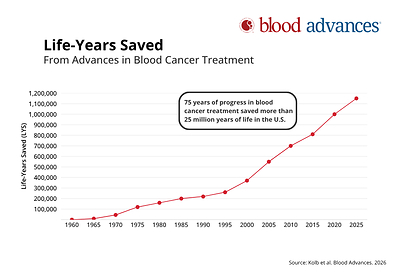
These data are consistent with a recent Blood Cancer United-led analysis published in Blood Advances, which estimated that advances in blood cancer treatment saved 25.8 million years of life in the U.S. from 1949 through 2024. Together, the findings demonstrate the impact of therapeutic innovation while identifying where progress is still urgently needed.
"We have made extraordinary progress against blood cancer, but a breakthrough only matters if it reaches the people who need it," said Gwen Nichols, M.D., chief medical officer of Blood Cancer United. "Research is critical, but our work doesn't stop there. We connect scientific discovery with education and support, access to care, and policy and advocacy, so patients and families have what they need at every step. These data show how far we have come and where we must work with greater urgency so every person affected by blood cancer can benefit from progress."
Males account for a greater share of blood cancer diagnoses
From 2018 to 2022, males represented 55.8% of blood cancer diagnoses in the U.S., compared with 44.2% among females. Males accounted for a larger share of diagnoses across each major blood cancer category except myeloproliferative neoplasms, for which females represented 54.2% of diagnoses and males represented 45.8%.
"Males are diagnosed with blood cancers more often than females, but we do not yet fully understand why," said Nichols. "The answer is likely to involve a complex mix of genetic, hormonal, immune and environmental factors that differ by disease. Closing that knowledge gap could deepen our understanding of blood cancer biology and help identify new approaches to diagnosis and treatment."
Other highlights from the new data include:
- Nearly 1 in 10 new cancer diagnoses in the U.S. will be a blood cancer in 2026. Leukemia, lymphoma and myeloma are projected to account for 192,030 cases, or 9.1% of the estimated 2,114,850 new cancer diagnoses nationwide.
- Approximately every nine minutes, someone in the U.S. dies from blood cancer. Leukemia, lymphoma and myeloma are projected to cause 55,830 deaths in 2026.
- Blood cancer death rates have declined substantially. From 2000 to 2023, mortality rates fell 42.7% for lymphoma, 30.3% for myeloma and 26.9% for leukemia.
- Blood cancer disproportionately affects older adults. The median age at diagnosis is 68, and more than 567,000 people 75 and older are living with or in remission from blood cancer. Hodgkin lymphoma is a notable exception, with a median age at diagnosis of 39.
- Leukemia is the most common cancer diagnosed among children and adolescents. It accounts for 25.6% of all new cancer cases among people younger than 20.
- Black people are diagnosed with myeloma at more than twice the rate of White people. From 2018 to 2022, the age-adjusted incidence rate was 14.8 per 100,000 among non-Hispanic Black people, compared with 6.5 per 100,000 among non-Hispanic White people.
About Facts 2025-2026
Facts 2025-2026: Updated Data on Blood Cancers brings together the latest available national and state-level statistics on leukemia, lymphoma, myeloma, myelodysplastic syndromes and myeloproliferative neoplasms. The publication includes incidence, prevalence, survival and mortality data by disease, age, sex, race and ethnicity. It also provides projected 2026 diagnoses and deaths for all 50 states and the District of Columbia. The publication draws from the National Cancer Institute's Surveillance, Epidemiology, and End Results Program, the Centers for Disease Control and Prevention's U.S. Cancer Statistics Public Use Databases and the American Cancer Society's Cancer Facts & Figures 2026.
Blood cancer mortality and projected blood cancer death data in this release include leukemia, lymphoma and myeloma. They do not include myelodysplastic syndromes or myeloproliferative neoplasms because those mortality data were not available at the time of publication
About Blood Cancer United®
Blood Cancer United® (formerly The Leukemia & Lymphoma Society) is the largest global nonprofit focused on blood cancer patient support, research, and advocacy. Since its founding in 1949, the organization has consistently evolved to better serve people affected by all 100-plus types of blood cancer. Blood Cancer United funds innovative research, offers free resources and personalized support, and advocates at state and national levels for more accessible and affordable healthcare for all patients. To learn more, visit www.BloodCancerUnited.org.
Media contact
Sandra Salviejo
Senior Director, Communications
Blood Cancer United
[email protected]
SOURCE Blood Cancer United® formerly The Leukemia & Lymphoma Society






Share this article