Disrupting Intellectual Property: Mary Guzman Insures the "How" Behind Innovation
On Disruption Interruption, Mary Guzman, Founder and CEO of Crown Jewel Insurance, explains why companies may be overlooking valuable trade secrets and how assigning a defensible value to proprietary know-how could affect asset protection, financing, and enterprise value.
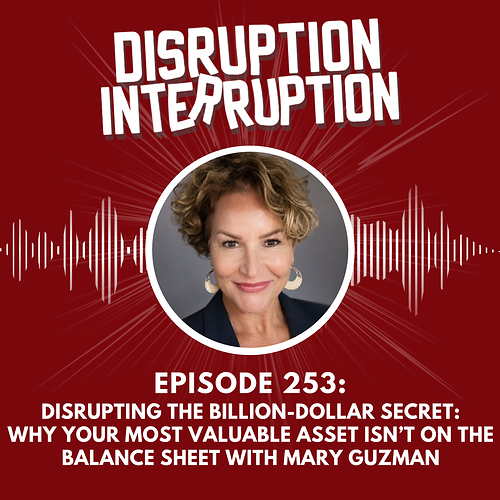
TAMPA BAY, Fla., Oct. 29, 2026 /PRNewswire/ -- Corporate intangible assets topped $97 trillion globally in 2025, growing 23% from the previous year, according to the World Intellectual Property Organization (WIPO). The same analysis notes that accounting standards keep an estimated 79% to 83% of intangible asset value from appearing on corporate balance sheets. Mary Guzman, Founder and CEO of Crown Jewel Insurance, joins host Karla Jo Helms (KJ) on the Disruption Interruption Podcast to explain where some of that unrecognized value may be hiding. Trade secrets can include the confidential processes, data, strategies, and internal know-how that give a company an advantage without being publicly disclosed. "It's the process and the how those things work that is the trade secret part," Guzman says.
Hidden Business Value Can Be Hard to Protect
Guzman says decades of emphasis on patents have left many businesses less prepared to identify proprietary knowledge that never becomes a registered form of intellectual property. Trade secrets can begin inside research and development (R&D), but they can also emerge from logistics and supply-chain processes, pricing models, product strategies, consumer data, software workflows, and knowledge accumulated through trial and error.
The problem becomes more visible when employees leave, other insiders take proprietary information with them, or share it without authorization. Guzman says cyber insurance has expanded to address risks including ransomware, privacy claims, and business interruption, while the financial value of intellectual property has generally remained outside that coverage. Insurers have also faced the problem of identifying and valuing the asset before a court has determined if it meets the legal standard for protection. "The cyber market basically has said, 'We're not going to cover the value of all of that R&D or the value of intellectual property assets, period,'" Guzman says.
That uncertainty becomes critical when an employee leaves with proprietary information. A company seeking an injunction may need to quickly demonstrate what the trade secret is, that it has taken reasonable measures to protect it, and that the people involved understood the information was confidential. Guzman says many companies discover only after suspected theft that they do not have that evidence readily available. "Most companies cannot do that easily, so they spend way too much time and, frankly, a lot of money on backwards discovery, trying to put the toothpaste back into the tube," she says.
Putting a Value on the Asset Before a Loss
Through Crown Jewel Insurance, Guzman works to identify and value proprietary information that may qualify for trade secret protection before a dispute occurs. She says that calculation can include what a company spent developing the asset, including unsuccessful iterations and "negative know-how" that could save a competitor from repeating the same mistakes.
The review also documents how the information is protected. If misappropriation is later suspected, Guzman says that evidence can support attorneys seeking an injunction, while insurance can cover legal and forensic costs. "With the push of a button, basically, we can show that they had trade secrets and we used reasonable measures," she says.
Guzman sees a broader implication for founders, Chief Financial Officers, lenders, and investors. In one hypothetical example, she describes technology with future contracts attached to it becoming a $60 million off-balance-sheet asset once the underlying trade secrets are valued. She argues that residual value could become relevant in financing, investment, and exit discussions. "If the company just fails and doesn't pay their loan back, you still have an asset that you can sell or license," Guzman says.
Links
Disrupting the Billion-Dollar Secret: Why Your Most Valuable Asset Isn't on the Balance Sheet with Mary Guzman
Disruption Interruption is the podcast where you will hear from today's biggest Industry Disruptors. Learn what motivated them to bring about innovation and how they overcame opposition to adoption.
LinkedIn: https://www.linkedin.com/in/mary-guzman-49183b29
Company Website: https://crownjewelinsurance.com
About Disruption InterruptionTM
Disruption is happening on an unprecedented scale, impacting all manner of industries — MedTech, Finance, IT, eCommerce, shipping, logistics, and more — and COVID has moved their timelines up a full decade or more. But WHO are these disruptors and when did they say, "THAT'S IT! I'VE HAD IT!"? Time to Disrupt and Interrupt with host Karla Jo "KJ" Helms, veteran communications disruptor. KJ interviews bad asses who are disrupting their industries and altering economic networks that have become antiquated with an establishment resistant to progress. She delves into uncovering secrets from industry rebels and quiet revolutionaries that uncover common traits — and not-so-common — that are changing our economic markets… and lives. Visit the world's key pioneers that persist to success, despite arrows in their backs at www.disruption-interruption.com.
About Mary Guzman
Mary Guzman is Founder and CEO of Crown Jewel Insurance and an insurance industry veteran with three decades of experience across brokerage and underwriting. Her work has included technology, media, cyber and intellectual property risk, with previous roles at organizations including Marsh, WTW, and McGriff. Guzman now focuses on trade-secret risk management, valuation, and insurance.
About Karla Jo Helms
Karla Jo Helms is the Chief Evangelist and Anti-PR® Strategist for JOTO PR Disruptors™. Karla Jo learned firsthand how unforgiving business can be when millions of dollars are on the line — and how the control of public opinion often determines whether one company is happily chosen, or another is brutally rejected. Being an alumnus of crisis management, Karla Jo has worked with litigation attorneys, private investigators, and the media to help restore companies of goodwill into the good graces of public opinion — Karla Jo operates on the ethic of getting it right the first time, not relying on second chances and doing what it takes to excel. Helms speaks globally on public relations, how the PR industry itself has lost its way, and how, in the right hands, corporations can harness the power of Anti-PR to drive markets and impact market perception.
References
- Brown, A., Garnham, A., Grewal, A. K., Bonaglia, D., Rivera Leon, L., & Wunsch-Vincent, S. (2026, March 31). The value of corporate intangible assets worldwide approaches USD 100 trillion in 2025; the US leads high-income economies; Morocco, China, and India top middle-income economies. World Intellectual Property Organization. wipo.int/en/web/global-innovation-index/w/blogs/2026/the-value-of-corporate-intangible-assets-worldwide
Media Inquiries:
Karla Jo Helms
JOTO PR™
727-777-4629
SOURCE Disruption Interruption







Share this article