EC-Council launches industry's first hands-on AI audit certification as White House Accord backs independent AI audits
The Certified AI Governance Auditor (CAIGA), the industry's first hands-on AI governance audit certification, arrives as the White House Accord puts independent assurance at the center of frontier AI oversight.
TAMPA, Fla., Nov. 19, 2026 /PRNewswire/ -- EC-Council, a global leader in cybersecurity, AI governance, and responsible AI, today announced the launch of the Certified AI Governance Auditor (CAIGA), the industry's first hands-on AI governance audit certification designed to build audit capability by teaching professionals how to test controls, examine evidence, assess outcomes, and document findings across increasingly autonomous AI systems.
CAIGA is built specifically to help auditors verify whether an organization is doing what it claims to do, and whether controls are implemented as required by a given framework, regulation, or standard.
It is a 'how-to audit' program and certification. Candidates conduct an audit of a case enterprise, control by control. Each candidate receives an educational license to ComplyX, EC-Council's platform for managing compliance requirements, assessing risks, evaluating controls, and organizing audit evidence. ComplyX maps to more than 90 regulations, frameworks, and standards.
The examination is proctored and open book. Candidates must be 18+ and qualify through official training with two years of relevant experience, or through an active recognized credential or equivalent experience in audit, GRC, risk, compliance, privacy, or information security.
"Understanding AI governance frameworks such as ISO/IEC 42001, the NIST AI RMF, and laws such as the EU AI Act is one thing; knowing how to independently audit against them is another. CAIGA builds that audit capability control by control, teaching professionals what to test, what evidence to examine, how to assess whether the evidence supports the control, and how to document defensible findings and recommendations," said Jay Bavisi, Founder & Group CEO, EC-Council.
Why CAIGA matters now
ISO/IEC 42001 requires organizations to conduct internal audits of their AI management systems at planned intervals. CAIGA is designed for internal audit teams assessing AI systems and external auditors evaluating clients, suppliers, and third parties.
On September 29, the White House Accord on Super Intelligence, a voluntary commitment signed by leaders from Google, Anthropic, Meta, OpenAI, xAI, and Nvidia, outlined four layers of controls and audits for frontier AI, including independent external assessment of whether controls, monitoring, and detection operate as intended. The Accord also calls for an independent committee of an organization's board of directors to oversee internal and external assurance and remediation.
That shift toward independent external assurance raises the bar for AI auditors, who must move beyond confirming that policies and controls exist and determine whether they work as AI systems become more autonomous.
Meanwhile, the states are setting AI-specific requirements. The Texas Responsible Artificial Intelligence Governance Act and California's Transparency in Frontier Artificial Intelligence Act took effect on January 1, 2026. Colorado's revised automated decision-making requirements and New York's RAISE Act are set to take effect from January 1, 2027.
Evidence that such verification is difficult to do well predates the Accord. In December 2025, the New York State Comptroller audited New York City's enforcement of Local Law 144, which requires annual independent bias audits of automated hiring tools. The city's enforcement agency had reviewed the published bias audits of 32 companies and identified one instance of noncompliance. The Comptroller's auditors reviewed the same companies and identified at least 17 instances of potential noncompliance.
"Agents can crawl across enterprise systems, invoke APIs, access data, use unapproved tools, and create shadow AI outside formal governance. An auditor has to know where that activity started, what permissions the system had, what it touched, whether it crossed a boundary, and whether a human could stop it. That requires evidence from the system itself, not just a policy or checklist," said Bavisi.
McKinsey's 2026 AI Trust Maturity Survey found that only about 30% of organizations reach maturity level three or higher in strategy, governance, and agentic AI governance and controls, while nearly 60% cite knowledge and training gaps as the leading barrier to responsible AI. CAIGA places strong emphasis on testing human oversight, autonomy limits, and intervention mechanisms against technical evidence.
"AI will transform audits from periodic reviews to continuous assurance," Bavisi added. "As agents take on more decisions and actions across enterprise environments, organizations will need auditors who can trace that activity, test the controls around it, and verify governance as it operates."
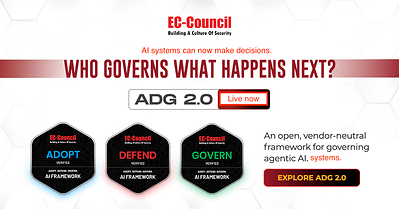
The launch follows EC-Council's October 1 release of ADG 2.0 which expanded its AI governance architecture with more than 180 controls, runtime governance, and defined evidence requirements. ADG establishes what organizations should govern, and the evidence those controls should generate.
CAIGA builds the professional capability required to independently test whether those controls operate as intended. CAIGA joins CAIPM (AI adoption), COASP (AI security), and CRAGE (AI governance) in EC-Council's AI certification portfolio.
CRAGE addresses how governance is established, while CAIGA addresses how it is independently tested.
Inside CAIGA
- Format: Hands-on audit of a case enterprise, with candidates examining evidence, testing controls, scoring results, identifying gaps, and documenting findings.
- Methodology: A single control-based audit method covering more than 180 controls across 12 control families, checkable audit requirements, mapped to over 90 regulations, frameworks, and standards, including ISO/IEC 42001, the NIST AI Risk Management Framework, and the EU AI Act.
- Duration: 40 hours across 20 modules and 125 topics.
- Examination: Exam code 612-40. Four hours, 120 scenario-based questions, proctored and open book.
- Tools: An educational license to ComplyX for up to one year along with a preloaded case enterprise, AI assistant, guided labs, sample evidence, and mappings across more than 90 regulations, frameworks, and standards.
- Courseware: Designed for continued use as a field reference after certification, covering evidence requirements, testing approaches, and interview questions.
CAIGA is designed to build capability across roles including AI Governance Auditor, AI Risk & Controls Specialist, Internal AI Audit Manager, Third-Party AI Risk Assessor, AI Assurance Consultant, and Head of AI Assurance.
As independent AI auditing moves into the frontier AI control model, the differentiator will no longer be whether an auditor understands governance. It will be whether that auditor can test the control, verify the evidence, and produce a defensible finding. CAIGA is built to develop that capability.
"The Accord identifies who should review frontier AI controls. It does not address whether enough people are trained to carry out those reviews," Bavisi said. "The New York audit shows that two reviews of the same material can reach very different conclusions. The difference is method and training."
To learn more about CAIGA, visit: https://www.eccouncil.org/ai-courses/certified-ai-governance-auditor-caiga/
About EC-Council
EC-Council is a global leader in cybersecurity and responsible AI, delivering integrated capabilities across people, services, and technology since 2001.
Creator of the Certified Ethical Hacker (CEH) program, EC-Council has certified over 400,000 professionals across 174 countries. Its portfolio includes 11 credentials accredited by ANAB under ISO/IEC 17024, with certifications recognized under U.S. Department of Defense DoD 8140 requirements.
EC-Council's Adopt. Defend. Govern. (ADG) AI Governance Framework maps 180+ controls to 90+ standards and regulations, including the EU AI Act, ISO/IEC 42001, and NIST AI RMF. It is available for free on EC-Council's website.
The EC-Council group portfolio spans EC-Council University, CodeRed, Academia, Cyber Insurance Academy, and CREST-accredited EC-Council Global Services. Its technology portfolio includes Aware for phishing defense, AI governance, and shadow AI detection, and FireCompass for agentic automated penetration testing and red teaming, and recognized by Gartner, Forrester, IDC, and GigaOm.
For more information, visit www.eccouncil.org.
Media Contact: [email protected]
SOURCE EC-Council





Share this article