


FDA Sets Peptide Impurity Thresholds as Low as 0.10%, Oath Research Analysis Finds
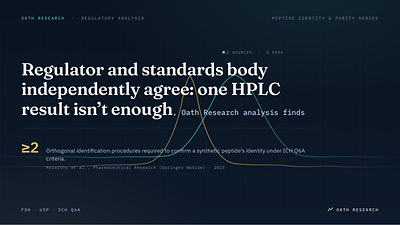
FDA guidance for synthetic peptide drugs requires identification of impurities above 0.10% and caps new impurities at 0.5% — U.S. FDA, 2021
GILBERT, Ariz., June 30, 2026 /PRNewswire/ -- Oath Research, a Gilbert, Arizona–based research peptide supplier, today released an analysis of the regulatory and analytical standards governing peptide purity verification — and what those standards mean for researchers evaluating supplier documentation.
Drawing on U.S. FDA guidance documents, the Federal Register, U.S. Pharmacopeia peptide monographs, and peer-reviewed research, the analysis finds that FDA guidance for synthetic peptide drug applications (2021) requires identification of all impurities present above 0.10% of the active pharmaceutical ingredient, and blocks regulatory approval entirely for any new impurity exceeding 0.5%.
For research peptides used in receptor-binding and quantitative biological studies, published literature (2020) sets the accepted purity threshold at greater than 95%, a bar the regulatory framework makes explicit through validated analytical methods.
How the FDA Defines and Regulates Peptides
Before purity standards apply, a compound has to be classified. The FDA's definitional boundary for peptides, established in a Final Rule published in the Federal Register in March 2020, places the upper size limit at 40 amino acids. Any alpha-amino acid polymer at or below that threshold is regulated as a drug, not a biologic. Above it, different regulatory pathways and analytical frameworks apply.
That classification decision has direct analytical consequences. Compounds regulated as drugs under the Federal Food, Drug, and Cosmetic Act are subject to drug-specific purity and impurity frameworks, including the guidance documents the FDA has issued for synthetic peptide drug applications. The 40 amino acid boundary, which the FDA determined after reviewing the pertinent scientific literature, is the threshold that determines which purity standards a synthetic peptide must meet, and therefore which analytical methods a supplier's Certificate of Analysis should reflect.
The practical relevance for researchers is that most commonly studied peptides, including growth hormone secretagogues, GLP-1 analogs, and repair peptides, fall within the 40 amino acid classification. That means the FDA's drug-framework impurity standards, detailed in the sections below, are the applicable reference point for evaluating purity documentation on those compounds.
The FDA's Impurity Identification Threshold: 0.10%
The FDA's 2021 guidance document on abbreviated new drug applications for highly purified synthetic peptide drug products sets the impurity identification threshold at 0.10% of the active pharmaceutical ingredient. Under that guidance, all peptide-related impurities present at more than 0.10% must be individually identified and described in the application. The threshold is not a purity floor; it is the level above which each impurity requires its own characterization.
The analytical implication of a 0.10% identification threshold is that it requires high-resolution purity testing. Standard HPLC (high-performance liquid chromatography) can detect and quantify impurities at that level, and the FDA's guidance explicitly references HPLC as the validated method for synthetic peptide purity analysis. A supplier's Certificate of Analysis that reports a single purity percentage without identifying individual impurities above 0.10% does not meet the documentation standard the FDA applies to synthetic peptide drug applications.
For researchers, the 0.10% threshold provides a reference point for evaluating how granular a COA needs to be. A document that reports 98% purity as a single figure leaves 2% of the compound's composition uncharacterized. Depending on what those impurities are, truncated sequences, oxidation products, or residual reagents, they may or may not affect experimental outcomes. The FDA's standard exists precisely because the identity of an impurity matters, not just its aggregate proportion.
The Hard Cap: No New Impurity Above 0.5%
The same 2021 FDA guidance establishes a categorical upper limit for new peptide-related impurities in generic synthetic peptide drug applications: 0.5% of the drug substance. Above that level, the ANDA pathway is blocked. Below it, the applicant must characterize each new impurity and justify why its presence would not be expected to affect the safety or effectiveness of the proposed generic peptide.
The 0.5% cap applies specifically to impurities not present in the reference listed drug, which the FDA terms "new" impurities. The distinction matters because it reflects the regulatory logic: a known impurity with an established safety profile is treated differently from an uncharacterized compound appearing in a new formulation. For researchers sourcing peptides, this framework suggests that the relevant question about an impurity is not only how much is present, but whether it has been identified and characterized.
Mass spectrometry is the analytical method typically used to confirm impurity identity at these concentration levels. HPLC establishes the quantity; mass spectrometry establishes what the compound actually is. A COA that documents both methods, HPLC for purity percentage and mass spectrometry for identity confirmation, is providing the two data layers the FDA's framework treats as necessary for adequate characterization.
The FDA has established specific impurity thresholds governing synthetic peptide drug applications that carry significant regulatory consequences when exceeded. Where an impurity exceeds 0.10% of the active pharmaceutical ingredient, each such impurity must be individually identified and characterized; failure to do so renders the Abbreviated New Drug Application incomplete. More critically, the presence of new impurities exceeding 0.5% of the drug substance effectively blocks the ANDA pathway entirely, as the application cannot proceed until the impurity is resolved (U.S. FDA, 2021). These requirements are outlined in the FDA's 2021 guidance on ANDAs for Certain Highly Purified Synthetic Peptide Drug Products That Reference Listed Drugs of Recombinant DNA Origin, published by the U.S. Department of Health and Human Services.
USP Monographs: Published Purity Standards for Therapeutic Peptides
The U.S. Pharmacopeia maintains official monographs for multiple therapeutic peptides, each specifying validated HPLC purity methods, reference standards, and acceptance criteria. Monographs covering compounds including Bivalirudin, Calcitonin Salmon, and Semaglutide became official as of December 1, 2023, giving researchers a published benchmark for what validated purity documentation looks like for specific peptide classes.
USP monographs function as documentary standards; they define the quality attributes of identity, purity, safety, and potency that regulatory authorities enforce. For a researcher evaluating a peptide supplier, a USP monograph for a given compound provides the reference framework against which a supplier's analytical methods can be compared. If a COA uses the same validated HPLC method specified in the relevant USP monograph and reports results against the same acceptance criteria, that alignment is documentable.
The practical value of USP standards for research procurement is that they are publicly accessible and compound-specific. A researcher sourcing a peptide for which a USP monograph exists can verify whether a supplier's testing methodology matches the published standard — rather than relying solely on the supplier's representation of what the test measures.
The >95% Purity Threshold for Research Applications
Regulatory frameworks address synthetic peptide drugs. For research peptides, compounds used in laboratory settings for receptor-binding assays, quantitative biological studies, and related applications, the relevant standard comes from the scientific literature rather than the FDA's drug approval pathway.
A 2020 peer-reviewed review published in Comprehensive Reviews in Food Science and Food Safety (PMC) finds that research and therapeutic peptides intended for receptor-binding or quantitative biological studies generally require greater than 95% purity to avoid distorted experimental outcomes.
The basis for that threshold is functional: impurities in a research peptide sample are not inert. Truncated sequences, oxidation products, and related compounds can bind to the same receptors as the target peptide, generate competing signals, or alter the quantitative relationship between peptide concentration and biological response. At purity levels below 95%, those effects become difficult to control for.
The 95% threshold represents the point below which experimental reliability becomes a documented concern, not a theoretical one. For researchers designing studies where peptide concentration is a controlled variable, a supplier's documented purity level and the analytical method used to establish it are material inputs to experimental design, not a procurement footnote.
Purity standards for peptides vary across regulatory frameworks and intended applications, though all rely on validated analytical methods to ensure compound integrity. Under the FDA's framework for synthetic peptide drugs submitted via the ANDA pathway, impurities exceeding 0.10% of the active pharmaceutical ingredient must be individually identified, with new impurities capped at 0.5%, as verified through HPLC for purity assessment and mass spectrometry for identity confirmation (U.S. FDA, 2021). The United States Pharmacopeia applies compound-specific acceptance criteria through its therapeutic peptide monographs, with purity assessed via validated HPLC methods tailored to each monograph (U.S. Pharmacopeia, 2023). In the research context, particularly for receptor-binding and quantitative studies, the literature consistently requires a minimum purity threshold of 95% to prevent distorted experimental outcomes, with HPLC serving as the standard industry method for verification (PMC / Comprehensive Reviews in Food Science and Food Safety, 2020).
What Independent Verification Looks Like in Practice
The analytical standards described above, FDA impurity thresholds, USP monograph methods, HPLC and mass spectrometry testing, converge on a common documentation requirement: a Certificate of Analysis that specifies the analytical method used, the impurities detected and their concentrations, the identity confirmation method, and the lot or batch to which the results apply. A COA that omits any of those elements cannot be independently verified against the published standards.
Batch-level specificity is the most frequently absent element in supplier documentation. A COA that reflects testing conducted on a representative sample of a product line, rather than on the specific lot a researcher is purchasing, does not establish the purity of the compound in that researcher's hands. The FDA's impurity framework (2021) applies at the batch level for a reason: manufacturing variability means that aggregate or representative testing can mask lot-to-lot differences in impurity profiles.
Independent laboratory verification, testing conducted by a laboratory with no commercial relationship to the supplier, addresses the conflict-of-interest question that in-house testing cannot. HPLC conducted by the supplier establishes what the supplier found. HPLC conducted by an independent, USA-based laboratory establishes what an arm's-length analysis found. For researchers who need to document their sourcing decisions in institutional procurement records, IRB submissions, or published methods sections, the independence of the testing laboratory is a material distinction.
Methodology
Oath Research synthesized findings from U.S. FDA guidance documents, the Federal Register, U.S. Pharmacopeia peptide standards, and peer-reviewed research published in the comprehensive Reviews in Food Science and Food Safety. Primary sources include the FDA Final Rule on the definition of a biological product (Federal Register, 85 FR 10057, March 2020), FDA guidance on ANDAs for highly purified synthetic peptide drug products (2021), U.S. Pharmacopeia peptide monographs and standards (effective December 2023), and a peer-reviewed review on peptide purity requirements indexed on PubMed/PMC (2020). No proprietary research was conducted. All figures are drawn from named third-party sources and reflect information available as of June 2026.
Frequently Asked Questions
What does "peptide purity" actually mean?
Peptide purity refers to the proportion of a sample that consists of the intended target compound, expressed as a percentage. A purity figure of 99% means that 99% of the sample, by weight or area, depending on the analytical method, is the specified peptide; the remaining 1% consists of impurities, which may include truncated sequences from incomplete synthesis, oxidation products, residual reagents, or other related compounds.
The FDA's 2021 guidance for synthetic peptide drug applications treats any individual impurity present above 0.10% of the active pharmaceutical ingredient as requiring separate identification, a standard that makes clear the purity percentage alone is not sufficient documentation; the identity of what comprises the remaining fraction matters as well.
What purity level is generally considered acceptable for research peptides?
Peptides intended for receptor-binding assays and quantitative biological studies generally require greater than 95% purity to avoid distorted experimental outcomes, according to a 2020 peer-reviewed review published in Comprehensive Reviews in Food Science and Food Safety (PMC). Below that threshold, impurities, including truncated sequences and oxidation products, can interact with the same biological targets as the peptide under study, introducing variables that affect the reliability of quantitative results.
For reference, FDA guidance for synthetic peptide drug applications sets impurity identification requirements that begin at 0.10%, a standard considerably stricter than the >95% research threshold, reflecting the higher stakes of pharmaceutical application.
How can I verify a peptide's purity independently?
Independent purity verification requires a Certificate of Analysis that identifies the specific batch tested, the analytical method used (typically HPLC for purity percentage), the identity confirmation method (typically mass spectrometry), and the laboratory that conducted the testing. A COA from an independent, third-party laboratory, one with no commercial relationship to the supplier, is distinguishable from in-house testing because it removes the supplier's conflict of interest from the result.
Batch-level specificity matters: a COA reflecting testing on a representative product-line sample does not establish the purity of a specific lot. Researchers who need to document sourcing decisions for institutional procurement, IRB submissions, or published methods sections should confirm that the COA covers the exact batch they are receiving.
Is a Certificate of Analysis (COA) enough to prove purity?
A Certificate of Analysis is necessary but not automatically sufficient. The evidentiary value of a COA depends on what it contains and who produced it. A COA should specify the batch number, the purity percentage, the analytical method used to establish that figure, any impurities detected above the identification threshold, the identity confirmation method, and the testing laboratory.
A COA that reports only a single purity percentage without identifying individual impurities, specifying the method, or naming the laboratory cannot be verified against published standards such as the FDA's 0.10% impurity identification threshold or the U.S. Pharmacopeia's validated HPLC methods. Independent laboratory verification, testing conducted by a USA-based laboratory with no commercial relationship to the supplier, is the element that makes a COA independently confirmable rather than self-reported.
Do official standards exist for peptide testing?
Official standards for peptide testing exist at multiple levels. The FDA's 2021 guidance for synthetic peptide drug applications establishes impurity identification requirements beginning at 0.10% of the active pharmaceutical ingredient and caps new impurities at 0.5% of the drug substance.
The U.S. Pharmacopeia publishes compound-specific monographs for therapeutic peptides, including Bivalirudin, Calcitonin Salmon, and Semaglutide, with monographs effective as of December 2023, each specifying validated HPLC purity methods, reference standards, and acceptance criteria.
These standards apply to drug applications and therapeutic compounds; for research peptides, the applicable reference is the scientific literature, which establishes >95% purity as the threshold for receptor-binding and quantitative biological studies (PMC, 2020).
About Oath Research
Oath Research is a Gilbert, Arizona–based research peptide supplier founded in 2025. The company publishes a public Certificate of Analysis for every batch it ships, independently verified by a USA-based laboratory using HPLC for purity analysis and mass spectrometry for identity confirmation. Each vial carries a batch number researchers can use to retrieve the exact test results for that lot at oathresearch.com.
Media Contact
Contact: Jerry Anderson
Email: [email protected]
Location: Gilbert, AZ
SOURCE Oath Research



Share this article