IEEE Study Presents New Approach to Control Dewetting of Thin Films
Researchers propose engineering of nonlocal optical environments to control dewetting of metallic thin films
PISCATAWAY, N.J., Nov. 2, 2026 /PRNewswire/ -- Dewetting of thin films is a phenomenon in which heat or laser irradiation destabilizes a continuous film, causing it to retract into nanoscale island-like structures. Compared to thermal dewetting, laser-induced dewetting offers greater precision, speed, and flexibility, and is a promising approach for patterning metallic thin films.
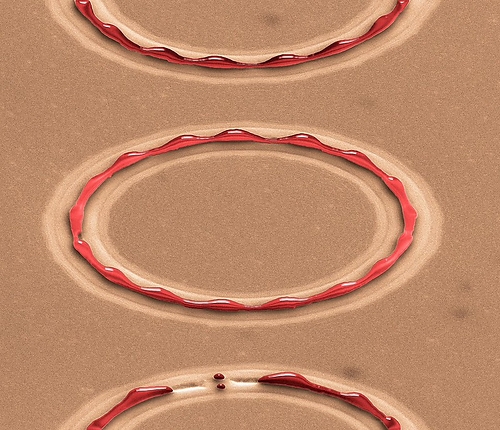
In applications such as plasmonic color laser printing and fabrication of substrate-engraved metasurfaces, controlling the size and distribution of the resulting nanostructures remains a major challenge. In others, including low-emissivity window coatings and nanoscale plasmonic devices, dewetting is undesirable because it shortens coating lifetime and degrades device performance.
A new study made available online on February 23, 2026, and published in Volume 32, Issue 3 of IEEE Journal of Selected Topics in Quantum Electronics on May 01, 2026, explores a unique approach to control laser-induced dewetting. "In this study, we explore how nonlocal optical environments, created using optically engineered nanophotonic materials like optical cavities, manipulate light and influence laser-induced dewetting in thin metallic films," explains
Dr. Thejaswi U. Tumkur, corresponding author of the study.
The researchers fabricated four samples with identical chemical compositions but different optical structures beneath a 10 nm gold film by varying the thickness of the underlying silica and gold layers. Two samples showed the expected solid-state dewetting behavior, while the others exhibited previously unreported features, including broad nano- and micron-scale particle size distributions and complex spatial patterns.
The findings indicate that nonlocal optical effects, alongside thermal, capillary, and fluid dynamic effects, influence dewetting. Finite-element simulations also ruled out local electric field variations as the cause.
"Our results offer a unique way of controlling the particle morphologies formed upon dewetting by engineering the underlying optical cavity," concludes Dr. Mikhail A. Noginov, corresponding author of the study. "This will help add more flexibility in controlling dewetting dynamics beyond conventional ways and can even help reduce dewetting where laser-induced damage is undesirable."
Reference
Title of original paper: Laser-Induced Dewetting of Gold Thin Films on Optically Engineered Substrates
Journal: IEEE Journal of Selected Topics in Quantum Electronics
DOI: https://doi.org/10.1109/JSTQE.2026.3665139
Media Contact
Kristen Amoroso
+1(732) 562-6694
[email protected]
SOURCE IEEE Photonics Society





Share this article