


pgEdge MCP Server for Postgres Now Generally Available, Including in pgEdge Cloud, Advancing Enterprise AI Infrastructure
Full featured Postgres MCP Server supports new and existing databases, to scale from prototype to production
ALEXANDRIA, Va., April 2, 2026 /PRNewswire/ -- pgEdge, the leading open source enterprise Postgres company, today announced general availability (GA) of the pgEdge MCP Server for Postgres. This full featured and production ready MCP server is designed for developers building Agentic AI applications in environments with strict requirements for high availability, security, data sovereignty and/or global deployment.
Unlike other available MCP servers, the pgEdge MCP Server for Postgres works with new and existing databases running any standard version of Postgres (v14 and newer), and offers flexible deployment options including on-premises (even air-gapped), self-managed cloud, or a managed cloud service via pgEdge Cloud. This deployment flexibility, coupled with the enterprise-grade capabilities of pgEdge Enterprise Postgres, allows developers to take their agentic AI applications all the way from prototyping to running in production on compliant and secure infrastructure.
"Most MCP servers today aren't built with enterprise requirements in mind," said David Mitchell, CEO of pgEdge. "We designed the pgEdge MCP Server for Postgres to deliver the flexibility of open source with the performance, security, and deployment control enterprises need—whether that's in the cloud, on-prem, or in air-gapped environments. It's a critical step toward making AI infrastructure production-ready."
The pgEdge MCP Server for Postgres works with AI application builders and code generators such as Claude Code, Cursor, Windsurf, and VS Code Copilot, and supports frontier models from OpenAI and Anthropic in addition to locally hosted models using Ollama, LM Studio, and other OpenAI API compatible products.
As with other pgEdge Postgres products, the pgEdge MCP Server for Postgres is fully open source via the Postgres license, and is fully supported by pgEdge's leading team of Postgres contributors and expert developers.
Key features include:
- Full schema introspection: The MCP server pulls detailed information about database structure beyond just table and column names, including primary keys, foreign keys, indexes, column types, and constraints. This allows the LLM to reason about the data model versus blindly querying it.
- Read-only and read/write support: Configurable via a switch.
- Security built-in: Supports stdio, HTTP and HTTPS, with TLS support, user and token authentication, and read-only enforcement by default.
- Multi-database support: Supports multiple databases (e.g. dev, staging, and production) and the ability to switch between them.
- Performance metrics: The server exposes pg_stat_statements and other data so the LLM can make performance optimization recommendations.
Additionally this GA release adds the following enhancements:
- Custom tools which can be written in SQL, Python, Perl or Javascript.
- A DBA Toolkit with pre-defined tools for analyzing database health, identifying top resource-consuming queries, and making index recommendations.
- Configurable base URLs for LLM and embedding providers for deployments where access is managed via proxy servers.
- Multi-host connection support for HA and failover.
- Reduced token usage via use of tab separated values (TSV) versus JSON, pagination of results and context window compaction.
- Token management tools for better rate limit handling
pgEdge will be attending the MCP Dev Summit 2026 on April 2-3 in New York at booth S13 and will be conducting live demos.
Product Availability
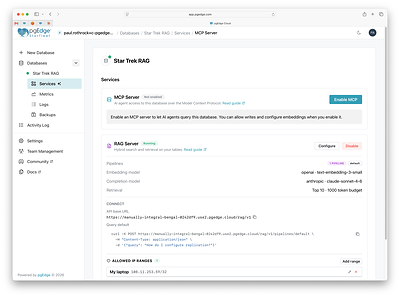
The pgEdge MCP Server for Postgres is available as a free download to all Postgres users, and is now also available within the pgEdge Cloud managed service. pgEdge customers with paid subscriptions for pgEdge Enterprise Postgres or pgEdge Distributed Postgres receive support at no extra cost. For self-hosted and self-managed deployment the product documentation and download can be found here.
pgEdge
pgEdge, the leading open source enterprise Postgres company, delivers open-source, 100% Postgres infrastructure for Agentic AI and enterprise applications that demand high availability, reliability, and data sovereignty. Its mission is to make it easy to build, deploy, and manage enterprise-grade applications at scale on Postgres. Headquartered in Northern Virginia, pgEdge is trusted by organizations including Bertelsmann, Qube RT, Jobot, and U.S. government agencies. Its investors include Akamai Technologies, Inc., Qube RT, Rally Ventures, Sands Capital Ventures, Grotech Ventures, and Sand Hill East.
For more information, visit www.pgedge.com.
SOURCE pgEdge




Share this article