Racura Oncology's RC220 Matches RC110 Drug Exposure in Nonclinical Bridging Study, Linking RC220 to Prior Clinical Experience in AML
Exposure ratios met pre-specified equivalence criteria on all three dosing days, supporting use of the established RC110 clinical dataset and dosing levels for RC220, including in the Phase 2b/3 EMILI trial in acute myeloid leukemia
SYDNEY, Nov. 17, 2026 /PRNewswire/ -- Racura Oncology Ltd (ASX: RAC) ("Racura" or the "Company"), a late clinical-stage biopharmaceutical company developing new small molecule-based approaches to cancer treatment focused on inhibiting MYC gene expression, today announced results from a Good Laboratory Practice (GLP) nonclinical pharmacokinetic (PK) bridging study showing that RC220, the Company's proprietary formulation of (E,E)-bisantrene, delivers systemic drug exposure equivalent to RC110, the earlier formulation used in two investigator-sponsored clinical trials in relapsed or refractory (R/R) acute myeloid leukemia (AML).
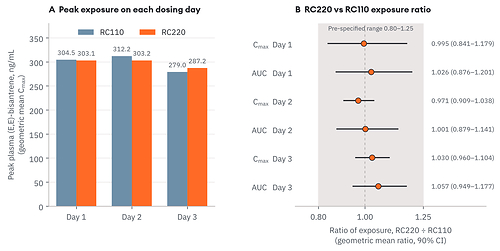
In the study, conducted in Beagle dogs (n = 6), the 90% confidence intervals (CIs) of the geometric mean ratios (GMRs) of RC220 to RC110 exposure for both peak plasma concentration (Cmax) and total exposure (area under the concentration–time curve, AUC) fell within the pre-specified equivalence range of 0.80–1.25 on each of three consecutive dosing days, with GMRs ranging from 0.971 to 1.057. These nonclinical data support applying the established RC110 clinical dataset and dosing levels to the clinical development of RC220, including the Phase 2b/3 EMILI trial in AML.
Daniel Tillett, Ph.D., Chief Executive Officer of Racura Oncology, said: "This nonclinical study was designed to answer a critical question for our RC220 clinical programs: does RC220 deliver the same drug exposure as RC110? The results of this GLP PK study show the two formulations delivered equivalent exposure to (E,E)-bisantrene. The findings provide an important bridge to the clinical experience with RC110, which produced a 40% response rate in two separate clinical trials in heavily pretreated AML patients. The bridging study results support our plans to evaluate RC220 in patients with AML in the EMILI trial as well as our HARNESS and CPACS clinical programs. I wish to thank the Racura team and our study partners for the careful execution of this important work."
Study Design and Results
RC110 and RC220 contain the same active ingredient, (E,E)-bisantrene, and differ only in their formulation excipients. RC220 was developed to allow (E,E)-bisantrene to be given through a peripheral vein, rather than requiring a central venous line.
The study used a two-period crossover design in which each male Beagle dog received once-daily intravenous doses (30-minute infusion) of RC110 and RC220 for three consecutive days, in random order and separated by a five-day washout, so that each animal served as its own control. Repeat daily dosing was examined because RC110 was given as a daily infusion over several consecutive days in the earlier AML trials, and the same approach is planned for RC220.
Equivalence was assessed using the statistical approach described in US Food and Drug Administration (FDA) and European Medicines Agency (EMA) bioequivalence guidance, in which the 90% CI of the GMR must lie entirely within 0.80–1.25. All six intervals met this criterion, with the widest being 0.841–1.179 for Day 1 Cmax (Figure 1).
The dog is a standard species for nonclinical PK and safety studies and was one of the two species used in the GLP toxicology program for RC220. The doses used were well below the level that causes harm, and no animal was harmed in the study. These results characterize drug exposure in the bloodstream of dogs; they do not measure anticancer activity. The safety and efficacy of RC220 in patients with AML remain to be established in clinical trials.
Significance for the RC220 Clinical Programs
RC110 was used in two investigator-sponsored clinical trials in R/R AML conducted at Sheba Medical Center, Israel. In a Phase 2 trial, RC110 given as a single agent produced an overall response rate (complete or partial responses) of 40% in 10 patients (Canaani et al., Eur J Haematol 2021). In a Phase 1b/2 trial, RC110 combined with fludarabine and clofarabine produced a response in 6 of 15 evaluable patients (Danylesko et al., Br J Haematol 2025). These results underpin Racura's plan to advance RC220 in AML through the Phase 2b/3 EMILI trial.
RC220 is already being administered to patients through a peripheral vein in the Phase 1 CPACS solid tumor trial and the Phase 1 HARNESS lung cancer trial. While the bridging study results are not essential for these trials, they may help accelerate dose escalation or progression to later-stage trials. Racura will use the results to support regulatory submissions for AML and other clinical indications.
About RC220 & (E,E)-bisantrene
RC220 is a proprietary formulation of (E,E)-bisantrene designed to overcome drug solubility issues that prevent safe peripheral intravenous infusion. (E,E)-bisantrene is a clinically validated small molecule anticancer agent that primarily functions via G4-DNA and RNA binding, leading to potent transcriptional inhibition of the important cancer growth regulator MYC and downstream pathways.
About Racura Oncology
Racura Oncology (ASX: RAC) is a late clinical-stage biopharmaceutical company with a mission to silence cancer. Our lead asset, (E,E)-bisantrene, is a small molecule anticancer agent that primarily functions via G4-DNA and RNA binding, leading to potent transcriptional inhibition of the important cancer growth regulator MYC. G4-binding by (E,E)-bisantrene has additional anticancer activities including inhibition of topoisomerase II and telomerase, as well as m6A RNA pathway modulation.
Racura is advancing RC220 to address the high unmet needs of patients across multiple oncology indications, including the EMILI Phase 2b/3 trial in acute myeloid leukemia (AML), the HARNESS Phase 1 trial in combination with osimertinib in mutant epidermal growth factor receptor non-small cell lung cancer (EGFRm NSCLC), and the CPACS Phase 1 trial in combination with the anthracycline doxorubicin, where we aim to deliver both cardioprotection and enhanced anticancer activity for solid tumor patients.
Learn more at www.racuraoncology.com.
Forward-Looking Statements
Some of the statements in this press release are forward-looking statements within the meaning of Section 27A of the Securities Act of 1933, Section 21E of the Securities Exchange Act of 1934 and the Private Securities Litigation Reform Act of 1995, which involve risks and uncertainties. Forward-looking statements in this release include, without limitation, statements regarding expectations regarding clinical development and regulatory strategy and the Company's ability to deliver meaningful value to patients and shareholders. These statements relate to future events, future expectations, plans and prospects. Although Racura believes the expectations reflected in such forward-looking statements are reasonable as of the date made, expectations may prove to have been materially different from the results expressed or implied by such forward-looking statements. Racura has attempted to identify forward-looking statements by terminology including "believes", "estimates", "anticipates", "expects", "plans", "projects", "intends", "potential", "may", "could", "might", "will", "should", "approximately" or other words that convey uncertainty of future events or outcomes to identify these forward-looking statements. These statements are only predictions and involve known and unknown risks, uncertainties and other factors, including market and other conditions. Any forward-looking statements contained in this press release speak only as of its date. Racura undertakes no obligation to update any forward-looking statements contained in this press release to reflect events or circumstances occurring after its date or to reflect the occurrence of unanticipated events, except as required by law.
SOURCE Racura Oncology Ltd

Share this article