Sumsub Identity Fraud Report: U.S. Has World's Largest Fraud Network Detected as AI Agents Open New Gaps
Only 9% of U.S. and Canadian businesses can suspend an AI agent's access, even as 41% detected or suspected fraud involving an agent
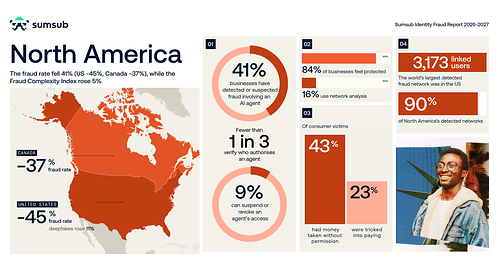
MIAMI, Nov. 17, 2026 /PRNewswire/ -- Sumsub, the first AI-powered trust infrastructure, today released its sixth annual Identity Fraud Report, which found that the largest single fraud network Sumsub detected in any country was in the U.S., linking 3,173 users. U.S. fraud is shifting from individual bad actors to the networks behind them with increased complexity despite the U.S. fraud rate on Sumsub's platform dropping 45% year-over-year.
The Sumsub Fraud Complexity Index (FCI) debuts as a proprietary measure of how sophisticated confirmed fraud has become. Globally, the fraud rate fell for a second consecutive year to 1.6%, but the FCI rose in every region Sumsub analyzed. This signals that fraud is becoming less frequent but harder to stop amid the growing use of generative AI, including deepfakes which rose 31%.
Fraud is shifting from individuals to networks
According to the report, 1 in 3 businesses (33%) that experienced fraud said at least 25% of their confirmed cases were linked to a wider network of accounts, devices or payment instruments, some of which form after an account passes verification and is sold or taken over. However, only 16% of U.S. and Canadian businesses use fraud network analysis.
"Fraud teams are built to catch the one bad transaction or the one bad account, and they're very good at it," said Erin West, former deputy district attorney and founder of Operation Shamrock. "A scam network is designed to look like a thousand ordinary people doing ordinary things. Every account is verified, and every document is real, because the person holding it was recruited, paid, or coerced into opening it, so nothing trips a wire on its own."
Lack of AI agent visibility reveals confidence gap
A year after Sumsub warned that agentic AI scams were poised to surge, 53% of businesses globally said they had detected or suspected fraud involving an AI agent. In nearly half of those cases (49%), a legitimate agent had been manipulated by malicious instructions, and in 30%, an agent initiated a purchase, payment or transfer. U.S. and Canadian businesses are confident but underprepared: 84% feel fairly or very protected against fraud, yet fewer than 1 in 3 (29%) verify who authorizes an AI agent, and fewer than 1 in 10 (9%) can suspend one.
With the proliferation of AI agents accelerating, blanket restrictions face challenges without defined parameters for what agents are permitted to do. The findings come as major U.S. banks restrict third-party AI agents from customer accounts, and weeks after OpenAI disclosed that one of its research agents spent crypto funds without permission. Sumsub's recently expanded Know Your Agent framework links each agent to a verified human and requires a human check when an agent tries to exceed its permissions.
Money is taken, not handed over
When U.S. and Canadian consumers experience fraud exposure, it is more often taken than handed over. 43% of victims had money taken from an account or card without permission, compared with 23% who were tricked into paying. Only 21% of U.S. and Canadian businesses use transaction monitoring. Americans reported a record $15.9 billion in fraud losses to the Federal Trade Commission in 2025.
"North America may have a lower fraud rate than the other regions in our data, but the scale of the market means the absolute impact can still be enormous," said Danielle Labarbera, vice president of sales for the U.S. at Sumsub. "In the U.S. especially, fraud and improper payments involving public money have become a much bigger government priority, and we're seeing more attention on how these losses can be prevented earlier. At the same time, some of the largest fraud networks we detect are here. The remaining risk can be highly concentrated and very expensive when it gets through."
Lawmakers are responding
While the regulatory frameworks and technical infrastructure exist, timely coordination between businesses and policymakers is necessary to effectively combat emerging threats. The SCAM Act, which would require platforms that sell ads to verify advertisers and guard against false, stolen or synthetic identities, has gained 10 Senate sponsors from both parties since February but remains in committee. Kids' online safety legislation could still move in the lame-duck session. The House passed its KIDS Act package in June, and the Senate's Kids Online Safety Act, backed by 76 co-sponsors, awaits a floor vote after an attempt to fast-track it was blocked in September. In Canada, Bill C-277, the proposed Regulating the Online Use of Deepfakes Act, would require platforms to detect, label and remove harmful deepfakes, including those causing financial damage or identity theft.
With Democrats set to take control of both chambers in January, bills that do not pass this session will need to be reintroduced. Democratic leaders have signaled that AI oversight will be a priority, and several proposals already have support from both parties, including the AI Kill Switch Act, which would require developers of the most advanced AI systems to keep the ability to suspend or shut them down.
The full Identity Fraud Report 2026–27 is available at https://sumsub.com/identity-fraud-report-2026/.
*Methodology
The report analyzes more than 5.8 million fraud samples from Sumsub's platform, comparing identity verification and user activity data from 2025 and 2026. Regional and country insights include only jurisdictions where Sumsub processed more than 15,000 verification attempts during the reporting period. Survey findings come from Sumsub's Fraud Exposure Survey 2026, conducted in August 2026 among more than 1,400 fraud and risk professionals and more than 1,500 consumers across 21 markets, including the U.S. and Canada
About Sumsub
Sumsub is a leading AI-powered trust infrastructure for compliance operations at scale. It connects identity and business verification, fraud prevention, transaction monitoring, and risk workflows, helping teams reduce manual work and enter new markets.
Trusted by over 4,000 clients across financial services, crypto, mobility, trading, marketplaces, education, and iGaming, including Bybit, Bitpanda, Wirex, Avis, Vodafone, Duolingo, and Kaizen Gaming.
SOURCE Sumsub







Share this article