57% of Small Business Respondents Cite Financial Pressures as Top Barrier to Retirement Saving, Ubiquity Retirement + Savings Survey Finds
Second annual survey of 2,000 respondents also finds 39% name plan costs and administration as their biggest benefits challenge
Key Takeaways
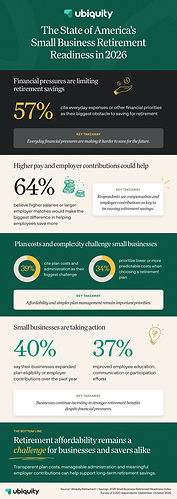
- Financial pressures are limiting retirement savings: 46% cite everyday expenses as their biggest obstacle to saving, rising to 57% when other financial priorities are included.
- Higher pay and employer contributions could encourage more saving: 64% believe higher salaries or a larger employer match would make the biggest difference in helping employees save, and 44% say employer matching is the plan feature employees value most.
- Plan costs and complexity strain small businesses: 39% name plan costs and administration as their biggest challenge, and only 40% feel very prepared to meet current and upcoming retirement plan requirements.
- Businesses are working to improve retirement benefits: 40% say they expanded plan eligibility or employer contributions over the past year, and 37% say they improved employee education, communication or participation efforts.
SAN FRANCISCO, Nov. 17, 2026 /PRNewswire/ -- According to Ubiquity Retirement + Savings' second annual Small Business Retirement Readiness Index, 57% of small business respondents cite everyday expenses or other financial priorities as a barrier to retirement saving. Everyday expenses lead, named by 46%, more than three times the share of any other response. The cost of offering retirement benefits is another concern, with 39% citing plan costs and administration as their biggest challenge.
"Small business owners know that every dollar counts, both for their businesses and their employees," said James Hobson, CEO of Ubiquity Retirement + Savings. "When it comes to retirement benefits, employers shouldn't have to choose between affordability and quality. Understanding plan costs, minimizing unnecessary fees and reducing administrative complexity can help businesses offer benefits that support long-term retirement savings."
Financial pressures are limiting retirement savings
Everyday expenses are the biggest obstacle to saving for 46% of respondents, followed by other financial priorities at 11%, for a combined 57%. Among those ages 25 to 64, between 53% and 61% cite financial pressures as a barrier to saving. Just 13% say nothing is holding them back, and they are on track for their savings goals.
Higher pay and employer contributions emerged as the strongest potential motivators for retirement saving. Asked what would make the biggest difference in helping employees save more, 64% chose either higher salaries (33%) or a larger employer match (31%). Better financial education (12%), more personalized guidance (6%) and simpler tools and technology (5%) trailed far behind. Employer matching is also the plan feature 44% believe employees value most.
Plan costs and administrative complexity weigh on small businesses
Plan costs and administration top the list: 39% of respondents name them as their biggest challenge. Changing regulations (25%), keeping benefits competitive (19%) and increasing employee participation (17%) follow.
Affordability and simplicity matter when choosing a retirement plan. Lower or more predictable costs would have the greatest influence for 34% of respondents, while 28% prioritize simpler administration and compliance support.
Many aren't keeping a close eye on what they pay. Overall, 29% say they understand their plan costs but rarely review them, and another 13% are unsure of their total costs. Among respondents whose businesses offer a retirement plan, 38% either rarely review their costs or are unsure what they pay.
Compliance requirements add to the challenge. Only 40% of respondents feel very prepared to meet current and upcoming retirement plan requirements, while 41% say they are somewhat prepared but still adjusting.
Despite struggles, businesses see clear value in strengthening retirement benefits
Businesses are taking steps to strengthen retirement benefits despite ongoing financial pressures. Over the past year, 40% say their businesses expanded plan eligibility or employer contributions, while 37% report improvements to employee education, communication or participation efforts.
Looking ahead, 44% expect to focus on improving participation, eligibility or contributions, and 18% expect to review costs or consider new providers.
"Employers shouldn't have to be retirement experts to run a good plan," Hobson added. "As costs, regulations, and employee needs evolve, they need clear visibility into what they're paying and a partner who keeps the plan competitive and compliant."
For small businesses navigating these challenges, Ubiquity Retirement + Savings offers retirement plans with transparent, flat-fee pricing and administrative support designed to simplify plan management. Learn more at www.myubiquity.com.
About the 2026 Small Business Retirement Readiness Index
Ubiquity Retirement + Savings' second annual Small Business Retirement Readiness Index is based on 2,000 completed survey responses collected in September and October 2026. The survey examined retirement plan adoption, compliance preparedness, plan costs, employee participation and personal retirement savings priorities. Findings reflect respondents' self-reported experiences and perceptions, including their views on what employees value. Percentages are rounded and may not total 100%.
About Ubiquity Retirement + Savings
Since 1999, Ubiquity Retirement + Savings has helped small businesses offer qualified retirement plans designed to meet their needs and support long-term financial success. Combining flat fees and technology with dedicated customer support, the company serves thousands of businesses and hundreds of thousands of retirement savers. Learn more at www.myubiquity.com.
MEDIA CONTACT
Interdependence for Ubiquity Retirement + Savings
Laura Waldron | 630-404-9493 | [email protected]
SOURCE Ubiquity Retirement + Savings







Share this article