


At UN Security Council, Israeli and Palestinian peacebuilders call on governments to make support for civil society permanent
Speakers urge more governments to join the International Fund for Israeli-Palestinian Peace and to deliver on the G7's commitment to include civil society, a week after peacebuilders met foreign ministers at the General Assembly
NEW YORK, Sept. 28, 2026 /PRNewswire/ -- Israeli and Palestinian peacebuilders briefing the UN Security Council today called on more governments to join the International Fund for Israeli-Palestinian Peace, and to give Israeli and Palestinian civil society a permanent place in foreign policy, with lasting funding and a standing seat at the table.
The Council was briefed by the cofounders of InterAct - Maoz Inon, an Israeli whose parents were killed in the Hamas attack on 7 October, and Aziz Abu Sarah, a Palestinian from East Jerusalem whose brother died after torture in Israeli detention. They spoke as members of the Alliance for Middle East Peace (ALLMEP), a coalition of more than 200 Israeli and Palestinian peacebuilding organizations.
"We have many problems in Israel and Palestine. But a weak civil society isn't one of them," Inon told the Council.
The International Fund for Israeli-Palestinian Peace was launched in June by the United Kingdom, Canada and Australia. It is modelled on the International Fund for Ireland, which supported community level peacebuilding for more than a decade before the Good Friday Agreement, and for years after, allowing the agreement to hold. It is the first multilateral mechanism dedicated to long term funding for the people and organizations building the foundations for peace on the ground.
"I urge this Council to invest where it matters most: the peacemakers on the ground," Inon said. "We applaud Canada, the UK, and Australia for initiating the International Fund for Israeli-Palestinian Peace. Other member states must join."
In their communiqué from the June 2024 G7 summit in Italy, leaders committed to "closely coordinate and institutionalize" their support for civil society peacebuilding. In practice that means long term funding, a standing role in diplomatic processes, and consistent political backing, rather than occasional invitations. This inclusion followed a months-long campaign backed by 37 UK parliamentarians, 22 Members of the European Parliament, more than 160 Israeli and Palestinian peacebuilding NGOs and 200 civil society organizations worldwide, as well as Pope Francis, whose support Maoz Inon and Aziz Abu Sarah secured in a personal audience with him ahead of the G7. Two years on, the commitment has yet to be fully delivered.
"Host us in your capitals, broadcast our message, amplify our voices. But don't just invite us once - make us a permanent part of your diplomacy and your budgets, as the G7 committed to in 2024," Abu Sarah told the Council.
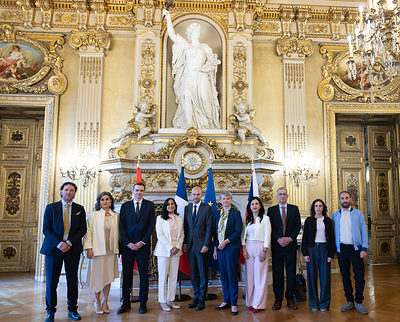
The briefing came a week after French Foreign Minister Jean-Noël Barrot convened a roundtable during the UN General Assembly, bringing Israeli and Palestinian civil society leaders together with foreign ministers and senior diplomats from 35 countries. ALLMEP members briefed on conditions on the ground, from escalating settler violence in the West Bank to the humanitarian crisis in Gaza and the risks and opportunities of upcoming elections. "All of the building blocks for peace are here on the table," Barrot told participants. "We are a resource for you as much as you are a resource to us."
"We also thank Minister Barrot for convening a roundtable with civil society leaders at last week's General Assembly," Abu Sarah told the Council. "Let's make that the new norm."
The roundtable is the latest step in a growing shift in how governments engage with the field. In 2025, recommendations developed by hundreds of Israeli and Palestinian peacebuilders in Paris were reflected in the New York Declaration, endorsed by 142 countries. This June, more than 150 civil society leaders returned to Paris to meet ministers from over 50 countries, producing the 2026 Paris Call, a policy roadmap delivered to G7 leaders.
"What the Council heard today is what hundreds of organizations across Israel and Palestine have been saying for years," said John Lyndon, ALLMEP Executive Director. "Governments have started to treat peacebuilders as partners. The task now is to make that permanent: more countries joining the Fund, and the G7's commitment turned into standing policy and funding, so that civil society's ideas and actions are integrated into every dimension of diplomacy."
The Security Council briefing also addressed the protection of civilians in the West Bank ahead of the olive harvest, accountability for violence, access for the Red Cross to detainees, Palestinian elections, and multi-narrative education.
About ALLMEP
The Alliance for Middle East Peace (ALLMEP) is a coalition of more than 200 Israeli and Palestinian organizations working to build the civil society infrastructure that lasting peace requires. ALLMEP works to ensure that the people and organizations reducing violence, building trust, and creating partnership between Israelis and Palestinians on the ground are recognized, connected, and resourced by governments and donors worldwide. Learn more at allmep.org.
Media Contact
Noga Malkin
Director of Communications
[email protected], +353899482601
SOURCE Alliance for Middle East Peace (ALLMEP)



Share this article