


Barndoor Acquires Diaphora to Bring Governed AI Automation to Enterprise Workflows
Build repeatable AI workflows as "blueprints" that are governed at every step and automatically
distributed to authorized employees
Designed to bring AI automation to higher-stakes enterprise workflows that still require
significant manual execution
The underlying automation engine will remain open source, allowing anyone to contribute,
extend or verify how it works
NEW YORK, Sept. 16, 2026 /PRNewswire/ -- Barndoor AI, the AI Gateway for enterprises, has acquired Diaphora, the startup behind Frags, the open-source engine for building AI workflows. The combined product will allow enterprises to build Blueprints, repeatable AI workflows that connect tools and data through a defined series of steps that can be governed and distributed across authorized teams. By combining Diaphora's workflow technology with Barndoor's governance and access controls, enterprises can build AI automations once and securely scale them across the organization.
The acquisition represents a "spin-in" of Diaphora, which began as an independent project developed by Simone Pezzano, with Jay Parisi collaborating on the technology as it evolved. Barndoor CEO Oren Michels later became an advisor to Diaphora and supported its early development. As the technology matured, Barndoor and Diaphora determined the companies were better positioned together, bringing Diaphora's technology and team into Barndoor. The full Diaphora team will join Barndoor as part of the acquisition.
Traditional automation has largely focused on predictable, rules-based tasks such as routing records, syncing systems and handling routine requests. AI has the potential to automate more complex work, but enterprises still face three major barriers: reliability, access and distribution. AI-generated outputs can be unpredictable, while allowing AI systems to take action across enterprise tools and data requires strict controls over what they can access and do. Diaphora and Barndoor were built to address opposite sides of this challenge: Diaphora focuses on making AI workflows more predictable, while Barndoor governs the access required to deploy them securely across an enterprise.
From AI pilots to enterprise adoption
Enterprises have rapidly introduced AI tools, but turning experimentation into repeatable workflows remains a challenge. Automations built in Diaphora can become governed MCP tools within Barndoor. Barndoor's role-based access controls determine who can discover and run each automation without requiring a separate provisioning process. Employees can then access the automations approved for their roles, allowing enterprises to securely distribute AI workflows across teams while maintaining centralized governance.
Built to make AI workflows more reliable and predictable
Diaphora is built on Frags, an open-source AI workflow runtime that uses the Frags Modeling Language (FML) to define how AI executes a workflow and constrain where an LLM can act.
"Most AI systems operate from a plan, what you hope is going to happen. A blueprint defines what actually happens," said Oren Michels, co-founder and CEO of Barndoor. "By combining Diaphora's workflow technology with Barndoor's governance, enterprises can make AI automation more predictable, easier to deploy and accessible to employees without requiring them to become experts at directing AI."
A Blueprint connects tools and data through a defined series of steps to create a repeatable workflow. AI can be used where judgment is required, while the remaining steps execute consistently according to the Blueprint. A salesperson finishing a customer call, for example, may need to log the call, update the customer record, schedule the next step and notify the account team. The Blueprint defines how those steps are executed each time. If it cannot complete a required step, it stops and identifies the issue rather than filling the gap with something plausible.
Governance makes adoption possible
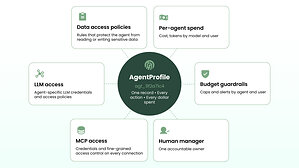
Barndoor governs which tools, data and models AI can access within an enterprise, and Diaphora Blueprints will inherit those controls. Employees only see and run automations authorized for their roles, while enterprises maintain a record of what each automation accessed, changed and cost. This allows a workflow to be built once and securely distributed to authorized users without a separate provisioning process.
"Barndoor is thought of as a governance and security product," said Michels. "This is where governance starts driving adoption instead of slowing it down. Nobody uses AI they don't trust, and nobody uses AI they don't know how to use. This answers both at once."
"Diaphora exists to make AI workflows predictable rather than leaving their execution to chance," said Simone Pezzano, co-founder of Diaphora and creator of Frags. "By joining Barndoor, we can pair that reliability with enterprise-grade governance and give teams a practical way to build and deploy AI workflows without having to recreate access controls for every automation."
The kind of work this opens up
AI that acts, not just drafts. Many AI tools used in the workplace today produce an output that a person must then review and submit. A Blueprint can be designed to complete the action itself, for example, identifying a billing error and posting a corrected invoice rather than simply proposing a correction for someone to approve.
Answers that live across multiple systems. Some workflows require information spread across systems with different owners and access controls. A quarterly customer health review, for example, might require pulling a contract from one system, usage data from another, support history from a third and billing information from a fourth. A Blueprint can carry the appropriate permissions for each step, allowing an authorized employee to run the workflow without requiring direct access to every underlying system.
"We've all built AI automations that work great on a laptop, but running them reliably across an enterprise is another story. Building automations at the speed of the agent economy demands fast, distributed and governed workflows, not one-off scripts nobody can scale or oversee," said Jay Parisi, co-founder and CEO of Diaphora. "That's why joining Barndoor made sense. Together, we're bringing automation creation and enterprise governance onto one platform."
The combination is already resonating with enterprises looking to move AI workflows from experimentation into broader deployment. Syndio, a pay equity and decision intelligence leader and Barndoor customer, sees predictability and visibility as critical to scaling AI across teams.
"Reliability is what turns an AI project into something we can put in front of the whole team. With Barndoor, if we know a workflow will follow the same defined process every time and can see exactly what touched it, we can deploy it far more broadly than anything we run today," said Nimrod Vered, CTO of Syndio. "The new workflow capabilities Barndoor gains through the Diaphora acquisition open many possibilities. We have issues with nondeterminism in AI today, which limits how far we can scale it across teams. This could be a critical piece of solving the internal hesitation around AI automations."
Get Started
Enterprises can start building governed, production-ready AI automations today. Visit diaphora.ai to sign up and put your first automation to work.
About Diaphora and Frags
Diaphora is built on Frags, an LLM workflow engine that executes workflows written in FML, the Frags Modeling Language. Frags treats complex workflows, like data retrieval and business processes as controlled actions that the AI cannot alter without authorization. It ensures that the LLM is only working where it's needed, saving money and lowering risk. Frags and FML will remain open source and supported by the Barndoor team to empower everyone with the tools they need to build trusted, reliable AI workflows.
About Barndoor
Barndoor is the AI Gateway for enterprises. Barndoor gives IT, security, and AI teams the visibility and fine-grained access control they need to govern agents, automations, and models. It secures every AI action, governing which tools and data agents and automations can access via MCP, and keeping LLM spend predictable, while blocking PII and sensitive data leaks before they reach a model or tool. Learn more at barndoor.ai.
SOURCE Barndoor AI




Share this article