Canada Is Posting More Cybersecurity Jobs, but Fewer Offer a First Step
New CCN report finds entry level opportunities falling as skills convergence reshapes cybersecurity work
OTTAWA, ON, Nov. 12, 2026 /PRNewswire/ -- The Canadian Cybersecurity Network has released its Q3 2026 Workforce Intelligence Report, revealing a serious contradiction in Canada's cybersecurity labour market.
Cybersecurity hiring reached 728 postings in the third quarter, rising 9.8 percent from Q2 and 64.7 percent from the same period in 2025.
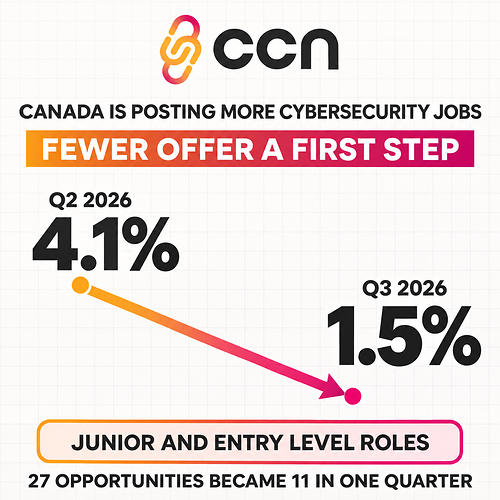
Yet junior and entry level roles fell from 4.1 percent of postings in Q2 to just 1.5 percent in Q3. Approximately 27 opportunities became only 11 in one quarter.
"Canada cannot solve its cybersecurity talent shortage by asking every candidate to arrive experienced," said François Guay, Founder and CEO of the Canadian Cybersecurity Network. "We are increasing cybersecurity hiring while removing the first step into the profession. If businesses continue competing for experienced people without creating opportunities to develop new talent, the shortage will not be solved. It will be institutionalized."
Several factors may be contributing to the decline. Employers are combining cybersecurity, privacy, governance, cloud, data, artificial intelligence and business responsibilities into fewer positions. AI tools are absorbing some junior tasks, while lean security teams increasingly favour candidates who can contribute immediately.
This reflects a broader shift CCN describes as skills convergence.
Organizations increasingly need people who can work across technology, security, risk, regulation, operations and business strategy. Cybersecurity professionals may now be expected to understand AI systems, communicate with executives, evaluate privacy implications and connect technical decisions to business outcomes.
AI bilingualism is becoming an important part of this convergence. It describes the ability to work fluently across cybersecurity and artificial intelligence, including how AI changes threats, operations, identity, governance and human decision making.
"AI bilingualism and skills convergence will define the next generation of work," Guay said. "But Canada cannot demand broader capabilities while eliminating the positions where people develop them. Employers must become active builders of talent, not simply consumers of experience."
These changes will be examined further in The Convergence Economy, CCN Intelligence's flagship report scheduled for January 2027. The report will explore how technology, security, business, policy and risk are coming together and changing how organizations compete, hire and make decisions.
The Q3 report was prepared through detailed analysis by Steve McMichael using Canadian Cybersecurity Jobs data.
CCN is calling on employers, educators and governments to expand paid internships, apprenticeships, structured junior roles, mentorship and work integrated learning. Employers should also reassess experience requirements that may unnecessarily exclude capable candidates.
Media organizations are invited to contact CCN for interviews, data questions or commentary on cybersecurity hiring, skills convergence, AI bilingualism and the changing needs of Canadian businesses.
Read the Q3 2026 Workforce Intelligence Report
Read the accompanying CCN analysis
ABOUT THE CANADIAN CYBERSECURITY NETWORK
The Canadian Cybersecurity Network is a national community of more than 47,000 people connecting the leaders, practitioners and organizations strengthening Canada's digital future. Through CCN Intelligence, CCN brings together trusted signals, expert perspective and community insight to help Canadian leaders make better technology and business decisions.
Media Contact
Francois Guay
Founder & CEO
Canadian Cybersecurity Network
236 983 7300
[email protected]
SOURCE Canadian Cybersecurity Network







Share this article