


CodeROI Platform Enhancement: Automated Evidence for the IRS's New Project-Level R&D Reporting ahead of 2026 Mandate
Building software in America has rarely been this well rewarded, but new IRS rules will soon demand project-level proof that most companies cannot produce. CodeROI builds that proof automatically while engineers do their normal work, then hands it to your CPA. Available in the United States and Canada.
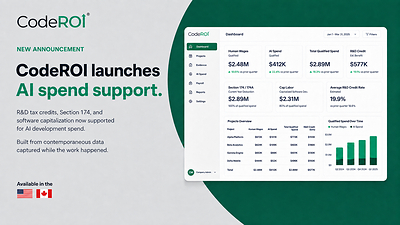
MCKINNEY, Texas, Aug. 5, 2026 /PRNewswire/ -- CodeROI today announced that its platform fully supports the IRS's new project-level R&D reporting requirements ahead of their tax year 2026 effective date, giving software companies in the United States and Canada an automatic way to build the evidence the redesigned Form 6765 demands, with no timesheets, no surveys, and no change to how their engineers work.
Here is something many CEOs do not know: if your company pays people to build software, the government will cover part of the cost. It is called the R&D tax credit, it is a dollar-for-dollar reduction in what you owe, and American companies collect more than $32 billion of it every year, according to IRS data. Startups that are not even profitable yet can use it to knock up to $500,000 a year off their payroll taxes.
In short, building software in America has rarely been this well rewarded. So why do so many eligible companies collect nothing, or collect nervously?
Section G: the new mandate, and why it is not a small change
Because the money comes with homework, and the homework just got harder. Starting with tax year 2026, most companies claiming the credit must complete Section G of the redesigned IRS Form 6765. On paper it sounds administrative: report your qualified research expenses by business component, meaning each product, process, or piece of software you developed, covering at least 80 percent of your total claim across up to 50 components, with the wages for each split into direct research, direct supervision, and direct support.
Here is what that actually means in practice. You cannot produce honest project-level numbers from the top down. The only way the math works is from the bottom up: you have to know where each individual engineer's time actually went, project by project, and then aggregate those person-level allocations back up into the business component totals the form demands. A company that has never tracked engineering activity at that level of detail cannot conjure it at filing time.
That burden is exactly why Section G caused an uproar. It was slated to be required for tax year 2025, and companies pushed back hard enough that the IRS made it optional for that year and delayed the mandate. The reprieve is now over: for tax year 2026, it is required. Make no mistake, this is not a form tweak. It is the biggest change to how the R&D credit is claimed in decades, converting it from a summary-level calculation into a project-level evidence exercise. A single total on a tax form will no longer do. Companies must show their work, person by person, project by project.
Does this apply to your business? A thirty-second gut check
Do you claim the federal R&D credit, or plan to? Do you pay people to build software? Then unless your claim is small enough to fall under the narrow exceptions, roughly speaking, under $1.5 million in qualified research expenses, which is about the payroll of a ten-person engineering team, and under $50 million in gross receipts, plan on Section G applying to you. Odds are it does.
The part your accountant does not do
Most executives assume their accountant has this covered. They do not, and it was never their job. Your CPA calculates the credit and files the return. The proof behind it, the record of what your engineers actually built and why it qualifies, has always been on you. Today, companies produce that proof the painful way: engineers filling out time surveys they resent, managers guessing percentages from memory, and finance teams spending weeks reconstructing a year of work they did not witness. It burns time, it annoys the exact people you hired to build product, and it rests on recollection instead of records.
CodeROI closes that gap. It connects to your GitHub in minutes and then disappears into the background. From that day on, it quietly builds the proof while your engineers do exactly what they were already doing. No timesheets. No surveys. No year-end interrogations. When it is time to file, you hand your CPA a clean, organized, audit-ready evidence package, and they do what they do best with it.
"I spent years on the accounting side of this, and the pattern never changed: filing the credit was the easy part. The evidence was the nightmare, because you cannot even calculate a defensible credit without proof to build it on," said Taylor Meadows, CPA, Founder of CodeROI. "Your accountant is excellent at the tax work. They are not inside your codebase, and they cannot invent records of work nobody captured. CodeROI captures it, so the claim is proven before anyone asks."
"We have claimed this credit for years and never had a problem"
Plenty of companies can say that, and it deserves a straight answer, because it hides a trap. "Never had a problem" almost always means "never been tested." Most R&D claims are never examined at all, and when the IRS does examine one, it typically arrives years after the money was collected; the IRS generally has at least three years after a return is filed, and longer in some circumstances. So a credit collected today is not settled today. It is simply unexamined. Cashing the check and proving the claim are two different events, and for most companies only the first one has ever happened. That is not security. It is survivorship.
And when an exam finally lands, it compounds. A documentation method is not a one-year decision: whatever a company did in the year under review, it almost certainly did the same way in every year it claimed. The IRS generally has three years after each return to assess additional tax, six years where gross income was substantially understated, and no time limit at all for fraudulent or unfiled returns. So an examiner who finds a broken approach in one year does not stop at one year. Every open year built on the same surveys and estimates carries the same flaw, and the company relives the same fight for each of them, unwinding and restating year after year, with interest and potential penalties stacking on top. A weak methodology is never one year's problem. It is a pattern, and patterns get priced retroactively.
The old approach made sense for the old rules. Questionnaires, timesheets, and year-end estimates were built for an era when the form asked for one total, and nobody looked closely unless something went wrong. The new form asks project-level questions, and tax practitioners widely read it as designed to let the IRS spot weak claims the moment they are filed. The IRS already demands this level of detail on amended refund claims and rejects the ones that lack it. A method that "worked" under summary reporting is about to be graded against questions it was never built to answer. And if an exam does come, the difference is stark: an examiner weighs a timestamped record captured while the work happened very differently from a percentage a manager estimated in a conference room a year later. One is evidence. The other is a memory with a signature on it.
Here is the part that should seal it: even if you ignore the risk entirely, the old way still loses, because it costs more effort every single year. Manual substantiation is a tax your company pays annually, forever, in engineer hours, finance hours, and goodwill. CodeROI is the more passive option, not the more demanding one. Connect once, and the surveys, the timesheets, and the year-end reconstruction simply stop. Your firm stays. Your CPA stays. What changes is what you hand them: records instead of recollections. The question was never whether your current approach got you the money. It is whether it proves you earned it, and why you would keep paying people to remember when the record can keep itself.
One connection, your whole code finance picture
The same record does more than back up the federal credit. It supports state R&D credits, Canada's SR&ED program at the federal and provincial level, and the software capitalization numbers, often called cap labor, that flow into your financial statements. Tax and accounting stop running on separate spreadsheets that quietly disagree, because both finally come from the same source of truth.
It also ends one of the strangest habits in business: waiting until months after the year closes to find out what your own numbers are. With CodeROI, finance leaders can watch their credit and cap labor figures take shape all year long, which means real cash planning, real forecasts, and no filing-season surprises.
Why the smart move is starting now
Engineering evidence is perishable. Work that is not captured when it happens is nearly impossible to reconstruct honestly later, and reconstructions from memory are exactly what invite scrutiny. A company cannot decide next spring to have kept better records this year.
"Every week a company waits is proof it can never get back," said Anna Meadows, CTO of CodeROI. "The code your team shipped this sprint is the strongest evidence of R&D you will ever have. Our job is to make keeping it effortless. Connect once, change nothing about how your engineers work, and the record builds itself."
CodeROI is a software platform, not a consulting firm. There is no months-long study, no team of outside analysts, and no one replacing your accountant. The software does the evidence work; your CPA keeps doing the tax filing. CodeROI serves organizations across the United States and Canada, from startups claiming the payroll tax offset to enterprises preparing for the new project-level reporting at scale.
About CodeROI
CodeROI is a deterministic, data-first software platform that automates software development tax incentives, software capitalization, and software development compliance. By generating an evidence-based record directly from the software development lifecycle, CodeROI helps organizations replace estimates with actuals, improve audit readiness, and produce more defensible financial and tax reporting.
See how much money your codebase is already earning you. Schedule a demo at www.coderoi.com.
Sources
- Internal Revenue Service, Statistics of Income. U.S. corporations reported more than $32 billion in research credits for tax year 2021, the most recent finalized data available.
- Internal Revenue Service, Instructions for Form 6765, Credit for Increasing Research Activities (Rev. December 2025). Section G business component reporting is required for tax years beginning after December 31, 2025, with limited exceptions; the maximum payroll tax research credit for a qualified small business is $500,000; research credit claims on amended returns must include specific supporting information to be considered valid.
- Internal Revenue Service, IR-2025-99 (October 1, 2025). Section G of Form 6765 optional for all filers for tax year 2025 and mandatory for tax year 2026 and beyond, with optional reporting for certain filers.
- Internal Revenue Code Section 6501. The IRS generally may assess additional tax within three years after a return is filed, with longer periods in certain circumstances, including six years for substantial omissions of gross income and no time limit for fraudulent or unfiled returns.
- Cherry Bekaert, "IRS Finalizes Form 6765 Instructions" (February 2026). The finalized instructions mark a shift to project-specific disclosure intended to improve detection of high-risk claims at filing.
SOURCE CodeROI





Share this article