Rivvor Debuts Valen™ Edge Series: Wireless, Wire-Free Compute for AI Inference at OCP 2026
First live demo of a cable-free rack whose blades connect over mmWave wireless corridors. Built in 11 months for AI inference at the edge.
ROSEVILLE, Calif., Oct. 29, 2026 /PRNewswire/ -- Rivvor, the deep-tech start-up building wireless interconnect for AI data centers and corporate HPC, today recapped the debut of its wireless AI inference system at the 2026 OCP Global Summit in San Jose. Rivvor ran the first live public demonstration of the Valen™ Edge Series Contactless Modular Compute System, a wire-free edge compute rack whose blades connect through engineered mmWave wireless corridors. No cables. No connectors.

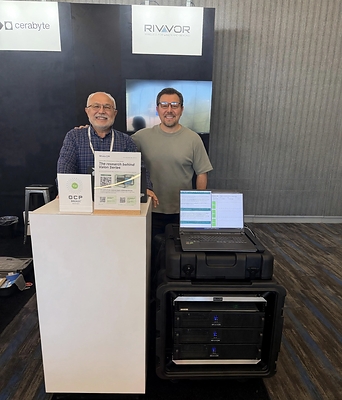
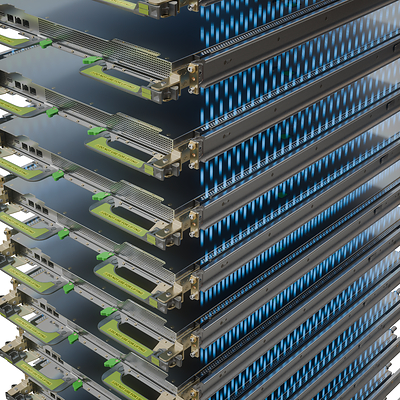
Valen went from concept to working system in 11 months, and the team fielded questions from hyperscalers, networking companies, and data center operators.
Why cables are the bottleneck
Power, cooling and interconnect now compete for the same space inside AI systems. Every high-speed link adds cables, connector fields, and mated interfaces that take up space, slow service, and lock network topology to the hardware.
Wireless scale-up networking for AI inference
Valen replaces the cables between blades with wireless corridors, so topology becomes software:
- Scale-up without cables. Blades connect through mmWave corridors inside the rack.
- Software-defined topology. Connections change in software to match inference workloads.
- More bandwidth, no extra cables. More corridors add capacity without cable volume.
- Built to work alongside copper and optics. Wireless links add paths where cables run out of headroom.
- Designed to route around congestion. Software shifts traffic onto open corridors when cabled paths saturate.
Valen Edge Series specs: what ran at OCP
Spec | Valen today (3-blade system) |
Blades | 3 AMD Ryzen blades, 128 GB RAM each |
Interconnect | mmWave wireless corridors, blade-to-blade |
Per-link throughput | 15 Gbps |
Links per blade | 7 |
Aggregate rack bandwidth | 300+ Gbps |
Latency | 250 ns, application memory to application memory |
Cables or connectors between blades | None |
Latency dropped from 1,600 ns round trip in an enclosed rack in June to 250 ns application memory to application memory today, driven by Rivvor's low-latency baseband.
"Cables were never built for how AI needs to scale," said Nazym Paltachev, CEO and Co-Founder of Rivvor. "Eleven months from idea to a live wireless system. Now we take it into the field."
From mmWave to sub-THz wireless interconnect
Valen's mmWave corridors are the first step. Next, Rivvor moves to sub-THz Bounded Electromagnetic Corridors (BEC) in the 100 to 500 GHz range on its own ASIC, designed to scale to 400+ Gbps per link in higher-density systems. Rivvor presented the architecture in its poster "Cable-Free: Bounded Electromagnetic Corridors for Rack-Scale AI Systems" at the OCP Future Technologies Symposium.
"mmWave is where we start, not where we stop," said Timour Paltachev, Chief Science & Product Officer and Co-Founder of Rivvor. "Same corridors, same architecture, orders of magnitude more bandwidth."
Contactless, wire-free compute for physical AI, robotics and space
The same contactless architecture fits anywhere cables limit density, weight, or reliability:
- Physical AI and robotics. No connector wear, and modules are simple to swap, including by robots.
- Space and orbital compute. Less cable mass at launch and no mated connectors to fail in orbit.
- Rugged and expeditionary edge. Nothing exposed to dust, sand, or vibration in field operations.
- AI data centers. Denser racks with more room for power and cooling.
"Every connector is a point of failure," said Konstantin Tiutin, CTO and Co-Founder of Rivvor. "Valen has none between its blades. Change the mission, change the connections."
See Valen live at Rivvor's Demo Night on November 12, 2026, at TBS Design Gallery in Santa Clara: rivvor.com/events.
About Rivvor
Founded in 2025 and headquartered in Roseville, California, Rivvor builds wireless interconnect platforms for AI data centers, corporate HPC, and edge compute, from today's mmWave corridor systems to sub-THz Bounded Electromagnetic Corridors. The company was co-founded by Nazym Paltachev, Timour Paltachev (AMD, DOE exascale programs), and Konstantin Tiutin. Rivvor is a member of the Open Compute Project.
SOURCE Rivvor, Inc.





Share this article