


The AI Boom's Biggest Data Centers Are Betting on One Company to Help Guard the Door
More than half of U.S. hyperscale data centers now rely on one company to guard their doors — and most Americans don't know the risk it's solving.
CUPERTINO, Calif., Sept. 3, 2026 /PRNewswire/ -- In an industry where NDAs keep vendor relationships quiet, Alcatraz AI is disclosing a number few physical security companies ever get to claim: more than half of the roughly 17 hyperscale data center operators headquartered in the U.S. now use its facial authentication platform, the Rock, to secure physical access to their facilities. The companies spending the most on AI infrastructure, and standing to lose the most from a breach, have converged on the same vendor to guard the door.
Alcatraz closed a $50 million Series B in April 2026, bringing its total funding to more than $100 million. The company closed out 2025 with triple-digit growth: 300%+ year-over-year growth in data center adoption, 200% growth in new enterprise customers, and a fivefold expansion across Fortune 500 deployments. More than 4 million people now authenticate through Alcatraz's platform.
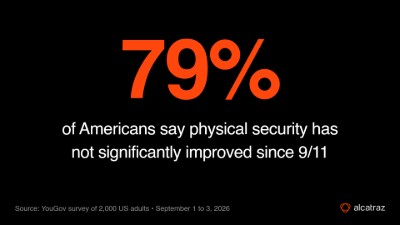
Cybersecurity has absorbed billions of dollars in investment over the past two decades, accelerating further after 9/11 redefined what "critical infrastructure" meant to American companies. Physical security didn't get the same consideration. A majority of office buildings still rely on the same badge and key-card technology from the 1990s. The first independent U.S. study measuring public awareness of tailgating finds that 58% of Americans have never heard the term used to describe an unauthorized person following someone else through a secured door or turnstile. Tailgating is the breach Alcatraz's technology is built to solve.
"Every company in America spent a decade locking down the network. We never locked down the door. How is it possible that 25 years after 9/11, most security still relies on a card or badge — a 30-year-old piece of technology? This study confirms what security directors already know: unless we upgrade the technology and make doors intelligent, buildings stay vulnerable."
— Tina D'Agostin, CEO of Alcatraz AI, who previously helped shape physical security and technology efforts for Chase Center and Salesforce Tower while at Johnson Controls, a $23.6 billion company and the global leader in physical security solutions
WHY THIS MATTERS FOR AI INFRASTRUCTURE SPECIFICALLY
The average cost of a data breach is $4.44 million globally, rising to $10.22 million in the United States, according to IBM's 2025 Cost of a Data Breach Report — driven mostly by downtime, reputational damage, and the cost of winning back or replacing clients, all outcomes a physical intrusion can trigger just as easily as a network breach. That exposure is what's pulling hyperscale operators toward a single standardized vendor rather than a patchwork of legacy access-control systems: badge and card readers can log who entered, but not who followed behind them.
"Hyperscale operators are among the top tech companies in the world. Of the roughly 17 hyperscale operators headquartered in the U.S., Alcatraz has signed over half of them and has rapidly become the standard to secure access to their facilities. While I'm prohibited from naming our clients, they include the largest tech companies in the world."
— Greg Sarrail, Senior VP, Alcatraz AI
"Data centers use Alcatraz because the cost of a data breach is extremely high, so they have to deploy the best technology available for access control," Sarrail said. "One tech giant tested Alcatraz alongside a dozen other technologies over four years. After rigorous testing, they chose only Alcatraz." Preventing unauthorized access is especially critical for data centers that provide co-location services, housing multiple clients within a single facility, Sarrail said: "They need to ensure the right people have entered the right spaces — not just the right building, but the right data halls, the right server racks — with an auditable record of who touched what and when, because the cost of a breach is just too high."
WHAT THE TAILGATING STUDY FOUND
The findings suggest the market has moved faster than public understanding of the risk it's solving:
- 58% of Americans have never heard the term "tailgating" used to describe this kind of breach.
- 76.8% of Americans either don't believe secured buildings can reliably detect an unauthorized entry (50.3%) or aren't sure (26.5%).
- Only 12% of Americans think a building's technology or access control system bears primary responsibility for stopping an intruder, versus 47% who still assume it's a person on duty — a mismatch with where AI infrastructure security budgets are actually being spent.
- 13% admit to sharing a badge, key card, or access code — the physical-world version of password sharing.
HOW IT WORKS
Badge and card systems are blind and binary: a valid credential opens the door, and the system's job ends there. It has no way to tell whether the person walking through is the one who badged in, or someone who simply followed a step behind. Alcatraz's facial authentication platform, the Rock, is built to close that gap without the privacy trade-off usually associated with biometrics.
That trade-off is also why hyperscalers, airports, and nuclear and energy operators — the environments with the least tolerance for error — have moved toward Alcatraz's approach and away from iris scanning, long considered the highest-security biometric standard. Iris recognition requires a person to stop and align themselves with a scanner. It works by capturing and storing a unique biological identifier, a form of personally identifiable information that itself becomes a target if breached. Alcatraz authenticates at walking speed but it doesn't store a photograph or a biometric template, matching the security bar the highest-stakes facilities require without the friction or the data-retention risk.
"Most access control reliant on badge or card technology is blind and binary: it only opens a door. It's completely unintelligent. Alcatraz harnesses AI technology to make the door intelligent without compromising employee privacy. The Rock recognizes whether someone belongs or doesn't. It provides real-time alerts to catch tailgating, and tells security personnel when and where a breach has occurred. Most importantly, our patented technology means employees are 100% anonymous — that's what distinguishes it from every other biometric on the market. This company was founded to safeguard employee privacy."
— Tina D'Agostin, CEO, Alcatraz AI
The platform installs alongside existing access control infrastructure rather than replacing it, and is operational on day one. No personal identification information, such as date of birth or address, is stored.
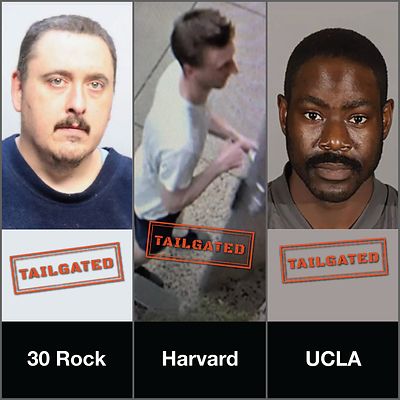
This summer's highest-profile physical security failures — unauthorized breaches at Harvard, UCLA, and 30 Rockefeller Center — all trace back to the same mechanism measured in this study: a valid credential, and no way to detect who followed behind it. The stakes are high whether the door leads to a dorm room or a data center floor.
ABOUT ALCATRAZ AI
Alcatraz is an AI-powered physical access control company headquartered in Cupertino, California. Its flagship product, the Rock™, replaces badge-based and legacy biometric security with fully anonymized facial authentication and real-time tailgating detection.
Alcatraz AI is trusted where security standards are highest and certifications hardest to earn: hyperscale data centers, financial institutions, airports, and nuclear and energy infrastructure. Its technology protects professional sports teams from the NBA to the NFL, Fortune 100 companies, universities, stadiums, and private individuals. The company closed a $50 million Series B in April 2026, led by BlackPeak Capital, Cogito Capital, and Taiwania Capital, bringing total funding to more than $100 million.
Privacy First. Last. Always.
MEDIA CONTACT
Bio_Tina D'Agostin_CEO-Alcatraz.pdf
SOURCE Alcatraz




Share this article