


Theia Helps Advance North America's First Evaluation of Vendlet Patient-Handling Technology
Theia3D's markerless motion capture platform, widely used across the biomechanics community, is helping researchers assess whether assistive patient‑handling tools can ease caregiver strain and improve safety
TORONTO, Aug. 11, 2026 /PRNewswire/ -- Theia, the leader in markerless motion capture, today announced that kinesiology researchers in New Brunswick, Canada, are using Theia3D, its AI-powered markerless motion capture platform, to evaluate a patient-handling system that helps caregivers safely reposition patients in bed while reducing the physical demands of one of healthcare's most demanding tasks.
The project is led by Dr. Michelle Cardoso, Research Chair at the Université de Moncton, and Dr. Wayne Albert, Dean at the University of New Brunswick. Their team is the first in North America to evaluate the Vendlet system, a powered patient repositioning system that uses motorized side rails and specialized sheets to gently turn and reposition patients in bed, reducing the physical demands of manual patient handling. Already used throughout Europe and other international markets, the Vendlet system has the potential to improve both caregiver safety and patient comfort. The Occupational Biomechanics Lab / Laboratoire de performance occupationnelle currently houses the only Vendlet system available for research in North America.
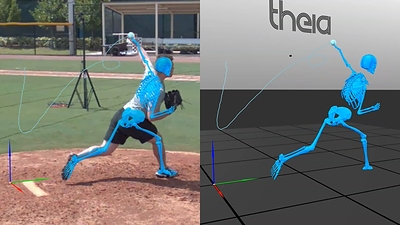
The work marks Theia3D's newest application in patient care, building on its established role in biomechanics research and sports movement analysis by expanding into one of healthcare's most physically demanding workflows. Drs. Cardoso and Albert are using Theia3D markerless motion capture to compare manual patient handling with and without the Vendlet system across nearly 550 laboratory-based trials involving simulated patients. Using artificial intelligence and standard video cameras, Theia3D captures and analyzes full-body movement without the markers or sensors traditionally required for biomechanics research, allowing researchers to efficiently measure caregiver movement during complex patient-handling procedures.
On June 25, ResearchNB, joined by representatives from the Research & Productivity Council (RPC) and the New Brunswick Continuing Care Safety Association (NBCCSA), visited the lab to meet with Drs. Cardoso and Albert. Together, the team discussed the development of a bracket system designed to make the Vendlet compatible with North American medical beds and explored opportunities to pursue patent protection for the design.
"Theia3D is giving healthcare researchers a clearer view of how caregivers move during physically demanding patient‑handling care," said Marcus Brown, CEO, Theia. "By capturing complex caregiver movement at scale, we're helping advance the scientific understanding of patient handling and providing evidence that can inform future approaches to caregiver safety and workforce sustainability."
Patient repositioning remains one of the most physically demanding responsibilities in healthcare. Studying these movements has traditionally been difficult because caregivers, patients, and medical equipment interact in close contact. Previous marker-based motion capture approaches required approximately 72 markers on a caregiver, 15 markers on a simulated patient, and an additional 8 to 10 markers on the bed, creating substantial setup, tracking, and processing challenges.
"While we've previously relied on traditional marker-based motion capture to study patient handling, this technology allows us to analyze these movements more naturally and has the potential to bring motion analysis into real-world clinical settings," said Dr. Cardoso. "Without the need for reflective markers, we can collect and process data much more efficiently, reducing both experimental setup and data processing time."
"Theia3D allows us to objectively measure how caregivers move while repositioning a patient, whether the task is performed manually or with an assistive technology," said Dr. Albert. "These measurements provide the evidence we need to evaluate new technologies and determine which approaches can reduce the physical demands placed on caregivers."
The research comes at a time when caregivers are facing mounting pressures across North America. Canada now has fewer than 2.5 hospital beds per 1,000 people, contributing to long ER waits and "hallway medicine" in both Canada and the U.S. as hospitals operate at or above capacity. At the same time, caregivers across hospitals and long-term care settings experience some of the highest rates of work-related musculoskeletal injuries, driven in large part by the physical demands of patient/resident handling. These system-level challenges only heighten the need for evidence-based tools that support worker safety and well-being while improving the quality of patient/resident care. The researchers shared preliminary findings from the laboratory-based trials at the 2026 World Congress of Biomechanics in July. The findings indicate that, compared with trained manual patient-handling techniques, use of the Vendlet system was associated with more neutral caregiver postures, lower joint and spinal forces, reduced cumulative loading, and lower perceived discomfort and effort during simulated patient-repositioning tasks. Drs. Cardoso and Albert will continue to share their findings with the scientific community through future presentations and publications.
While this project focuses on healthcare, organizations such as the NBA use Theia3D to analyze athlete movement and improve performance. Its use in this project demonstrates how sports-proven motion capture technology can be successfully applied to broaden healthcare research and improve patient care.
About Theia
Theia is a leader in AI-powered markerless motion capture, transforming video into precise 3D biomechanics insights without markers, wearable suits, or specialized sensors. Built on decades of scientific research, Theia's technology enables researchers, clinicians, sports organizations, and industry leaders to accurately measure and analyze human movement in real-world environments. Trusted by leading institutions worldwide, Theia is advancing the understanding of biomechanics across healthcare, rehabilitation, sports performance, ergonomics, and human movement research.
Learn more at www.theiamarkerless.com.
See Media Kit HERE.
Media contact:
Dwain Schenck
E: [email protected]
M: 203-223-5230
SOURCE Theia




Share this article