


WSSA and APMS Collaborate to Advance Aquatic Weed Management
An overlap in leadership boosts synergistic progress in aquatic weed control initiatives
WESTMINSTER, Colo., Sept. 15, 2026 /PRNewswire/ -- The Weed Science Society of America (WSSA) commends the Aquatic Plant Management Society (APMS) for its recent and ongoing initiatives to research and manage aquatic plants, and for its successful collaboration with WSSA member scientists to manage and control aquatic weeds. The APMS is a WSSA affiliate society with many members that belong to both organizations.
This summer, the APMS convened its 66th Annual Meeting in Phoenix, Arizona (July 13-16). During the meeting, Ramon Leon, Ph.D., NC State University, was awarded the APMS T. Wayne Miller Distinguished Service Award for his efforts to convert the Journal of Aquatic Plant Management (JAPM) from print-only to open-access digital publication. Dr. Leon is the JAPM Editor, an APMS Board member and WSSA member scientist. Another WSSA member, Chris Mudge, Ph.D., U.S. Army Corps of Engineers, was also recognized at the APMS conference. Dr. Mudge earned the top research award for the society, the APMS Outstanding Research Contributor award, for his efforts to advance aquatic plant management initiatives to protect water resources in the U.S.
Four other WSSA member scientists now serve in top APMS leadership roles. Lyn Gettys, Ph.D., University of Florida, serves as Past President, and Gray Turnage, Ph.D., Mississippi State University was elected Vice President. WSSA member scientists now also serve as APMS Secretary -- Greg MacDonald, Ph.D., University of Florida – and APMS Board of Directors (BOD) – Mirella Ortiz, Ph.D., Utah State University. In addition, Benjamin Sperry, Ph.D., University of Florida is now on the APMS BOD, having had notable involvement as a WSSA member scientist in previous years.
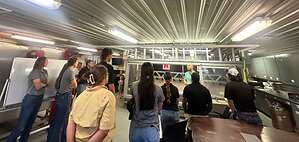
The APMS annual meeting theme this summer was "Water in the Arid Southwest - Policies, Allocation & Ecosystem Challenges." The event attracted 113 individuals who were able to view 41 research presentations and 15 research posters on diverse aquatic management topics, including weed management.
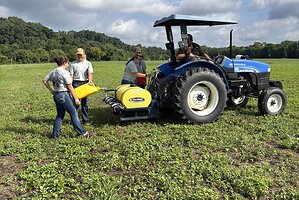
At the meeting, 17 graduate students from eight universities had a unique opportunity to experience some water scarcity and aquatic weed management issues in the Southwest during a visit to the Tres Rios Wetlands. This recently constructed U.S. Army Corps of Engineers (USACE) wetland system serves as an important environmental restoration project that includes rehabilitation of nearly 700 acres in and around the Salt River, creating a vital wetland and riparian habitat for flora and fauna, especially migratory birds. As part of the excursion, students were divided into groups to mark and map the presence of invasive saltcedar (Tamarix spp.) to geolocate weed populations designated for later removal as part of a bird nesting habitat improvement project.
The annual meeting also featured an expert panel discussion entitled: "20 Years of Aquatic Plant Management: What's Changed?" Part of those discussions included the volatility in federal funding for aquatic plant management in recent years, the importance of new technology and research needs, and a general movement towards non-chemical aquatic weed control options in some regions.
Earlier this year, both WSSA and APMS sent leadership to meet with key U.S. agriculture and environmental representatives and legislators in Washington, D.C., to help further the mission for each society. Whether legislative, scientific, or educational, these collaborations will continue this fall and into next year.
"Working with APMS gives us a stronger voice in communicating the funding needs of aquatic weed research and management," says Ian Burke, Ph.D., WSSA President. "Together, we can help decision-makers understand how sustained investment supports the science, tools and next generation of scientists needed to protect our water resources."
For more information about APMS, visit https://apms.org/. For more information about WSSA and its weed and invasive plant management resources, visit: www.wssa.net.
About the Weed Science Society of America
The Weed Science Society of America is a nonprofit scientific society, founded in 1956 to encourage and facilitate the development of knowledge concerning weeds and their impact on the environment. The Society promotes research, education and extension outreach activities related to weeds, provides science-based information to the public and policy makers, fosters awareness of weeds and their impact on managed and natural ecosystems, and strengthens cooperation among weed science organizations across the nation and around the world. For more information, visit www.wssa.net.
SOURCE Weed Science Society of America





Share this article