AI Health Advice Prompts 69% to Schedule or Expedite GI Specialty Care
New Oshi Health survey reveals AI tools prove useful for people with digestive concerns and drive specialist care, with more than two in three stating they moved an appointment earlier or booked one they wouldn't have otherwise
NEW YORK, Nov. 10, 2026 /PRNewswire/ -- New survey data showing that many people living with chronic, disruptive digestive symptoms are relying on artificial intelligence (AI) to augment their care and their clinician relationships. This new data sheds light on how AI-generated health advice is shaping people's beliefs and behaviors, and creating a more informed path to care.
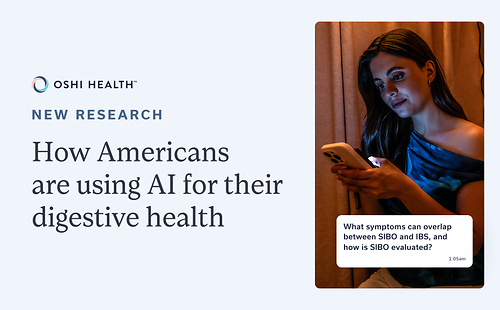
The survey of 285 Americans who use AI for digestive health concerns shows they rely on it for a wide range of needs, often as a convenient digestive health coach, and that privacy is a key reason why many turn to AI first. The results also show that even as people find AI useful, it leads most respondents to human clinicians. Sixty-five percent (65%) said something they learned from AI prompted them to book an appointment, while 69% moved an appointment earlier or scheduled one they otherwise wouldn't have. Forty-five (45%) have used AI to prepare information or materials for an appointment.
These findings follow an August 2026 Pew Research Center survey that showed 34% of Americans have used an AI chatbot for at least one health-related purpose. Taken together, they point to a significant shift in how people navigate healthcare, with AI increasingly serving as the first stop for those trying to understand what their symptoms mean and what to do next.
Still, most still prefer to reach out to a clinician for confirmation and guidance. Nearly three-quarters (72%) believe it is extremely or very important to discuss information from an AI tool with their healthcare provider. A large majority of respondents reported wanting their healthcare provider to act as an AI fact-checker, with 74% citing they prefer a human to verify the accuracy of AI information and more than half (56%) want help personalizing the information to their own bodies.
"AI offers things the healthcare system can't, including immediate expertise and availability at any hour with unlimited patience and no wait time. That makes it incredibly useful for helping someone make sense of what they're feeling, especially with symptoms they may be embarrassed to talk about," said Dr. Sameer Berry, co-founder and chief medical officer at Oshi Health. "But convenience isn't the same as care. Today's models can make mistakes and can miss key nuances in a patients' presentation or history. AI can't yet order diagnostics like imaging studies or prescribe treatment for complex disorders. AI also doesn't take the local nature of healthcare into account, and often fails to understand regional aspects that are relevant to a patient's care."
For Embarrassing Symptoms, AI Offers Guidance and Language
This survey offers a revealing look at why patients are turning to AI. Nearly two-thirds (65%) of respondents said they use AI to research sensitive or private symptoms anonymously, while 44% have used it to share anxiety about their symptoms or seek reassurance.
That willingness to confide in AI makes sense given a longstanding challenge in digestive healthcare: people often don't want to talk about what's happening in the bathroom. Earlier Oshi Health research found that only 45% of Americans were very comfortable discussing their bowel habits with a healthcare provider, while 35% said they often relied on the internet or social media for GI information because they were too embarrassed to talk with a provider.
"There are things people will type into a browser or a chatbot at midnight that they may be embarrassed to say out loud in a doctor's office," Berry said. "AI can give people a definition for what they're experiencing and help them ask better questions. The opportunity is to make sure that the private conversation is the beginning of high quality care."
AI Is Forcing a New Standard of Care
For healthcare providers, the traditional patient journey is changing. Increasingly, patients may arrive at an appointment having already researched their symptoms, considered potential diagnoses, explored treatments, or made changes on their own.
According to the survey, 59% started a new supplement, and 42% adjusted a prescription medication based on advice from an AI tool. Most use AI to self-manage a condition: 86% used AI to understand their symptoms, 60% used it to trace an underlying cause, and 45% used it to identify personal food triggers.
The new standard of care, Berry said, is to expect patients and clinicians are using AI, and to give them an accessible clinical resource that can help put that information into context: "We need to welcome people to use AI for questions about their health – and we need to make it easier for them to get a trusted clinical perspective as well as access to labs, tests, procedures, and prescriptions needed to get them to good health."
That distinction can be especially important in GI care, where similar symptoms can have very different causes and effective treatment often requires looking beyond a single symptom. Diet, medications, stress, sleep, gut-brain interactions, and underlying medical conditions can all contribute to digestive symptoms.
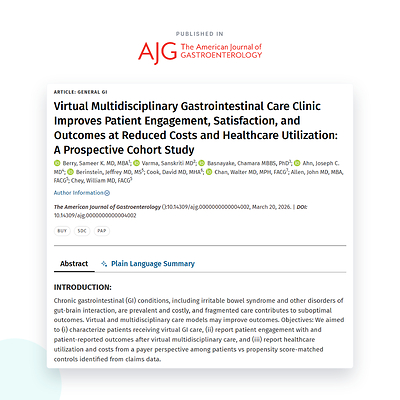
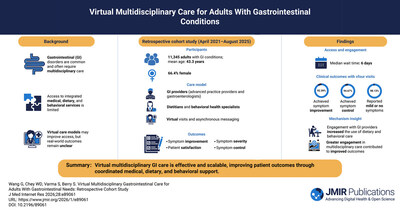
Oshi Health's virtual GI care model brings together GI-specialized clinicians, including medical providers, dietitians and gut-brain health specialists, to evaluate factors together: Diet, medications, stress, sleep, gut-brain interactions, and underlying medical conditions can all contribute to digestive symptoms. As patients increasingly enter care with AI-generated information and questions, that multidisciplinary approach can help patients separate useful information from advice that may not fit their medical history, medications, or individual needs.
Survey Methodology: This report is based on an online survey of 285 U.S. adults, fielded using SurveyMonkey in July 2026. To qualify, respondents reported digestive health needs (such as IBS, IBD, GERD, Celiac disease, or frequent symptoms like bloating, pain, or reflux) that were disruptive or very disruptive to daily life in the past 12 months, and they reported using AI tools to research or manage those needs. Respondents were roughly split between men and women, spanned adults 18 and older across all major U.S. regions, and used AI for GI needs at varying frequencies, from less than once a month to several times a week.
About Oshi Health
Oshi Health is the only nationwide multidisciplinary gastrointestinal (GI) medical clinic combining specialized medical, dietary, and gut-brain care proven to get patients better, faster. Available to adults in all 50 states with the convenience of telehealth and in-network with most insurance providers, Oshi's care accelerates the speed to diagnosis and symptom control – significantly improving people's quality of life. To learn more visit www.oshihealth.com.
SOURCE Oshi Health




Share this article