The survey found broad support for a preventive, patient-first approach to medicine:
- 60% say the U.S. healthcare system should prioritize preventing illness, versus 19% who say it should prioritize treating existing illness.
- 54% say decisions about which medications are made legal should be driven primarily by patient health outcomes, versus just 6% who say pharmaceutical-industry investment.
- 74% support the government making preventive treatments easier to access, even if it reduced pharmaceutical-industry revenue.
Awareness, not opposition, is what is missing. Nearly half of adults (49%) say they have heard nothing at all about peptides. While almost no one objects to a legal, prescription pathway, many people simply have not heard the debate yet. Even so, the reach is already real: 5% of adults, more than 13 million people, report that someone in their household has used a compounded peptide in the past three years.
"Americans are clearly asking for safe access to peptides. They're asking for a U.S. pharmacy, a U.S. doctor's prescription, and a U.S. label they can trust," said Ken Underwood, founder of Peppies. "A majority support it, and only 3% of Americans are against it. The FDA is the one body that can make that legal, and this is the public telling them loud and clear what they want: an end to Peptide Roulette."
The findings land against a documented safety backdrop. Peptide compounds placed in the FDA's "Category 2" in 2023 did not lose their audience. Demand moved offshore, with U.S. imports of peptide and hormone compounds from China reaching roughly $328 million in the first three quarters of 2025, about double the year before (The New York Times, citing U.S. customs data). In a May 2026 white paper, the patient-safety nonprofits ECRI and the Institute for Safe Medication Practices (ISMP) reported that testing of grey-market peptide products found purity as low as 5% (as little as 5% of the vial being the labeled peptide), plus arsenic and lead exceeding the toxicity thresholds set for injectable drugs. A 2018 peer-reviewed study measured those metals at up to ten times the limit for injectable drugs, with the arsenic in its more toxic inorganic form (Janvier et al., Talanta, 2018).
Underwood says the risk is in how people are forced to buy. "I'm not a scientist, and I'm not here to tell anybody whether these work or how they work. There are board-certified physicians who call peptides an exciting frontier in medicine. That's for them and the FDA to sort out. My concern is millions of people are buying these right now over a sketchy WhatsApp source, from an online supplier in China they've never heard of, or from somebody's TikTok 'side hustle' that has turned into a million-dollar overnight business; meanwhile, nobody is checking what's in the vial. These aren't reckless American consumers. They just don't have a legal option. That's the part I think we can actually fix."
Peppies is positioning itself to become a trusted national peptide brand if and when the FDA creates a safe, legal U.S. market.
The committee's vote will be advisory and non-binding; any actual change to access would require separate FDA rulemaking, with its own formal public-comment period. This release reflects Peppies' advocacy for a safe, legal regulatory pathway and outcome, not a claim that any specific peptide is safe, effective, or approved. By "safe access," Peppies means legal, regulated access through licensed U.S. providers, not a claim about the safety of any peptide. Peppies does not sell peptides and is not affiliated with the FDA.
See the poll and stay updated. Get the full topline and crosstabs at peppies.com/poll, and sign up at peppies.com/#notify to be alerted the moment the official public-comment window opens.
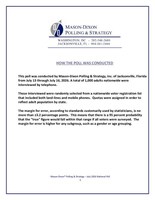
Methodology. The survey was conducted by Mason-Dixon Polling & Strategy, Inc. from July 13 through July 16, 2026, among 1,000 adults nationwide interviewed by telephone, randomly selected from a nationwide voter-registration list that included landlines and mobile phones, with quotas assigned to reflect adult population by state. The margin of error is no more than plus or minus 3.2 percentage points. It was commissioned and paid for by Peppies, LLC. Full topline results, crosstabs, and a downloadable summary are available at peppies.com/poll.html.
About Peppies. Peppies (peppies.com) is an independent, fully-cited consumer-education resource on therapeutic peptides and the U.S. regulatory process, building toward becoming America's first trusted peptides brand. It does not sell, promote, or facilitate the sale of any peptide, makes no claim that any peptide is safe or effective, and is not affiliated with the FDA. Peptides for Life.
SOURCE Peppies, LLC







Share this article