


BIO Asia-Taiwan 2026 to Be Held in Mid-July in Taipei
Focusing on AI Integration to Unlock Opportunities
for Accelerating Commercialization
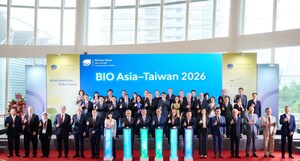
TAIPEI, April 16, 2026 /PRNewswire/ -- The annual event, BIO Asia–Taiwan 2026, jointly organized by Taiwan Bio Industry Organization (Taiwan BIO) and the global Biotechnology Innovation Organization (BIO), will take place from July 15 to 19 at the Taipei Nangang Exhibition Center, TaiNEX 1 and 2. This year's theme, "Asian Inspiration, Global Impact," highlights the integrative power of innovation together with AI to connect Asia with global networks, investment, regulation, and supply chains, creating an international platform to accelerate biotech commercialization.
Three Key Highlights of This Year's Event
BIO Asia–Taiwan 2026 Chairman Johnsee Lee highlighted three major features of this year's gathering. First, showcasing new opportunities for rapid commercialization in the AI era. Second, highlighting Asia's emerging strengths in biomedicine. And third, the expanding contribution from international and academic sectors. He emphasized that the biotech industry's core competitiveness lies in the speed from "bench to bedside", that is, transforming research into clinical treatments, and that AI provides unprecedented integration capabilities to accelerate this process. Accordingly, the conference will feature multiple forums linking research innovation, investment, regulation, and supply chains.
With growing participation from international investors and industry players, this year's event will further expand in scale compared to previous years. Business matchmaking sessions are expected to exceed 10,000 individual meetings, with over 2,200 exhibition booths and participation from more than 20 countries in national pavilions and regional forums. These impressive numbers reflect Asia's rising importance as both a global biotech market and a hub of innovation, enhancing its international visibility.
Recent biomedical-related developments across Asia also highlight regional strengths. For example, results from Taiwan's Precision Medicine Initiative (TPMI) have been published in Nature, drawing global attention. Such achievements will be presented and discussed at this year's conference. To strengthen talent development, the event will also introduce special discounted programs to encourage student participation and foster industry-academia collaboration.
Showcasing Asia's Innovation Strengths to Meet Global Healthcare Needs
Taiwan BIO Chairman Liu Lee-Cheng stated that Asian innovation can address both domestic healthcare goals and global public health needs, and attract multinational pharmaceutical companies facing patent cliffs and pipeline gaps. In Taiwan, companies such as Alar Pharmaceuticals and Pharmosa Biopharm have secured licensing deals worth hundreds of millions of US dollars. A recently approved gene therapy for AADC deficiency developed by NTU Hospital, serves as a model for translating academic research into commercialized therapies. Additionally, Academia Sinica's achievements in precision medicine and proteomics have gained recognition in top-tier journals, drawing global attention.
Integrating Forums to Build an Acceleration Platform
Taiwan BIO Vice Chairman Jo Shen explained that this year's event uses speed as one of its core concepts, integrating the Innovation Forum (technology), Investment Summit (capital and venture building), and Regional Collaboration Forum (regulatory alignment) to create a full lifecycle acceleration platform, from early R&D and clinical trials to manufacturing and market entry. By leveraging AI, CDMO/CRO ecosystems, capital investment, and regulatory harmonization, the time to bring new drugs to market could be shortened by 5 to 7 years, she reported.
The Innovation Forum will focus on five key areas: drug design, preclinical testing, clinical trials, integrated manufacturing and supply chains, and data-driven decision-making, demonstrating Asia's competitive advantage in speed over all facets. Over 100 distinguished speakers will participate, including internationally-renowned glycoscience expert and former Academia Sinica president Chi-Huey Wong; 2013 Nobel Prize laureate Randy Schekman, who uncovered the mechanisms of exosomes; and serial biotech entrepreneur, investor, and philanthropy advocate Rudi Powels.
The Investment Summit will focus on accelerating capital deployment and improving investment success rates, emphasizing venture building models that combine industry and capital. The summit will include cross-border investment discussions, IPO insights, early-stage fundraising, M&A strategies, and other facilitated activities to connect investors with startups.
The conference will also spotlight Taiwan's strengths in exosome applications, bringing together academic, clinical, and industry experts to present the latest developments, establish new standards, and showcase successful commercialization cases, including innovations transforming the cosmetics industry.
Expanding International Participation
This year's Regional Collaboration Forum will be bigger than ever, with last year's participants the United States, Canada, Japan, Australia, Belgium, Switzerland, and India joined this year by Poland, the Netherlands, South Korea, Hong Kong, and Indonesia. Industry associations from various countries will also convene to discuss regulatory alignment, industrial policy, and investment mechanisms to lower barriers for global market entry and enhance Asia's competitiveness.
Chairman Liu added that with coordinated efforts across government, industry, academia, and healthcare sectors, Taiwan's role in the global biotech landscape is steadily rising. Supported by strong policy and industrial foundations, Taiwan is transitioning from a manufacturing and R&D base into an Asia-Pacific hub for biotech innovation and investment. With its growing scale and global recognition, BIO Asia–Taiwan is poised to become one of the world's most important annual biotech events.
Website: www.bioasiataiwan.com
SOURCE Taiwan Bio Industry Organization




Share this article