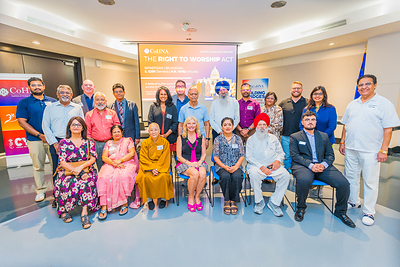
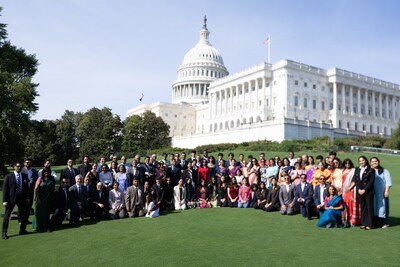
Built around advocacy, education and community building, the conference brought young Hindus together for a day of interactive workshops on addressing misconceptions about Hinduism, public policy and civic engagement, and Hinduphobia on college campuses. Networking activities throughout the day also gave attendees an opportunity to connect with other Hindu youth and exchange experiences from their own schools, campuses and communities.
"We wanted attendees to leave with more than just an awareness of the issues," said Dhyey Ray, executive director of CYAN, who helped organize the conference. "The goal was to give young Hindus practical tools to advocate for themselves and their communities, while also creating a space where they could meet others who care about the same issues."
Check out vignettes from the day. https://www.youtube.com/watch?v=nPiSsg0Xpws
U.S. Rep. Suhas Subramanyam (D-Va.) joined virtually, sharing about his path into public service, Hindu American representation and the importance of remaining confident in one's identity. "I'm proud to be Hindu. I'm proud of being an American," Subramanyam told attendees, urging young people not to hide their identity, but to "embrace it," as he recalled how he was asked to downplay his Hindu background and even change his name, when he first ran for office.
During a Q&A session, Subramanyam also encouraged young people to become involved in public service and civic life, emphasizing the importance of representation.
The keynote address from Shawn Binda, a global Hindu educator and creator of Hindu Lifestyle, began with a central challenge. "Why are you Hindu?" Drawing on his Indo-Caribbean upbringing, Binda framed meaningful Hindu advocacy around three elements: "head, heart, and belonging." Develop the knowledge to understand and explain the tradition, cultivate a personal and emotional connection to Dharma, and build a sense of community across different Hindu backgrounds.
"You also can't always advocate for Hinduism as a reaction to some attack," Binda told attendees. "...That flame will eventually die out. There needs to be something deeper that draws us towards a tradition."
Expert sessions and student-led experiences
Broader conversations about Hindu identity and advocacy were backed up with real-life examples and practical tools young people could apply in their own campuses and communities.
- From the Room to the Record: NCRI analyst & youth advocate Prasiddha Sudhakar discussed why identifying and documenting discrimination matters, drawing on her earlier campus advocacy around a working definition of Hinduphobia and her later research analyzing anti-Hindu hate and disinformation online.
"You can't fight what you can't name," Sudhakar told attendees, adding that "it's important to have a name for discrimination." Her interactive session also asked participants to consider the choices they would make in different situations involving bias and misrepresentation.
- Hinduphobia on College Campuses: Rutgers students Riya Patel and Nikhil Gill solicited participant experiences of religious or cultural misrepresentation in academic settings. Attendees examined real-life Hinduphobic statements in university contexts and discussed their language, assumptions, and emotional impact.
- Common Misconceptions About Hinduism: CoHNA president Nikunj Trivedi and Shawn Binda reviewed Hindu beliefs and practices, highlighting ways young Hindus can approach difficult conversations with greater knowledge and confidence.
- Advocacy and Public Policy workshop:CYAN leaders Shyam Kumar, Anika Ajgaonkar and Mira Trivedi, introduced participants to different methods of creating change, including research and evidence-building, coalition-building, direct engagement with decision-makers, public education, and institutional processes.
Interactive learning
"If you notice problems in your school curriculum or anti-Hindu rhetoric, you can make changes on a small scale," said Ayushi Sharma, a student at Rutgers University. "The step-by-step approach made advocacy feel much more achievable."
Conference participants got to put these principles of advocacy into practice through interactive group exercises modeling commonly found scenarios — including the (mis) representation of Hinduism in school textbooks or the mislabeling of beef-derived ingredients and alternatives in university dining.
"Helping organize this conference gave me the opportunity to connect with other young Hindus who are willing to speak openly about their concerns and work together to address misrepresentation," said Anika Ajgaonkar, a Rutgers University student and member of CYAN. "It was encouraging to see how many different perspectives could come together around a shared commitment to advocacy."
The conference's formal programming concluded with emcees Riya Patel and Nikhil Gill encouraging attendees to carry forward what they had learned, stay connected with fellow participants, and continue their involvement in advocacy through CYAN.
"The conference reflected CYAN's growing effort to provide Hindu youth with opportunities to move from awareness to active civic engagement while building relationships with others confronting similar issues," said Shyam Kumar, founder and president of the CYAN chapter at Rutgers University. "I'm excited to stay involved and continue my journey in advocacy."
About CoHNA
CoHNA is a grassroots-level advocacy and civil rights organization dedicated to improving the understanding of Hinduism in North America by working on matters related to the Hindu community and by educating the public about Hindu heritage and tradition. For more information, please visit https://cohna.org or follow us on X (formerly Twitter), Facebook, LinkedIn and on Instagram.
About CYAN
CYAN (CoHNA Youth Action Network) is CoHNA's youth wing, focused on empowering young Hindus through advocacy, education, and community engagement. For more information, visit https://cyan.cohna.org or follow us on Instagram.
SOURCE Coalition of Hindus of North America








Share this article