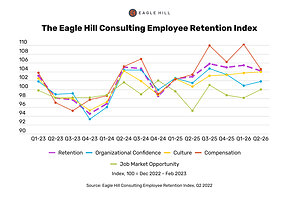
All four Eagle Hill Consulting Retention Index sub-indicators – Culture, Compensation, Organizational Confidence, and Job Market Opportunity – shifted this quarter. The Culture Indicator rose 0.2 points, while the Organizational Confidence Indicator fell 1.3 points. The Compensation Indicator dropped 3.7 points, and the Job Market Opportunity Indicator declined 2.3 points to 98.7, continuing is fourth consecutive run as the weakest performing sub-indicator.
"The Eagle Hill Employee Retention Index tells a compelling story about the close of 2025," said Melissa Jezior, president and chief executive officer of Eagle Hill Consulting. "Despite a typical year-end dip, U.S. workers are entering 2026 more likely to stay with their employers than they were coming into 2025. Employees are anchoring onto the relative stability of their current roles as they see fewer viable or attractive external opportunities. The data indicate that workers are staying because they feel increasingly satisfied with their organizational culture and compensation, as their views of the job market soften."
"But while high retention rates might seem ideal, it could be problematic for employers who made need to downsize their workforce. Also, the tight job market could mask underlying issues if employees are staying out of fear rather than engagement," Jezior added. "As such, this is a critical moment for employers to understand why their people are staying. And with workers more committed to staying, organizations have a prime opportunity to strengthen their talent pipeline, upskill their workforce, and address skill gaps that may have gone unnoticed during high-turnover periods."
The findings follow the latest U.S. Bureau of Labor Statistics (BLS) Job Openings and Labor Turnover Survey (JOLTS) data that revealed that job openings remained unchanged at 7.7 million in October 2025, with both hires and total separations little changed at 5.1 million. Within separations, quits remained steady at 2.9 million and layoffs at 1.9 million. The stagnation in hiring and turnover reflects a labor market where both employers and workers are exercising caution, with workers staying put amid limited external opportunities, a trend that aligns closely with the Eagle Hill Retention Index findings.
Additional key findings Employee Retention Index findings are as follows:
- Internal drivers of retention – Culture, Organizational Confidence, and Compensation – reached multi-year highs throughout 2025, signaling increasingly positive employee attitudes about their day-to-day work experience and long-term prospects within their organizations.
- The Job Market Opportunity Indicator fell 2.3 points to 98.7, remaining the lowest-performing Index sub-indicator for the fourth consecutive period. This marks a shift from prior years, where Job Market Opportunity was often a leading indicator.
- Millennials lead the workforce as the employees most likely to stay in their roles over the coming six months, with a Retention Index of 115.4. Millennials are the only generation to see gains in the Retention Index this period, rising 1.2 points.
- Millennials hold significantly higher Organizational Confidence, Compensation, and Culture indicator scores than all other workforce generations. With Millennials representing a major portion of the workforce, their higher satisfaction and commitment is positive news for organizations positioning top-performing Millennials for leadership roles.
- The Retention Index slightly declined among women, Gen Z, Gen X, and Baby Boomer workers this period, in line with pervious Q4 trends of workers indicated they may be more prone to leave than they were last period.
The Eagle Hill Employee Retention Index is a first-of-a-kind market indicator that tracks worker sentiment across four proven drivers of retention: organizational confidence, culture, compensation, and job market opportunity. The data across the four drivers for the third quarter of 2025 is as follows:
- The Organizational Confidence Indicator measures how confident employees are in their organization's future and leadership. This indicator declined 1.3 points to 103.4.
- The Culture Indicator looks at employee sentiment about their workplace culture, connections, and whether they feel valued and recognized. This measure increased 0.2 points to 103.3.
- The Compensation Indicator measures how employees view their compensation, benefits, and ability to grow their compensation at their organization. This indicator fell 3.7points to 106.2. This decline follows last quarter's historic high.
- The Job Market Opportunity Indicator measures how employees perceive external prospects for employment and job security in the near term. This indicator declined by 3.3 points to 101, reversing its previous increase.
Each month, the Eagle Hill Consulting Employee Retention Index measure shifts in workforce retention based upon ongoing employee opinion surveys on factors related to worker intentions to change jobs. As the Employee Retention Index increases, it signals an increase in retention in the next six months. As the Employee Retention Index decreases, it signals to employers that workers are more likely to leave their jobs, and organizations can expect more turnover in the next six months.
The Eagle Hill Consulting Employee Retention Index is based on a monthly omnibus survey conducted by IPSOS of a nationally representative sample of U.S. adults employed full or part time. Quarterly indices and reports are issued based on a minimum of 1,200 aggregated responses per quarter. Respondents are polled on a range of workforce topics including organizational confidence, culture, compensation, and job market opportunity.
The survey commenced in December 2022 and the most recent data was collected from October – December 2025.
Eagle Hill Consulting LLC is an award-winning business that provides unconventional management consulting services in the areas of Organizational Performance, Business Intelligence, Technology Enablement, Talent, and Change Management. The company's expertise in delivering innovative solutions to unique challenges spans across Fortune 500 companies, government agencies, and global nonprofits. Eagle Hill has offices in the Washington, D.C. metropolitan area, Boston, MA, and Seattle, WA. More information is available at www.eaglehillconsulting.com.
SOURCE Eagle Hill Consulting LLC








Share this article