How American Ambulance Is Using AI to Improve EMS Documentation
EAGAN, Minn., Nov. 10, 2026 /PRNewswire/ -- As the sole ALS provider across Kings, Fresno and Madera counties in California, American Ambulance operates approximately 150 ambulances each day and around 200,000 transports annually. Its crews manage a substantial documentation workload alongside patient care, leading the organization to implement ImageTrend AI Assist to help streamline documentation workflows.
In this environment, maintaining efficient and accurate documentation is critical. Crews often had to manually type detailed patient narratives, revisiting sections to correct spelling, add missing details or rework phrasing. These steps slowed report completion and added friction, especially during high call volumes or long shifts. Maintaining consistency and completeness across fields such as treatment entries also required careful review and follow-up from QA and leadership teams.
Narrative writing was often the most time-consuming part of the process. "The narrative is really the longest time piece because you're sitting there typing it out," said Scott Charlston, American Ambulance's CQI/CQA coordinator.
These pressures created a need for a faster, more efficient way to document patient care without compromising quality.
A Phased Approach to AI Adoption
American Ambulance began implementing ImageTrend AI Assist to support its documentation workflows. Rather than introducing the technology across the organization all at once, Charlston and his team began with a select group of experienced documenters, including supervisors, field training officers and critical care team members. According to Charlston, the phased approach gave the organization time to "gather feedback and build training before rolling it out more widely."
American Ambulance then developed structured training and incorporated it into its quarterly continuing education program, giving crews guidance on how to use the technology effectively.
Two capabilities quickly emerged as particularly valuable: speech-to-text dictation for narrative documentation and image capture for scanning face sheets, medication information and other patient details. Crews primarily used AI Assist to dictate narratives, allowing them to capture patient stories more naturally while reducing manual typing. For Charlston, the ability to dictate a narrative and have the technology produce text with "good grammar" was "really the biggest piece for us."
Faster Documentation, More Complete Data
As adoption grew, American Ambulance saw improvements in the speed, detail and consistency of patient care documentation. Crews could dictate narratives rather than type them manually, helping them complete reports more quickly and with fewer interruptions. Narratives also tended to be longer and more complete, while scanning face sheets and other documents helped crews capture additional information more consistently.
The organization also saw improvements beyond narrative writing. More treatments were documented in structured fields instead of appearing only in the narrative, reducing the need for QA follow-up. Crews consistently identified dictation and image capture as two of the most useful additions to their documentation workflow.
"Using it to dictate the narrative, it saves a ton of time," Charlston said. "If you do it right, you could have a PCR done in just two or three minutes."
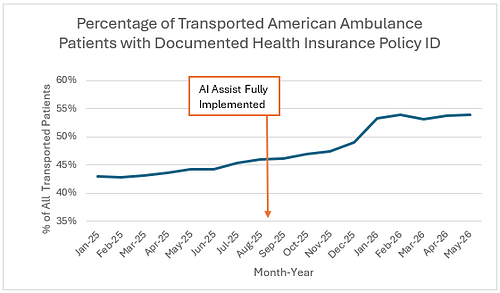
The ImageTrend Research Team also analyzed documentation trends before and after full implementation. The percentage of transported patients with a documented health insurance Policy ID increased from about 43% to about 54%, with a noticeable rise after AI Assist was fully implemented in September 2025. More consistent Policy ID capture can support reimbursement by reducing the need for billing staff to locate missing insurance information later.
AI Assist also became a routine part of the crews' workflow. Its value became especially clear during a recent internet outage, when crews had to return to completing PCRs manually. "That's when you really see the difference," Charlston said.
Expanding AI-Assisted Quality Checks
American Ambulance continues to expand its use of AI-powered tools, including AI-driven review and validation. The team is also rolling out AI-based checks intended to identify missing treatments, inconsistencies and other documentation gaps. For Charlston, one of the most valuable applications is catching a missing treatment and giving crews a way to "check and make sure you're all good."
The organization plans to reinforce usage through training, reminders and ongoing refinement. Charlston emphasizes that successful adoption depends not only on the technology, but also on how it is introduced and supported. American Ambulance remains focused on using AI to reduce documentation burden, improve consistency and support crews without adding complexity to daily work.
Read the full American Ambulance case study to learn more about its implementation of ImageTrend AI Assist.
SOURCE ImageTrend LLC





Share this article