Incheon National University Study Evaluates eDNA metabarcoding for Fish Diversity Assessment
Analysis of 59 datasets shows eDNA excels at detecting fish diversity but remains limited for biomass estimation
INCHEON, South Korea, June 9, 2026 /PRNewswire/ -- Environmental DNA (eDNA) metabarcoding has emerged as a powerful tool for monitoring aquatic biodiversity, enabling researchers to identify fish species from traces of DNA found in water without the usage of invasive techniques on fishes. Though this technique is gaining attraction, it introduces certain biases and uncertainties during various stages, thereby impacting the production of reliable eDNA results. This challenge necessitates the understanding of strengths and limitations of the technique.
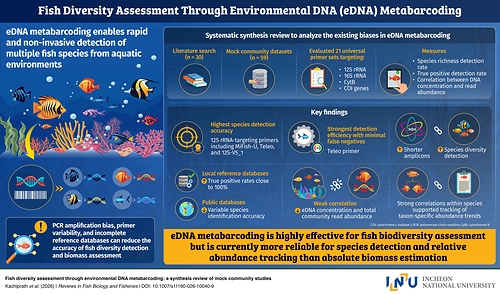
Against this backdrop, in a new synthesis review, Dr. Chang-Bum Jeong, Dr. Bhavya Kachiprath, Mr. In-Cheol Yeo, Ms. Sung-Eun Hong, Ms. Harim Jeong, and Mr. Kyu-Young Shim, all from the Department of Marine Science, Incheon National University, Republic of Korea, evaluated the performance of fish eDNA metabarcoding by analyzing 59 mock community datasets drawn from 30 independent studies. Mock communities are controlled experimental systems in which the exact species composition and DNA concentrations are known, providing a reliable benchmark for testing detection accuracy. The paper was made available online on February 16, 2026, and was published in Volume 36, of the journal Reviews in Fish Biology and Fisheries.
The team assessed how effectively commonly used universal fish primers detected species and whether sequencing read abundance reflected actual DNA concentrations. "One of the most important findings from our research is that eDNA metabarcoding is already highly effective for detecting fish diversity, but its reliability strongly depends on methodological choices such as primer selection and reference database quality," says Dr. Jeong.
The review found that primers targeting the 12S rRNA gene, particularly Teleo, MiFish-U, and 12S-V5_1, consistently achieved strong species detection and accurate taxonomic identification. The researchers also found that studies using locally curated reference databases achieved substantially higher identification accuracy than those relying solely on public databases. These findings highlight the importance of developing comprehensive regional DNA barcode libraries. As eDNA metabarcoding becomes more widely used, improving these databases could significantly enhance the reliability of biodiversity assessments.
"Another important finding from our study was that methodological choices such as Primer selection, amplification bias, and reference database strongly influence study outcomes,"explains Dr. Kachiprath. By identifying and understanding these biases may help researchers produce robust eDNA results and avoid overinterpreting. The researchers also examined whether eDNA metabarcoding could be used to estimate fish abundance and biomass, a capability that could support fisheries management and conservation efforts. While eDNA metabarcoding reliably answers the question of which species are present, sequencing read abundance showed weak relationships with DNA concentration across diverse fish communities, limiting its usefulness in estimating total fish biomass.
"eDNA metabarcoding is currently much better at answering the question 'Which species are present?' than accurately estimating total fish biomass or abundance," says Dr. Jeong.
Despite this limitation, the review identified stronger relationships between DNA concentration and sequencing reads within individual species or closely related groups, suggesting eDNA metabarcoding may still be useful for tracking relative abundance trends in targeted monitoring programs.
The findings could help researchers select more effective primers, improve regional DNA reference libraries, and develop more standardized eDNA metabarcoding approaches. In the longer term, the work may support more reliable biodiversity assessments for fisheries management, conservation planning, invasive species detection, and ecosystem restoration.
Reference
Title of original paper: Fish diversity assessment through environmental DNA
metabarcoding: a synthesis review of mock community studies
Journal: Reviews in Fish Biology and Fisheries
DOI: 10.1007/s11160-026-10040-9
About Incheon National University
Website: https://www.inu.ac.kr/sites/inuengl/index.do?epTicket=LOG
Media Contact:
Jong Jin Lee
82-32 -835 -9325
[email protected]
SOURCE Incheon National University






Share this article