


New Agency Report Shows Early Evidence of Washington State Charter Public Schools Producing Graduates with Better Life Outcomes
Within Seven Years of High School Graduation, Early Trends Point to Charter Public School Alumni with Higher Employment, Salaries and Homeownership than Their Peers
SEATTLE, March 18, 2026 /PRNewswire/ -- A new report, based on a survey commissioned by Agency, Inc. and conducted by The Harris Poll, shows early indicators of success in early adulthood among Washington state charter public school graduates, including being notably more likely to have achieved full or part-time employment, earn higher salaries and own homes within seven years of high school graduation, when compared to their district school peers. While all schools frequently tout standardized assessment data, high school graduation rates and college acceptance rates as evidence of their impact, there is little known about life outcomes for students after they graduate.
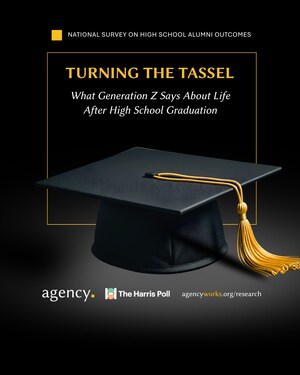
The report, Turning the Tassel in Washington State: Outcomes for Charter School Graduates From 2019–2025, is based on an oversample of 400 Washington public high school graduates, as part of a national survey of 5,000 people who graduated from public schools during this period. An additional survey of more than 1,000 Washington parents provided deeper insights into their priorities and opinions on public education. Together, these surveys reveal important trends to help better understand both life outcomes for young adults and education priorities in the state.
"While the Washington charter sector is still young, it is hard to argue with trends pointing in this direction. The numbers are astounding," said Debbie Veney, Founder and CEO of Agency and author of the report. "It's hard to imagine that any parent wouldn't want their child to attend a school that is likely to produce results like this, and it should be equally hard for policymakers to explain why these exceptional public schools are not more broadly supported and scaled."
Although the number of recent charter school graduates from Washington state who participated in the survey is small (less than 100), the results are still compelling and worth discussion. The results for Washington show promising indicators similar to—if not better than—states with much larger and more mature charter sectors.
Among the key findings:
- 83%** of Washington charter school alumni are working part-time or full-time, compared to 62% of district alumni.
- Employed Washington charter school alumni earn an average of $120,109** per year compared to $76,178 for district alumni.
- 47%** of Washington charter school alumni report owning their home compared to 18% of district alumni.
- 97%** of Washington charter school alumni pursued postsecondary education or training compared to 86% of district alumni.
- 93%** of Washington parents agree they should have a choice in where their child goes to school.
Among Washington state survey respondents who self-identified as Black, Latino, Hawaiian/Pacific Islander and Native American, differences were even more pronounced. Employed charter school graduates from these communities reported earning $132,611** annually on average compared to $69,714 for district peers—a difference of nearly $63,000. It should be noted that Washington charter alumni who reported salary and postsecondary completion outcomes for this report attended the very first charter public schools in the state, which primarily served Latino students. Today's students are more racially diverse, including more White, Black and Asian students.
Charter public school graduates in Washington state were also notably more likely to say their high schools prepared them for life after graduation:
- 97%** said their school encouraged them to break barriers or defy expectations.
- 96%** said their teachers were invested in helping them plan for post-graduation success.
- 93%** said their school helped them understand their options after graduation.
The parent survey revealed strong engagement around education policy:
- 87% of parents pay attention to candidates' education positions when voting.
- 92% want candidates to prioritize better public school options.
- 89% say having more than one type of public school option is a good thing.
"For Washington families, the ability to choose a school that works best for their child isn't political—it's about setting their child up for a successful future," said Chris Korsmo, Executive Director of the Washington State Charter Schools Association. "Washington families value schools that meet the specific learning needs of their children to prepare them for college and career. This report highlights encouraging outcomes for many charter public school grads—relatively high full-time employment, salaries and homeownership—all promising indicators for our young charter school sector and Washington families."
"This report offers an early and encouraging glimpse into what's possible when students have access to schools that are deeply invested in their success, not just through graduation, but into adulthood. While the data is directional, the trends point toward something meaningful: that school quality matters, and that Washington families deserve more of what's working. Excellent schools are one of the most powerful levers we have for expanding opportunity in this state, and reports like this remind us why that work is so urgent," said Julie Kennedy, Executive Director of Excellent Schools Washington.
(**Results in Washington state for charter graduates based on small bases (N=50–99) and should be interpreted as directional only.)
Washington Graduates Method Statement:
The research was conducted online in the United States by The Harris Poll on behalf of Agency, Inc. among 400 U.S. adults in Washington State age 18+ who graduated from public (district or charter) high school within the last 10 years. The survey was conducted September 9–22, 2025. Raw data were not weighted and are therefore only representative of the individuals who completed the survey. Respondents for this survey were selected from among those who have agreed to participate in our surveys. The sampling precision of Harris online polls is measured by using a Bayesian credible interval. For this study, the sample data is accurate to within ± 4.9 percentage points using a 95% confidence level. This credible interval will be wider among subsets of the surveyed population of interest. All sample surveys and polls, whether or not they use probability sampling, are subject to other multiple sources of error which are most often not possible to quantify or estimate, including, but not limited to coverage error, error associated with nonresponse, error associated with question wording and response options, and post-survey weighting and adjustments.
Washington Parents Method Statement:
The research was conducted online in the United States by The Harris Poll on behalf of Agency, Inc. among 1,013 U.S. adults in Washington State age 18+ who are parents or legal guardians of children who are not yet in school, currently in school, or graduated in the past 10 years from school. The survey was conducted October 20 – November 5, 2025. Data are weighted where necessary by age by gender, race/ethnicity, region, education, marital status, household size, employment, and household income to bring them in line with their actual proportions in the population. Respondents for this survey were selected from among those who have agreed to participate in our surveys. The sampling precision of Harris online polls is measured by using a Bayesian credible interval. For this study, the sample data is accurate to within ± 4.4 percentage points using a 95% confidence level. This credible interval will be wider among subsets of the surveyed population of interest. All sample surveys and polls, whether or not they use probability sampling, are subject to other multiple sources of error which are most often not possible to quantify or estimate, including, but not limited to coverage error, error associated with nonresponse, error associated with question wording and response options, and post-survey weighting and adjustments.
The full report, methodology and additional findings are available at www.agencyworks.org/research.
Media Contact:
Jennifer Diaz, agency
[email protected]
813-293-2112
SOURCE Agency



Share this article