


New Research Finds 61% of U.S. Consumers Welcome AI-Assisted Pay Later Recommendations, But on Their Terms
PYMNTS Intelligence report, produced in collaboration with Splitit, reveals that consumers want AI-assisted Pay Later experiences that preserve control, protect credit scores, and work with the credit they already have
The report also finds that more than one in three consumers used card-linked installments in the past three months, compared with one in eight who used BNPL
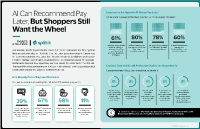
ATLANTA, July 6, 2026 /PRNewswire/ -- Splitit, the global leader in card-linked installment payments, today released findings from new PYMNTS Intelligence research on how artificial intelligence is shaping Pay Later decisions at checkout and across emerging commerce channels. "The Pay Later Ecosystem Report: Consumers Will Let AI Recommend Pay Later, But They Want Control," produced in collaboration with Splitit, finds that 61% of the 2,034 U.S. consumers surveyed would allow an AI shopping assistant to recommend a Pay Later option for at least one common purchase category. Among Gen Z, that number climbs to 80%. That openness comes with clear conditions: consumers want control, transparency, and the final say.
The findings also challenge some of the assumptions that have driven the rapid growth of traditional Buy Now, Pay Later products. Consumers increasingly favor solutions that leverage existing credit relationships rather than require them to establish new ones.
"Our research makes it clear that consumer trust in AI-assisted commerce is real but conditional," said Karen Webster, CEO, PYMNTS. "People are open to AI guidance, as long as they control the final decision. That distinction matters enormously for anyone building payment products, commerce platforms, or AI shopping tools. The companies that succeed will be the ones that use AI to simplify decisions rather than replace them."
"The findings point to fundamental consumer requirements," said Nandan Sheth, CEO of Splitit. "Shoppers with purchasing power are looking for more flexibility with the credit they already have. As AI becomes more integrated into buying journeys and commerce expands beyond traditional checkout, pay-later solutions that require new applications or credit decisions become friction points. Consumers want control, transparency, and affordability. Card-linked installments work within consumers' existing financial relationships rather than asking them to create new ones."
The report spans generations, income levels, and purchase categories. Together, five findings stand out.
Consumers want a guide, not a decision-maker
Twenty-eight percent of consumers say approval before purchase would make them more likely to trust recommendations from AI tools related to Pay Later options.
Just 2% want full automation. The preferred model is guided choice, one where shoppers can review, modify, approve, or reject a recommendation before making any commitment.
Credit score protection is now a baseline expectation
Fifty-nine percent of consumers cite credit score protection as essential when evaluating Pay Later options. That puts it at the top of consumer non-negotiables for AI-selected Pay Later, ahead of the lowest total cost, the most affordable monthly payment, and no new loan opened.
Affordability beats rewards, and credit card installments beat BNPL
Twenty-four percent of consumers say their top priority is finding the lowest-cost extended payment option, compared with 18% who prioritize card rewards programs. When it comes to the preferred Pay Later format, credit card installments outpace traditional BNPL by a margin of three to one: 36% used card-linked installments in the past three months, while only 12% used standalone BNPL.
Life stages matter more than income
Gen Z consumers place greater emphasis on budgeting assistance and credit monitoring, while older consumers use AI for these same tasks at lower rates, and are more likely to reject AI involvement overall. Generation predicts AI use for Pay Later more strongly than income does, with a 15-point spread across age cohorts versus a 4-point spread across income brackets.
Different generations want different levels of AI involvement
Sixty-four percent of Boomers and 40% of Gen X would not be open to AI choosing Pay Later in any category, versus 20% of Gen Z and 22% of Millennials. Gen Z consumers are more comfortable with AI participating in the decision-making process, but still expect a human checkpoint before making any commitment.
Takeaways for merchants, issuers, and fintechs
For merchants, the data suggest that payment flexibility is becoming one of the most important levers for conversion in commerce. As commerce becomes more distributed across mobile, in-store, social, and AI-driven channels, merchants that enable shoppers to use the credit they already have are best positioned to convert demand into completed transactions while maintaining ownership of the customer relationship.
For issuers, the findings reinforce the strategic value of installment products built directly into existing credit card relationships. Rather than ceding customer engagement to third-party lending platforms, issuers can deliver the flexibility consumers want while strengthening loyalty, engagement, and card utilization.
For fintechs, the research suggests that the next phase of innovation may be less about creating new forms of credit and more about making existing credit more flexible, transparent, and accessible.
The future of agentic commerce
As AI-powered systems begin helping consumers shop, compare products, and eventually transact on their behalf, the payment infrastructure supporting those experiences will face the same consumer expectations revealed in the research: no new credit decisions, no application friction, and no unnecessary interruptions.
Splitit has backed Google's Universal Commerce Protocol, the open standard for agentic commerce, reflecting its belief that card-linked infrastructure is a natural foundation for the next generation of AI-driven commerce.
To learn more, read the full report, "The Pay Later Ecosystem Report: Consumers Will Let AI Recommend Pay Later, But They Want Control."
About Splitit
Splitit is the only global installment payments platform that lets shoppers use the credit they already have. By turning card-linked purchases into flexible installments, Splitit gives consumers a simple, transparent way to pay over time, while merchants get paid upfront. Merchants boost conversion and order value, while issuers drive card engagement and strengthen cardholder loyalty — all without third-party brand redirects or added risk. Trusted by leading brands across luxury retail, digital marketplaces, and technology, Splitit is used in more than 100 countries and powers embedded installments inside Samsung Wallet for seamless in-store payments worldwide. Learn more at Splitit.com.
About PYMNTS Intelligence
PYMNTS Intelligence is a leading global data and analytics platform that uses proprietary data and methods to provide actionable insights on what's now and what's next in payments, commerce and the digital economy. Its team of data scientists include leading economists, econometricians, survey experts, financial analysts, and marketing scientists with deep experience in the application of data to the issues that define the future of the digital transformation of the global economy. This multilingual team has conducted original data collection and analysis in more than three dozen global markets for some of the world's leading publicly traded and privately held firms.
Media Contacts:
The Harris Agency
David Resnic or Chrissy Carney
[email protected]
SOURCE Splitit USA, Inc.






Share this article