


Primally Pure Urges Consumers and FDA to Rethink Sunscreen Ingredients
From a regenerative farm to Times Square - how a non-toxic skincare brand is sparking a national dialogue about what's really in your sunscreen.
MURRIETA, Calif., May 26, 2026 /PRNewswire/ -- Primally Pure, the non-toxic skincare brand born on a regenerative farm, is sparking a long-overdue conversation about sunscreen. This summer, the brand is launching "Trust the Sun. Question Your Sunscreen.," a campaign calling for updated ingredient safety standards, independent research, and the kind of ingredient transparency consumers deserve. The initiative poses important questions about common sunscreen ingredients: Why are sunscreen ingredient safety standards stuck in the last century? Why are some of the chemicals banned from oceans and reefs still allowed on our skin? Why are only two of 16 sunscreen ingredients recognized as safe and effective?
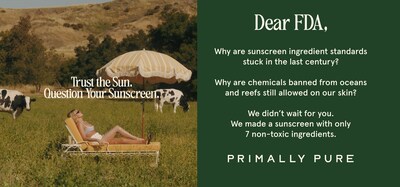
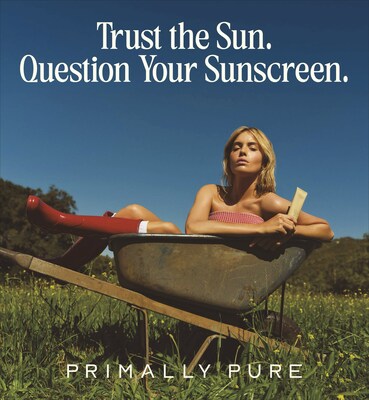
"Consumers are paying attention now," said Bethany McDaniel, founder of Primally Pure. "They're reading labels, asking questions and looking beyond marketing claims. They deserve transparency. They deserve simplicity. They deserve ingredients they can actually trust. This campaign is our invitation to raise the bar for our industry and for regulators."
The campaign aims to shed light on publicly available data that most consumers have never seen. The FDA last materially updated its sunscreen ingredient safety regulations in 1999.i In 2019, the agency found that only 2 out of 16 active sunscreen ingredients had enough safety data to be confirmed safe and effective. More than seven years later, no final public action has been taken, and ingredients the FDA itself could not confirm are safe remain on store shelves nationwide.ii
Also in 2019, the FDA's own funded study, published in JAMA, revealed something striking: oxybenzone, a common sunscreen ingredient, was absorbed into the bloodstream at levels more than 400 times the FDA's threshold for requiring additional safety testing.iii Meanwhile, several of these same chemical filters have been banned from marine environments in Hawaii, the U.S. Virgin Islands, and Palau to protect coral reefs and ocean ecosystems.iv Deemed too harmful for the ocean, but still approved for daily use on human skin.
"We question what's in our food. We question what's in our cleaning products. Parents read every ingredient before they feed their kids," McDaniel said. "All we're saying is: do the same thing with your sunscreen. Even if you never buy ours. Just read the label. Ask if those ingredients have been proven safe. And if they haven't, ask why they're still there."
The backstory of Primally Pure makes the campaign's reach even more striking - from a regenerative farm in Southern California to a billboard in Times Square. The brand didn't start in a lab or a corporate office. It started in Bethany McDaniel's kitchen on Primal Pastures, her family's regenerative farm, where she began making skincare products using tallow rendered from the farm's own grass-fed, pasture-raised cattle, alongside ancestral botanicals and essential oils. Primally Pure has built a growing, devoted following thanks to transparency, non-toxic, natural product formulations, and the brand's refusal to accept industry norms as good enough.
Last year the brand expanded into sun care, sparking immediate controversy. "We hit a nerve when we launched our SPF collection," McDaniel said. "A company that makes non-toxic sunscreen, labeled anti-sunscreen by critics, because we dared to question what's in conventional formulas. That moment told us this conversation needed to be even louder."
Primally Pure isn't just asking questions - it's giving consumers ways to take action. The brand has launched a petition on Change.org calling on the FDA to modernize sunscreen ingredient safety standards, inviting the American public to add their voices to a growing demand for transparency, updated testing, and ingredients that have actually been proven safe. Primally Pure also built a free sunscreen ingredient checker so anyone can look up what's in their sunscreen and decide for themselves. The message is simple: this isn't about one brand or one product. It's about every consumer's right to know what they're putting on their skin and to demand better.
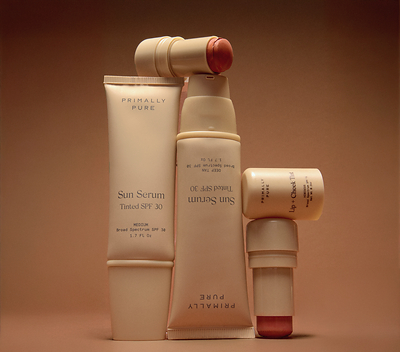
As proof that non-toxic sunscreen is possible, Primally Pure built an SPF collection formulated with less than 10 ingredients. The Sun Cream SPF 30 uses non-nano zinc oxide at 25% - one of only two UV filters the FDA classifies as safe and effective - alongside grass-fed beef tallow, beeswax, coconut oil, mango butter, lavender, and peppermint. No chemical filters. No synthetic fragrance. "We wanted to prove that consumers don't have to choose between real protection and real ingredients," McDaniel said. "Less than 10 ingredients. That's a sunscreen. Everything else is a choice the industry made, not a necessity."
The Trust the Sun. Question Your Sunscreen. campaign is live now. The brand is posing questions directly to the FDA on a billboard in Times Square, publishing an open letter on its website, launching a free sunscreen ingredient checker, and filing a national petition on Change.org. Explore it all or shop the Primally Pure Non-Toxic Sunscreen collection at https://primallypure.com/pages/question-your-spf.
About Primally Pure
Primally Pure is a non-toxic skincare company rooted in ingredient transparency and ancestral practices. Founded by Bethany McDaniel on her family's regenerative farm in Southern California, the brand formulates every product with real, soil to skin ingredients - from grass-fed tallow to wildcrafted botanicals. Primally Pure's Sunscreen collection, body care, skincare, and home lines are available exclusively at primallypure.com.
i U.S. Food and Drug Administration. (1999). Sunscreen drug products for over-the-counter human use; final monograph. Federal Register, 64(98), 27666–27693.
ii U.S. Food and Drug Administration. (2019). Sunscreen drug products for over-the-counter human use; proposed rule. Federal Register, 84(38), 6204–6275.
iii Matta, M. K., Zusterzeel, R., Pilli, N. R., Patel, V., Volpe, D. A., Florian, J., Oh, L., Bashaw, E., Zineh, I., Sanabria, C., Kemp, S., Strauss, R., Serkiz, Y., Nguyen, A., & Narayan, P. (2019). Effect of sunscreen application under maximal use conditions on plasma concentration of sunscreen active ingredients: A randomized clinical trial. JAMA, 321(21), 2082–2091. https://doi.org/10.1001/jama.2019.5586
iv Hawaii State Legislature, Act 104, S.B. 2571 (2018); U.S. Virgin Islands Legislature, Act No. 8185 (2019); Republic of Palau, Responsible Tourism Education Act (2018).
SOURCE Primally Pure





Share this article