


Research Tours Bring Added Value to Annual Weed Contests
WSSA student competitors and contest volunteers boosted learning with after competition events
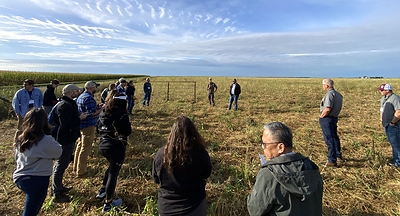
WESTMINSTER, Colo., Aug. 27, 2026 /PRNewswire/ -- Students and volunteers representing North Central and Western affiliates of the Weed Science Society of America (WSSA) were able to tour two, premier agricultural research facilities after extensive competitions in weed science acumen were completed this summer. The two tours helped boost the learning gained from the contest itself.
On July 30, roughly 70 volunteers and 110 undergraduate and graduate students met in Gothenburg, Nebraska, for the 2026 North Central Weed Science Society (NCWSS) and Western Society of Weed Science (WSWS) Weed Contest competitions. The contests tested student knowledge on weed identification, sprayer calibration, and herbicide injury diagnosis, among other practical weed science skills.
Afterwards, on July 31, participants could elect to tour one or two nearby research facilities: the University of Nebraska-Lincoln Precision Application Technology (PAT) Lab, and/or at the Bayer Crop Sciences Water Utilization Learning Center.
"The tours attracted about 55 attendees from NCWSS and WSWS, including several industry representatives," says Milos Zaric, Ph.D., Assistant Professor, University of Nebraska-Lincoln, who helped host the PAT Lab tour. "The tour highlighted ongoing research and extension efforts focused on pesticide delivery across ground applications (conventional and targeted), aerial applications (piloted and non-piloted), and specialty crop sprayers. The tour also addressed how increasing regulatory requirements associated with the Endangered Species Act are shaping future research and extension and collaborative priorities."
The NCWSS and WSWS Weed Contest locations rotate each year to various sites, and this was the first time Nebraska hosted the contest since 2018. This year's event allowed the state to showcase its leadership in agricultural education, notes Rodger Farr, a Bayer Crop Science field agronomist and one of the event's organizers, and tour host.
"The Bayer Crop Science Water Utilization Learning Center tour highlighted the diverse research Bayer is conducting on the Great Plains," he says. "Visitors learned about the multiple different crops that Bayer produces and is developing, from corn and soybeans to cotton and emerging biofuel crops. Additionally, visitors also learned about Bayer's new VyconicTM soybean that is resistant to five different herbicides that will be commercially launched soon as well as Bayer's current and future generations of short-statured corn hybrids."
The tour also addressed careers in industry as a whole, the need for multi-disciplinary knowledge and how weed science provides an excellent base for that necessary knowledge, adds Farr. "Participants gained a better understanding of the wide scope of research and development done by Bayer outside of herbicides, including germplasm, cropping systems, fungicides, and environmental stewardship. Students also learned more about how careers in industry can be varied and may not be directly related to their field of study at face value, while also highlighting the importance of a weed science background and participating in events such as the weed contest."
Showing how various agricultural research disciplines ultimately tie together can promote even greater progress in the discipline of weed science itself, notes Farr. "This information is important for improving weed control by helping students understand complexities of biological systems and how disciplines outside of weed science are necessary to understand the entire system," he says. "By better understanding the entire system, better weed management recommendations and decisions can be made that are tailored to the economics and environmental constraints of each situation."
Zaric concurs. "Participants gained a better understanding of how application technology can be optimized to improve product efficacy and application efficiency, reduce off-target movement, and safeguard crop safety," he says. "Just as importantly, the tour also encouraged discussion of new collaborative opportunities in research, extension programming, and next-generation student training and professional development."
For more information about WSSA, its regional affiliates, weed contests and events, visit: www.wssa.net.
About the Weed Science Society of America
The Weed Science Society of America is a nonprofit scientific society, founded in 1956 to encourage and facilitate the development of knowledge concerning weeds and their impact on the environment. The Society promotes research, education and extension outreach activities related to weeds, provides science-based information to the public and policy makers, fosters awareness of weeds and their impact on managed and natural ecosystems, and strengthens cooperation among weed science organizations across the nation and around the world. For more information, visit www.wssa.net.
SOURCE Weed Science Society of America




Share this article