


Retirees Are Enjoying Life Amid Health and Financial Uncertainties
New report examines the real-life experience of people who are currently retired
LOS ANGELES, Dec. 18, 2025 /PRNewswire/ -- Four in 10 retirees indicate their enjoyment of life (44%) and happiness (41%) have improved since they retired, according to Retirement Realities: The Experience of Retirees, a survey report released today by nonprofit Transamerica Center for Retirement Studies® (TCRS) in collaboration with Transamerica Institute®.
"Retirement is a major life change. It brings freedom and time for personal pursuits and, unfortunately, it also comes with aging-related health issues and financial constraints," said Catherine Collinson, CEO and president of Transamerica Institute and TCRS. The survey finds encouraging news that two in three retirees (66%) indicate their standard of living has stayed the same, 33% of retirees indicate their general health has declined, while 28% say that their financial situation has declined.
"Retirees are settling into a new chapter in life. However, many departed from the workforce prematurely and, possibly, abruptly," said Collinson. "Most retired before Social Security's Full Retirement Age, which is between ages 66 and 67, depending on the year they were born." More than half of retirees retired sooner than planned (52%) with reasons including employment-related issues (47%) and personal health-related issues (40%). The median age at which retirees considered themselves to be retired is 62.
Enjoyment of life and staying healthy are top priorities
"Retirees are living in the moment. They have a strong sense of purpose, and they are focusing on what matters most," said Collinson.
The survey findings highlight that retirees are:
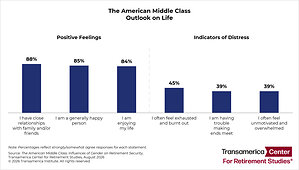
- Embracing happiness. Almost nine in 10 consider themselves to be a generally happy person (89%).
- Prioritizing what is important to them. More than two in three retirees cite enjoying life (70%) and being healthy and fit (67%) as their top priorities in life.
- Spending their time in meaningful ways. With regard to how they are spending their time, almost six in 10 retirees indicate they are spending more time with family and friends (59%), while roughly four in 10 are traveling (44%) and pursuing hobbies (39%).
- Safeguarding their health. Seventy-five percent of retirees are concerned about their health in older age. Most are taking care of their health by seeking medical attention when needed (75%) and getting routine physicals and health screenings (71%) which top the list of healthy activities they are engaging in on a consistent basis.
Financial fragility is common among retirees
"Having given up employment and the income that comes with it, retirees have limited financial resources," said Collinson. "Retirees are especially vulnerable to economic uncertainty, inflation, rising health care costs, market volatility, and other factors that can easily erode their buying power."
The survey findings illustrate retirees' financial situation:
- Only one in four retirees (27%) is very confident they will be able to maintain a lifestyle they consider comfortable throughout their retirement.
- Retirees are living on limited income. Retirees have an annual household income (HHI) of $63,000 (estimated median) as of late 2024. Almost six in 10 retirees (58%) fall within the "middle class" which TCRS broadly defines as an HHI range of $50k up to $200k. Thirty percent of retirees have an HHI of less than $50k, compared with only 9% who have an HHI of $200K or more.
- Social Security is the main source of income for many retirees. When asked about their primary source of income throughout their retirement, more than half of retirees cite Social Security (53%). Twenty-one percent of retirees expect their primary source of income to come from personal savings, including 401(k)/403(b)/IRAs (11%) and other savings and investments (10%). One in five retirees cite a company-funded pension plan as their primary source of income (20%).
- Some retirees risk running out of savings, and some have no retirement savings. As of late 2024, retirees have saved $126,000 in total household savings excluding home equity (estimated median). One in 10 retirees (12%) have no savings, 25% have saved $1 to less than $100k, 18% have $100k to less than $500k, 12% have $500k to less than $1 million, and 17% have $1 million or more.
"Many retirees are getting along and living within their means, but they may have difficulty withstanding a costly financial shock, for example, the need for long-term care," Collinson.
Declining health and the potential need for long-term care loom large
"A reality of growing older is that our health and abilities may decline to the point that we need help with daily activities. For retirees, this possibility is becoming more real as time goes by," said Collinson.
The survey findings reveal retirees' fears and how they could address them:
- Retirees are worried about the potential need for long-term care. Four in 10 retirees (41%) cite declining health that requires long-term care as one of their greatest retirement fears. At least three in 10 retirees fear losing their independence (36%), cognitive decline/dementia/Alzheimer's disease (32%), and possible long-term care costs (30%).
- Few retirees are very confident they can afford long-term care. Only 15% are very confident, while 41% are somewhat confident, 24% are not too confident, and 20% are not at all confident.
- Almost half of retirees envision leaning on family and friends to serve as their caregivers. When asked about their plans for receiving long-term care, 47% of retirees say they plan to rely on family and friends, including their spouse (30%), family members (26%), and friends (5%). Twenty-eight percent plan to move to an assisted living community, and 25% would use a professional paid in-home caregiver. Three in 10 retirees (30%) do not have plans for receiving long-term care.
"One of the most important things retirees can do is plan for long-term care in older age, by starting a dialogue with family and researching the available options and associated costs," said Collinson. "Especially today, amid the increasing demand for long-term care services and the skyrocketing cost of care, it is far better to proactively plan versus procrastinate until there's a crisis when emotions are running high and options are limited."
Retirees' experience can inform future generations
"Retirees have a wealth of life experience, perspectives, and lessons learned that can help younger generations as they save, invest, and plan for retirement," said Collinson.
Reflecting on their working years, retirees offer these pearls of wisdom:
- 72% feel they did as much as they could to prepare for retirement.
- 65% wish they had been more knowledgeable about retirement saving and investing.
- 48% would like to have received more information and advice from their employer on how to reach their retirement goals.
- 44% waited too long to concern themselves with saving and investing for retirement.
- 43% said debt interfered with their ability to save for retirement.
- 41% agree that they should have relied more on outside experts to monitor and manage their retirement savings.
"Achieving a secure retirement is the culmination of a lifelong journey of learning and growing personally and professionally, working, saving, investing, and safeguarding our health. Our daily decisions combined with longevity planning can position ourselves for success," said Collinson. "At the same time, Americans need policymakers to future-proof our retirement system and ensure the sustainability of safety nets, such as Social Security and Medicare, so that everyone can retire with peace of mind."
Retirement Realities: The Experience of Retirees is part of TCRS' 25th Annual Retirement Survey, one of the largest and longest-running surveys of its kind. The report examines the health and well-being, personal finances, and life experience of retirees. It provides detailed survey findings and offers recommendations for retirees and policymakers. Along with other recent reports featuring retirees, Retirement Throughout the Ages: The American Middle Class and Social Security: The Cornerstone of Retirement Income, the report can be downloaded at www.transamericainstitute.org. Follow on LinkedIn, Facebook, and X @TI_insights and @TCRStudies.
About Transamerica Center for Retirement Studies
Transamerica Center for Retirement Studies® (TCRS) is a division of Transamerica Institute®, a nonprofit, private operating foundation. TCRS conducts one of the largest and longest-running annual retirement surveys of its kind. The information provided here is for educational purposes only and should not be construed as insurance, securities, ERISA, tax, investment, legal, medical, or financial advice or guidance. Please consult independent professionals for answers to your specific questions. www.transamericainstitute.org
About the 25th Annual Transamerica Retirement Survey
The analysis contained in Retirement Realities: The Experience of Retirees was prepared internally by the research team at Transamerica Institute and TCRS. It is based on an online survey conducted within the U.S. by The Harris Poll on behalf of Transamerica Institute and TCRS between September 11 and October 17, 2024, among a nationally representative sample of 10,009 adults including 2,690 people who are retired. Data was weighted where necessary for age by gender, race/ethnicity, region, education, marital status, household size, household income, and smoking status. Respondents were selected from among those who have agreed to participate in our surveys. The sampling precision of Harris online polls is measured by using a Bayesian credible interval and the worker sample data is accurate to within ±1.2 percentage points using a 95% confidence level. This credible interval will be wider among subsets of the surveyed population of interest. Percentages are rounded to the nearest whole percent.
Media contact: Kyle Moschen
[email protected]
SOURCE Transamerica Institute






Share this article