


Dictation has spent a decade getting better at hearing. The next leap is getting it to understand where your words are going.
Loqua, the context-aware voice typing tool, today launches its official release for Mac and Windows — with multimodal capabilities in active development. Early users can get started free at theloqua.ai.
WILMINGTON, Del., July 15, 2026 /PRNewswire/ -- For years, voice typing was judged on one question: can machine hear you correctly? On that question, the industry has essentially won. Whisper-class speech models, paired with large language models that strip filler and fix punctuation, now transcribe clean speech at near-human accuracy.
And yet most people still type. That gap — between solved transcription and unused dictation — is the most interesting problem in the category, and it's the one we set out to close at Loqua. It has almost nothing to do with hearing.
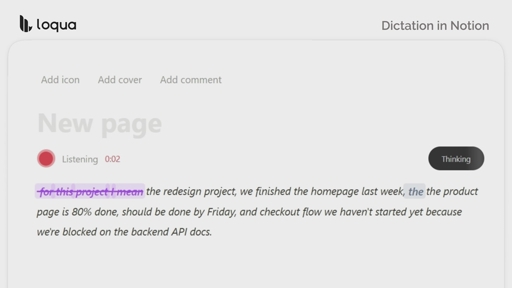
The truth the benchmarks hide is this: a transcript can be perfectly accurate and still be completely wrong.
The same words mean different things in different places
Say "add a guard before fetch profile." In a code editor, it should respect the identifier fetchProfile and read as a code-adjacent instruction. In a tracker like Linear, it should become a task with an owner. In Slack, it should become a plain sentence. One identical sound, three correct outputs.
Audio alone cannot choose between them. A speech model answers one question — what words did the user say? — but dictation depends on a second question audio can't reach: what should those words become, right here, at this cursor?
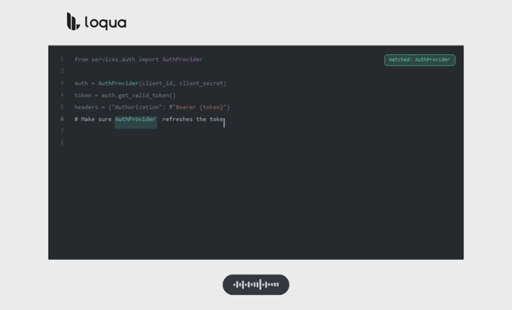
The failures are ordinary, not exotic. "Cache the auth client" and "cash the auth client" are acoustically identical; only the file type tells you which is meant. You say "fetch profile," and the function on the page is fetchProfile — a transcript hears two lowercase words, but the symbol matters. "Replace this with a guard clause" is useless until you know what "this" points to. A louder microphone fixes none of these.
The fix isn't a bigger microphone. It's a pair of eyes.
At Loqua, we build voice typing for the desktop, and we became convinced the next advance was multimodal — voice plus vision. Not a machine that watches everything you do, but a listener that sees the small slice of screen its words are about to land in.
Loqua takes three local signals the moment you speak. The audio path proposes what was said. A context path reads where the text will land — the active app, the field type, selected text, the tokens around your cursor. An app path adds the destination's rules: code syntax, Markdown, or plain prose. All three shape the words before a single character appears. When signals disagree, Loqua trusts the harder evidence and lowers confidence rather than inventing it.
On modern desktops this is practical, not theoretical, because the hardware is already there. Loqua runs on-device, using each platform's native acceleration to keep end-to-end latency near 200 milliseconds — fast enough that the first words appear while you're still talking, and unaffected by hotel Wi-Fi or a plane.
Powerful enough that it needs a boundary
A listener that sees your screen may observe your code, your messages, your drafts. So the line is drawn in the architecture, not the marketing. Loqua understands your current writing context in real time — the active app, input field, and a small amount of text near your cursor — used only to make this moment's expression feel more natural in context. Loqua doesn't OCR remote content, summarize windows you aren't typing in, or keep a visual history.
Context awareness isn't unique to Loqua. Some tools already use it to varying degrees. The honest distinction is depth — Loqua goes deep on the desktop, making stronger assumptions about your editor, your IDE, and the apps you actually work in all day.
From hearing to understanding
Voice typing is graduating from a transcription problem to a destination problem. Hearing the words is no longer the hard part. Knowing what they should become when they arrive is. That's the leap Loqua is built around: not voice that hears you more clearly — voice that sees what you see, and writes what you meant, where you meant it.
*Loqua is a context-aware voice typing tool for Mac and Windows, built for people who work on a desktop all day. Performance figures are internal benchmark and dogfooding numbers, not a third-party bakeoff. Free to start, at theloqua.ai.
Media Contact:
[email protected]
SOURCE Loqua

Share this article