


According to Farmers Insurance®, Hail Claims Rise During Spring Storm Season--Important Home and Car Coverage Details to Review
Drawing on claims experience, Farmers Insurance highlights key home and car coverage details to review as hail damage represents a meaningful share of claims activity across homes and cars.
WOODLAND HILLS, Calif., May 13, 2026 /PRNewswire/ -- Farmers Insurance claims experience consistently shows a seasonal increase in hail‑related losses during the spring. As storms become more frequent this time of year, the insurer is sharing hail preparation insights to encourage consumers to review coverage for homes, cars and recreational property—including boats and motorcycles—before severe weather strikes, including a few key coverage details that can significantly impact how a claim is handled.
"Many homeowners may not be fully aware of how their homeowners insurance policy would cover roof damage caused by hail," said Bobby Massey, Head of Catastrophe Claims at Farmers Insurance. "Our goal is to help customers feel informed and supported before they ever need to file a claim, because reviewing a few key coverage details ahead of time can make a stressful situation easier to navigate."
The size of hail might surprise you
The National Oceanic and Atmospheric Administration (NOAA) notes that hailstones can range in size from pea‑sized pellets to softball‑sized chunks of ice, with larger hail significantly increasing the risk of damage to roofs, vehicles and other property.1 Imagine the impact a softball‑sized hailstone could have if it struck a windshield or roof at full speed.
That scenario is not as far‑fetched as it sounds. In March 2026, scientists from the Insurance Institute for Business & Home Safety (IBHS) confirmed the largest hailstone ever recorded in Illinois—a massive stone measuring more than 6.6 inches across at its widest point.2
Hail damage represents a meaningful share of Farmers® claims activity—highlighting how impactful hailstorms can be
Over the past 24 months:
- Hail‑related homeowners claims accounted for about 20% of claim dollars paid and 31% of total homeowners claims volume.
- Hail‑related car comprehensive claims made up roughly 20% of both claim dollars paid and total car claim counts.
Together, these figures highlight how a single hailstorm can affect multiple types of property at once—underscoring why understanding coverage and preparing ahead of time matter.
(Claims data reflects analysis of hail related homeowners and automobile comprehensive claims activity from January 2024 through March 2026)
Important insurance coverage topics to review proactively
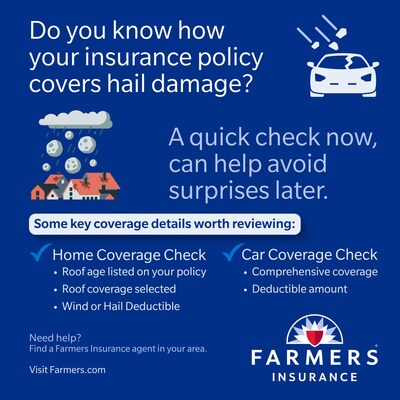
Coverage can vary based on individual policies and circumstances. Some insurance details can have a significant impact if hail damages a home or car. As part of a proactive coverage review, here are a few key areas worth discussing with an insurance agent before storm season.
Home insurance
- Roof coverage and roof age matter.
Roof coverage can vary based on the options selected on a policy and the age of the roof. In simple terms, older roofs may be covered differently than newer ones, which can affect how a claim is handled after hail damage. - Make sure roof information on the policy is up to date.
If a homeowner replaced their roof in recent years, it's recommended they review their declarations page* to confirm the roof age listed is accurate. Homeowners can let their insurance agent know if the information needs to be updated and be prepared to share supporting documentation. - Understand policy deductibles ahead of time.
Some policies include a separate wind or hail deductible. Reviewing deductible amounts in advance can help set expectations about potential out‑of‑pocket costs after a storm.
Car insurance
- Confirm comprehensive car coverage.
Hail damage to cars is typically covered under comprehensive coverage, not liability or collision. - Review the comprehensive deductible.
Knowing this amount ahead of time can help owners understand what to expect if hail damages a car.
Coverage for recreational vehicles such as boats and motorcycles may differ from home and car policies and often requires separate review.
Where to look for coverage and deductible details on an insurance policy
*A declarations page is the summary page of a policy that lists coverages and deductibles all in one place. It's typically found at the start of the policy documents or available digitally through an insurer's online portal or mobile app, such as the Farmers® Mobile App available to Farmers customers.
An insurance agent can help review coverage details
A Farmers Insurance agent can help answer coverage questions and support customers who want to align their policies with current needs.
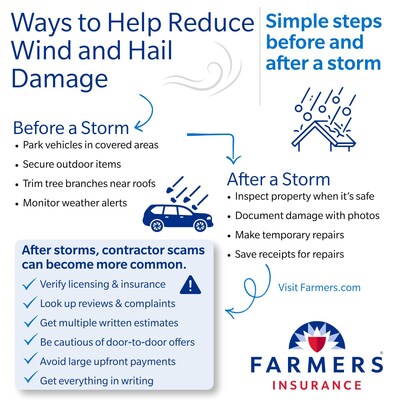
Ways to help reduce wind or hail damage to property
Before a storm
- Park vehicles in garages or covered areas when possible.
- Move outdoor furniture, grills, and décor inside.
- Trim overhanging tree branches near roofs or vehicles.
After a storm
- Inspect roofs, siding, and windows for signs of damage once it's safe.
- Take photos or video of any visible damage.
- Protect property from further damage. If it's safe to do so, make temporary or emergency repairs—such as placing a tarp over a hole in the roof—to help prevent additional damage.
- Save receipts and documentation for materials or emergency repairs, as they can support a claim and speed up the process if repairs are reimbursable.
How to spot conditions that may signal hail is coming: NOAA notes that hail often develops during strong thunderstorms, making weather alerts, local forecasts, and visible storm activity important signals to watch. Staying aware can give people more time to take action before hail hits.
Researched-backed ways to improve a roof for future hail seasons
When planning ahead—such as making future roof improvements or replacing a roof—there are options homeowners can consider to help make roofs more durable against hail.
According to research from the IBHS, steps that can help reduce hail damage include:
- Choosing roofing materials tested for realistic hail impacts. IBHS research shows that roofing materials tested using hailstones that replicate the size, density, and speed of natural hail tend to perform better than those evaluated with simplified testing methods. In a recent study3, IBHS tested 24 impact‑resistant asphalt shingle products using realistic hail impacts and published performance ratings to help homeowners and contractors better understand how different materials hold up during hail storms. Homeowners can review IBHS research findings and hail‑impact resistant shingle ratings at ibhs.org when planning future roof improvements.
- Ensuring proper installation and secure attachment. IBHS research shows that correct fastening and attachment help roofs better absorb hail impacts and reduce the likelihood of shingles loosening or failing during storms.
- Maintaining roofs as they age. IBHS research suggests that addressing wear and tear—such as aging shingles or weakened roof coverings—can help reduce the risk of damage when hail occurs.4
- Considering FORTIFIED Roof™ standards when building or replacing a roof. IBHS's FORTIFIED Roof™ program incorporates research based design and construction practices intended to improve roof performance against severe weather, including hail. These standards focus on system level resilience, not just individual products.5
Why roof resilience matters
"IBHS research shows that hail doesn't need to be extreme to cause meaningful roof damage, especially when roofs are aging or not designed with resilience in mind," said Greg Pannhausen, Head of Property Product at Farmers Insurance and a member of the Board of Directors for IBHS. "Investing in stronger roofing materials and proven construction standards can help homeowners reduce damage, shorten recovery time after storms, and protect what matters most."
Additional information and hail preparation resources are available at Farmers.com, where Farmers Insurance shares practical guidance to help consumers prepare before severe weather strikes.
Sources:
- 1National Oceanic and Atmospheric Administration (NOAA) https://www.noaa.gov/jetstream/hail
- 2 Insurance Institute for Business & Home Safety (IBHS), "How Scientists Confirmed Illinois' Largest Hailstone Ever" https://www.youtube.com/watch?v=KnWPFu-6Bc8
- 3Insurance Institute for Business & Home Safety (IBHS), Hail Impact-Resistant Shingle Ratings, https://ibhs.org/hail-impact-resistant-shingle-ratings/
- 4 Insurance Institute for Business & Home Safety (IBHS), Hail Research Overview https://ibhs.org/risk-research/hail/
- 5IBHS FORTIFIED Roof™, https://fortifiedhome.org/roof/
About Farmers Insurance
"Farmers Insurance®" and "Farmers®" are tradenames for a group of insurers providing insurance for automobiles, homes and small businesses and a wide range of other insurance and financial services products. Farmers Insurance Exchange, the largest of the three primary insurers that make up Farmers Insurance, is recognized as one of the largest U.S. companies on the 2025 Fortune 500 list. For more information about Farmers Insurance, visit Farmers.com.
Contact: |
External Communications |
Farmers Insurance |
|
818-965-0007 |
|
SOURCE Farmers Insurance





Share this article