Harness Report Reveals AI Coding Accelerates Development, DevOps Maturity in 2026 Isn't Keeping Pace
Study finds teams moving faster with AI are also taking on more deployment risk, manual rework, and burnout
SAN FRANCISCO, March 11, 2026 /PRNewswire/ -- Harness, the AI Software Delivery Platform™ company, today released a new study finding that while AI is accelerating code production, many organizations haven't modernized the delivery systems responsible for testing, securing, and deploying those changes. The result is more deployment instability, more manual downstream work, and increased pressure on engineering teams to keep releases running smoothly.
The State of DevOps Modernization 2026 – based on responses from 700 engineers and technical managers across the United States, the United Kingdom, France, Germany, and India – builds on the AI Velocity Paradox introduced in the 2025 State of AI in Software Engineering report, showing that while organizations are creating code faster, everything that happens after code — testing, securing, and deploying it — hasn't kept up. The impact shows up clearly in day-to-day delivery operations:
- Faster deployments – 45% of developers who use AI coding tools very frequently (multiple times per day) deploy code to production daily or faster. That compares with 32% of daily users and 15% of weekly coding tool users.
- More deployment problems – 69% of very frequent AI coding users say their teams experience deployment problems always, nearly always, or frequently when AI-generated code is involved. Across all respondents, 58% agreed they had these concerns.
- Longer incident recovery times – Teams using AI coding tools multiple times per day report it takes them an average of 7.6 hours to restore or resolve production incidents, compared with 6.3 hours for occasional, weekly users.
- More manual work after code is written – 47% of very frequent AI coding users report that manual work, such as QA, remediation, and validation, has become more problematic, versus 28% of occasional users.
- More after-hours work – 96% of very frequent AI coding users report being required to work evenings or weekends multiple times per month due to release-related work, compared with 66% of occasional users.
The findings reveal a clear pattern: the more frequently teams use AI coding tools, the faster they produce code — but the more strain their delivery systems experience. That strain is increasingly falling on engineering teams. On average, respondents say developers spend 36% of their time on repetitive manual tasks such as copy-paste configuration, human approvals, chasing tickets, and rerunning failed jobs. As delivery speeds increase, this operational burden is contributing to longer hours and rising developer burnout.
"AI coding tools have dramatically increased development velocity, but the rest of the delivery pipeline hasn't kept up," said Trevor Stuart, SVP and General Manager at Harness. "Last year, we found 78% of developers spend at least 30% of their time on manual, repetitive tasks. This year that number is even higher for many teams. What this tells us is that organizations are adopting AI to generate code, but not yet modernizing the processes, automation, and guardrails needed to handle that speed safely. If companies want AI to reduce burnout instead of increasing it, they need to modernize the entire software delivery lifecycle."
AI Speed Is Exposing Delivery Bottlenecks
The findings suggest that faster code generation is exposing weaknesses in downstream DevOps processes, where automation and standardization have not kept pace.
Across respondents:
- 73% of engineering leaders and practitioners say "hardly any" development teams have standardized templates or "golden paths" for services and pipelines.
- Only 21% say they can add functioning build and deploy pipelines to an environment in under two hours.
- 77% say teams often need to wait for others for routine delivery work before they can ship code.
The research also indicates that quality and security controls are struggling to keep up with increased delivery velocity. Among developers who use AI coding tools multiple times per day, 51% report more code quality or efficiency problems and 53% report more vulnerabilities and security incidents since adopting these tools.
Taken together, the findings suggest that without standardized foundations and automated guardrails, speed gains at the coding layer can translate into downstream friction, higher operational risk, and more strain on engineering teams.
Scaling AI-Driven Development Safely
"The organizations benefiting most from AI-driven development are the ones that have modernized their delivery foundations," Stuart added. "Standardized pipelines, automation, and built-in guardrails allow teams to move faster without sacrificing reliability or security."
To capture the benefits of AI-assisted development while reducing operational risk and developer burnout, organizations should focus on three priorities:
- Standardize delivery pipelines — Use repeatable templates and "golden paths" that make it easy to deploy applications safely and consistently.
- Automate quality, security, and compliance checks — Introduce automated controls earlier in the development lifecycle to catch problems before they reach production.
- Implement safety guardrails — Use mechanisms such as feature flags, automated rollbacks, and centralized secrets management to limit the impact of failures.
With these foundations in place, enterprises can move faster without sacrificing reliability, security, or developer well-being.
About the Research
This report is based on a survey of 700 engineering practitioners and managers from large enterprises, commissioned by Harness and conducted by independent research firm Coleman Parkes in February 2026. The sample included 300 respondents from the United States, and 100 each in the United Kingdom, Germany, France, and India.
About Harness
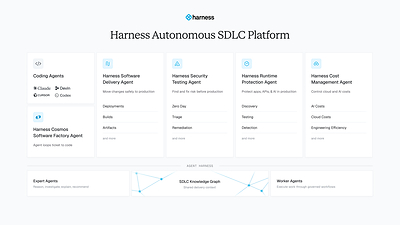
Harness is the AI Software Delivery Platform™ company, enabling engineering teams to build, test, and deliver software faster and more securely. Powered by Harness AI and the Software Delivery Knowledge Graph, the platform brings intelligent automation to every stage of the software delivery lifecycle after code—removing toil and freeing developers from manual, repetitive work. Companies like United Airlines, Morningstar, and Choice Hotels use Harness to accelerate releases by up to 75%, cut cloud costs by 60%, and achieve 10x efficiency across DevOps. Based in San Francisco, Harness is backed by Goldman Sachs, Menlo Ventures, IVP, Unusual Ventures, and Citi Ventures.
SOURCE Harness






Share this article