


IBM Ventures Invests in BQP as Quantum-Algorithm Physics Acceleration Reaches Production
- IBM Ventures has invested in BQP, bringing total funding to $8M and backing BQP's expansion from engineering design into real-time operational decisions. The investment extends a technical relationship that began in 2023, when BQP joined the IBM Quantum Network.
- Classical solvers leave roughly 85% of a GPU's floating-point capacity idle. BQP's flagship platform, BQPhy®, puts that capacity to work, resolving full-fidelity physics inside operational decision windows.
- BQPhy® is in production with aerospace and defense customers, with contracted and committed revenue up 8x since BQP's 2025 seed round and 3x customer growth.
SYRACUSE, N.Y., Sept. 2, 2026 /PRNewswire/ -- BQP, the physics acceleration company, today announced a strategic investment from IBM Ventures, the venture capital arm of IBM. The investment brings BQP's total funding to $8M and funds BQPhy®'s expansion from engineering design into operational deployment, scaling delivery and go-to-market as BQP expands beyond aerospace and defense. Venn10 Capital and existing investor Monta Vista Capital also participated. Since its 2025 seed round, backed by New York State's venture arm and other institutional investors, BQP has grown contracted and committed revenue 8x, tripling its customer base and growing platform users 20x.
"An engineer with a deadline doesn't care where the answer came from. They care that it arrived in time and that the physics is right. The industry spent years treating this as a hardware problem that warranted faster chips, more of them, and eventually a quantum one. But it was always a software problem," said Abhishek Chopra, Founder and CEO of BQP.
Chopra added: "We spent those years earning our way into engineering workflows, so when the quantum machines are ready, nothing about how those teams work has to change. That's the path IBM has watched us build since 2023, and this investment says it's the right one."
Mission-critical decisions have deadlines, and high-fidelity physics simulations rarely meet them. More hardware has not closed the gap. Classical physics solvers leave roughly 85% of a GPU's floating-point capacity idle, because the sparse iterative methods underneath simulation are bound by memory access rather than compute. Teams choose between accurate models that return the right answer too late, or fast methods that answer on time by skipping the physics, leaving hidden risk behind over-engineered safety margins.
BQPhy® removes this trade-off between speed and accuracy. Its physics-AI optimization engine resolves the full physics inside the decision window, using the GPU capacity classical solvers leave idle. The platform delivers this through two solvers that share a single SDK, integrated natively into MATLAB as a MathWorks Connections Program partner, with standard APIs for Python, Julia, and other frameworks. This enables engineers to get the answers without leaving the tools they already use. QuantumNOW™ is in production today on customers' existing CPU and GPU infrastructure, and each deployment maps which problems belong on a QPU - making QuantumMAX™, BQP's quantum-native solver in development, an on-ramp rather than a bet. It is written for heterogeneous CPU-GPU-QPU execution rather than a single hardware target.
"What stood out with BQP is that users don't have to change how they work to get quantum-accelerated results. Their proven track record of developing software that helps enterprises build a practical path toward hybrid quantum-classical computing is what gives IBM Ventures confidence in making this investment," said Emily Fontaine, Global Head of IBM Ventures.
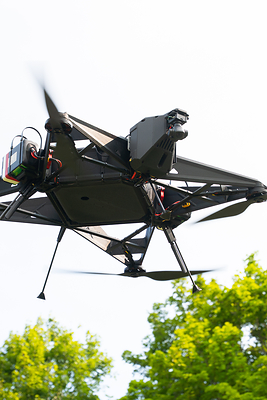
In aerospace and defense, BQP's furthest-along work is in space. Under an SBIR with the U.S. Space Force and SpaceWERX, extending earlier work with the SDA TAP Lab, BQPhy®'s physics AI propagates a catalog of more than 3,000 space objects in under a second, roughly 250x faster than the open-source Orekit solver by compressing the model using proprietary algorithms.BQP also holds a CRADA with the Air Force Research Laboratory's Aerospace Systems Directorate and has demonstrated BQPhy® on radio-frequency signal problems for the tactical edge with NavalX. With Modovolo, BQP built a system-level propulsion optimization for UAV mission profiles, expanding from three design variables to more than twelve and tuning propeller and motor as a single unit; integration took roughly one week through the API.
In energy, BQP is applying the same platform to commercial systems, with EV battery thermal management work funded by India's Ministry of Heavy Industries and the Indian School of Business.
The same engine that predicts where a satellite is heading also predicts how heat moves through a battery pack or a data center rack: different industries with the same high-dimensional physics that has to resolve before the decision window closes.
QuantumNOW™ is in production; QuantumMAX™ is proving out. In work presented at USNC/TAM 2026, BQP ran QuantumMAX™ on quantum hardware for uncertainty quantification in computational fluid dynamics, reaching the same accuracy as classical Monte Carlo with fewer samples on a benchmark-scale problem. BQP's research is published in IEEE, AIAA, and APL Quantum, with best paper awards at AeroCon 2026 and the IEEE Space, Aerospace and Defence Conference (SPACE 2026).
Media Contact
Ludington Media on behalf of BQP
[email protected]
New York, NY • (551) 795-5950
About BQP
BQP (formerly BosonQ Psi) is a physics acceleration company applying quantum algorithms to mission-critical operational decisions. Its unified Quantum-HPC platform, BQPhy®, pairs physics AI surrogates with an optimization solver, delivering results on today's CPU and GPU infrastructure through QuantumNOW™ with quantum-native acceleration in development through QuantumMAX™ - both on a single SDK. Headquartered in Syracuse, New York, with offices in the UK and India. Learn more at https://www.bqpsim.com
SOURCE BQP




Share this article