


Introducing Harness Agent DLC: New Capabilities for the AI Agent Development Lifecycle
Enterprises can now ship AI agents with the same governance, testing, and security they already trust for application code
SAN FRANCISCO, July 21, 2026 /PRNewswire/ -- Harness, the AI Software Delivery Platform™ company, today announced it is extending its platform to cover the full AI Agent Development Lifecycle (DLC), giving enterprises a single set of pipelines and controls to build, test, deploy, and run agents the same way they already ship everything else.
Every enterprise is building AI agents, but most can't get them past internal pilots or proofs of concept. According to Gartner®, "Only 8% of organizations have agentic AI in production." The software delivery lifecycle enterprises trust for shipping application code hasn't extended to agents yet, trapping the ROI of internal AI investments. Real innovation arrives once a company can run an agent live with the same trust and confidence it has in the rest of its software.
"When we started Harness, the vision was a safety harness for code," said Jyoti Bansal, co-founder and CEO of Harness. "Until recently, that meant application code. Today it also means agentic code, written across engineering, product, sales, and support teams alike, each building agents for their own workflows. Everything you've done for software delivery over the last decade — governance, orchestration, security, testing — you can now do for agents in the same platform."
Why AI agents break the traditional software delivery lifecycle
Traditional software works because it's predictable. Application code is deterministic. Run the same test against the same code twice, and it produces the same result both times.
Agents don't work that way: an agent's underlying language model decides how to complete a task, and the same agent, given the same input, can choose a different tool or take a different action from one run to the next. A test that passes once offers no guarantee it will pass the next time. Incidents stop being reproducible on demand, which means the standard playbook for catching and fixing bugs doesn't transfer either.
The stakes rise with the size of the business. A rogue agent can expose customer data, violate a compliance policy, or take an action nobody approved. Enterprises need a way to answer for what their agents are doing, and the traditional software delivery lifecycle was never built to give them one.
New Harness Agent DLC products and capabilities
Agent DLC closes the gap between building an agent and delivering it safely to production. Today's launch includes five new products and capabilities spanning testing, deployment, operations, and governance:
- Harness AI Evals make agent quality measurable, letting teams define eval datasets, wire up scoring functions, and set quality gates that automatically catch regressions whenever an agent or model changes.
- Agent Deployments extend the canary releases, approvals, and OPA guardrails that Harness already applies to Kubernetes deployments to managed agent runtimes like Amazon Bedrock AgentCore and Google's Agent Runtime. Agents now ship through existing pipelines instead of a separate cloud-specific workflow.
- AI Configs support the release and management of prompts and model changes at runtime, backed by the same feature flagging infrastructure that already manages code releases. Teams can test what performs best and roll back instantly, without redeploying.
- AI Asset Catalog automatically discovers every agent, skill, and plugin built across an organization's repositories and links each to an owner, so nothing ships or runs unaccounted for.
- Harness AgentTrace records what happens during a single agent run and across a full multi-step session, showing which path an agent took, where it slowed down, and how different models or prompts affect the outcome. Harness is also open-sourcing the foundational components behind AgentTrace, including harness-sdk and harness-evals, so developers can bring the same tracing primitives into their own AI applications.
In addition, existing Harness products already extend to agents without requiring any changes: Continuous Integration builds them like any other service, Artifact Registry tracks their versions and dependencies, AI Test Automation validates their responses in plain English criteria, and AI Cost Management extends spend visibility to every agent and model.
Securing the Agent DLC
Agents choose their own approach and path to get there, so their behavior is hard to predict and just as hard to secure. They expand their own attack surface by connecting to tools and APIs, spawning sub-agents, and inheriting trust from every model they touch. Static scans were never designed for this kind of risk. Harness is launching new security capabilities to close that gap.
Shift-left: constrain what agents can do before they ship.
- Primitive Scanning flags misconfigurations in agent skills, prompts, and models.
- AIBOM captures every model, tool, and dependency an agent was built with.
- AI Testing runs agents against adversarial inputs and the OWASP Top 10 for LLMs.
Shield-right: enforce policy and maintain visibility once they're live.
- Agent Discovery and Posture Management continuously surfaces agents as they're invoked, maps how they connect and orchestrate work, and assesses their posture across the organization.
- AI Firewall enforces policy in real time against prompt injection, tool misuse, and data exfiltration.
Together, these capabilities give Agent DLC a single audit trail from development to production.
Built on the Harness platform
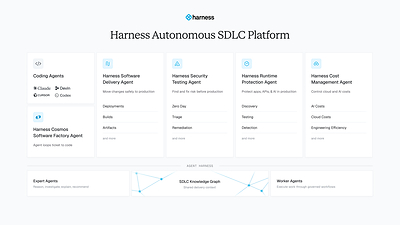
Harness built context and intelligence directly into the platform with the Software Delivery Knowledge Graph, which captures and connects data from every stage of the delivery lifecycle, now spanning both applications and agents. Organizations relying on siloed tools don't have that same connected view.
In June 2026, Harness introduced Autonomous Worker Agents, a platform for building and safely running AI agents inside software delivery pipelines. Worker Agents run as governed steps within those pipelines, covered by the same controls Harness already applies to every deployment.
Agent DLC extends that same context and governance across the full agent lifecycle. The pipelines, policies, approvals, and evidence that already apply to an organization's code now apply to its agents too, so eval gates, deployment approvals, and security checks run as stages within a single pipeline, from the moment an agent is created through everything it does afterward.
Availability
Harness Agent DLC capabilities are rolling out now to Harness customers. For a full breakdown of what's included at each stage of the lifecycle, visit https://www.harness.io/blog/introducing-harness-agent-dlc.
Gartner, Emerging Market Quadrant for AI Agent Development Platforms — Established Vendors, 8 June 2026. GARTNER is a trademark of Gartner, Inc. and/or its affiliates
About Harness
Harness is the AI Software Delivery Platform™ company, enabling engineering teams to build, test, and deliver software faster and more securely. Powered by Harness AI and the Software Delivery Knowledge Graph, the platform brings intelligent automation to every stage of the software delivery lifecycle after code — removing toil and freeing developers from manual, repetitive work. Companies like United Airlines, Morningstar, and Choice Hotels use Harness to accelerate releases by up to 75%, cut cloud costs by 60%, and achieve 10x efficiency across DevOps. Based in San Francisco, Harness is backed by Goldman Sachs, Menlo Ventures, IVP, Unusual Ventures, and Citi Ventures.
SOURCE Harness





Share this article