La Luce Cristallina Launches CMOS-Compatible Oxide Pseudo-Substrate, Enhancing Scalability for Silicon Photonics and Advanced Electronics
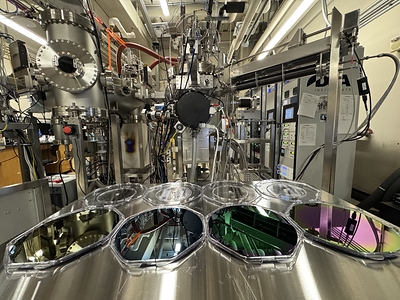
AUSTIN, Texas, Jan. 27, 2026 /PRNewswire/ -- La Luce Cristallina today announced it has launched its new CMOS-compatible oxide pseudo-substrate, enabling high-quality, epitaxial strontium titanate (SrTiO₃) films to be grown directly on 200-mm silicon and silicon-on-insulator (SOI) wafers. This platform bridges the gap between academic oxide research and commercial manufacturing, facilitating the development of advanced oxide devices using standard semiconductor tools. The solution supports superconducting RF electronics, ultra-low-loss RF components, single-photon detectors, quantum sensing, advanced computing architectures and other emerging applications aligned with silicon photonics and heterogeneous integration.
Today's researchers often rely on small, costly single-crystal SrTiO₃ substrates that are incompatible with standard fabrication facility workflows. La Luce Cristallina's pseudo-substrate platform eliminates these bottlenecks by aligning with foundry-driven roadmaps for heterogeneous integration, co-packaged optics, wafer-level prototyping and next-generation photonics, enabling manufacturing scalability. The solution delivers large-area wafers, high-quality epitaxial films (with thicknesses ranging from 4 to 50 nanometers) and standard CMOS tool compatibility.
"Our new CMOS-compatible oxide pseudo-substrate brings high-performance oxide electronics out of the lab and onto industry-standard silicon wafers, unlocking scalable devices for RF components and quantum applications," said Agham Posadas, CTO and Co-Founder, La Luce Cristallina. "By improving cost and scalability while eliminating CMOS tooling incompatibilities, we can help customers across the silicon photonics ecosystem accelerate innovation."
La Luce Cristallina's wafer-scale approach significantly expands usable area while maintaining film quality, supporting numerous applications across diverse, growing markets. Experts estimate that the RF components market will grow from $50 billion to $91.19 billion by 2030, bolstered by the defense and sensing sectors, 5G deployments and satellite communications. Amid strong government funding, the quantum technologies market (including sensing, detection and superconducting electronics) is projected to reach $20.20 billion by 2030, growing at a compound annual growth rate (CAGR) of 41.8 percent.
The platform can support oxide electronics research for universities, national laboratories and commercial R&D teams that were previously constrained by substrate availability. La Luce Cristallina currently serves customers across integrated photonics research, quantum computing and other advanced electronics sectors. Read more here about La Luce Cristallina's other recent news, including its 200-mm barium titanate wafer.
"La Luce Cristallina's CMOS-compatible oxide pseudo-substrate removes one of the biggest barriers to scaling oxide electronics," said Ron Kelly, CEO of Ambature, Inc. "By enabling high-quality strontium titanate films on 200-mm silicon wafers using standard semiconductor tools, La Luce Cristallina is helping companies like Ambature move advanced RF and quantum technologies from research environments toward real-world systems."
About La Luce Cristallina
La Luce Cristallina (LC) is a manufacturer of Si-integrated high-performance materials for silicon photonics, focused on barium titanate (BaTiO₃) materials enabling electro-optic modulators for low power and medium to high frequency photonic applications such as field sensors, biosensors, optical interconnects, space applications, quantum information (QI) and neuromorphic computing (AI). We're leading the transition from silicon to high-performance BaTiO₃ as we shape the future of photonic materials amid industry shifts in optical interconnects, sensing and high-performance computing.
La Luce Cristallina Contact
Rowshanak Irani
+1 737 781 0325
[email protected]
Media Contact
Jeannette Bitz, Engage PR
+1 510 295 4972
[email protected]
SOURCE La Luce Cristallina





Share this article