


NeuroRester Announces 75% Sleep Efficiency Boost in Latest Kantar Study
Participants with ongoing sleep troubles report improvements within one week
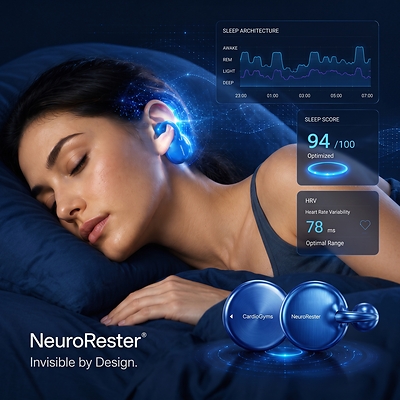
CAMPBELL, Calif., Aug. 28, 2026 /PRNewswire/ -- Designed to support restful sleep, relaxation, and daily recovery routines, NeuroRester® announced in late July 2026 their next generation wearable wellness device which focuses on three core pillars: sleep preparation, daily relaxation, and physical recovery. The launch is supported by findings from the recent Kantar Sleep Wearable HUT Final Report, which evaluated home-use testing among 51 US participants who had reported ongoing sleep difficulties.
Access the full Kantar research report at https://neurorester.com.
Participants reported improvements in how they experienced their sleep, and the report gains held throughout the final night of the test. Most notably, the percentage of "good nights" reported by users rose from 34% to 43%, with sleep latency and daytime dysfunction showing the most significant gains across the test group.
What the study revealed
Significant Morning Improvements
(participant-reported, product week vs. each participant's own baseline week)
Baseline |
After 7 Nights |
Change |
|
Overall Sleep Satisfaction |
2.94 |
3.29 |
+0.35 |
Refreshed on Waking |
2.57 |
2.9 |
+0.33 |
Ease of Waking Up |
2.83 |
3.16 |
+0.33 |
Ease of Falling Asleep |
3.3 |
3.62 |
+0.32 |
Calmness of Sleep |
3.13 |
3.36 |
+0.23 |
Noted themes from participants:
Better Mornings: "I'm falling asleep easier and staying asleep longer and wake up well rested and energize the next day to complete the task that..."
Faster Sleep Onset: "It's easier for me to fall asleep quicker and sleep more throughout the night continuously."
Research focus and methodology
To capture authentic home-use experience, the Kantar study employed a single-arm trial design focused on self-reported participant outcomes.
- PSQI (Pittsburgh Sleep Quality Index): a standardized questionnaire of self-rated sleep quality, completed before and after the product week.
- Daily Morning Perception Gains: Overall sleep satisfaction, ease of waking up, and feeling after waking.
- Structural Shift in Night Quality: Rating of 'Good Nights' over 'Bad Nights' and the perceived benefits from the 1st night of use to the 7th night of use.
These findings demonstrate that integrating NeuroRester into a daily wellness routine may support relaxation and recovery. The brand's core philosophy - test first - trust second is reflected in its investment in independent consumer research. As the market for recovery technology rapidly expands, these results support NeuroRester's position as a research-driven leader in sleep and relaxation.
Supporting statistics
In the study, participants reported an easier transition into sleep and higher overall sleep satisfaction during the product week. NeuroRester® is designed for individuals looking to support recovery and build healthier sleep habits. Unlike passive wellness trackers, the system is designed to take an active part in users' wind-down and relaxation routines.
The end-of-test verdict, given once on the final day of use: "73% report improvement, and 35% felt it within the first three days".
NeuroRester approaches sleep recovery through a full-body lens, recognizing that rest depends on interconnected biological systems, not just brain waves. An earlier generation of the company's technology was evaluated in a peer-reviewed, single-arm pilot study (n=20) conducted by researchers at Harvard Medical School and Brigham and Women's Hospital and published in Nature and Science of Sleep (2019), which established an initial observation between structured pre-sleep signaling and nighttime rest - not as a treatment claim, but as a self-reported pattern. In the August 2026 Kantar Home Use Test of the current-generation system, participants reported a 73% improvement in daily sleep efficiency within seven nights, with 35% first noticing a change within the first three days.
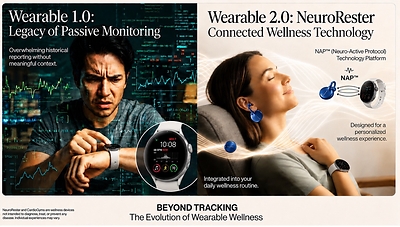
Its AI automated engine analyzes information from connected wearable wellness devices alongside brief user check-ins to personalize daily and nightly support. The result is intended to create a continuous feedback loop in which each day's activity influences recommendations and device settings, allowing the system to evolve alongside changes in an individual's routine and recovery patterns.
Highlighting the growing evolution of wearable technology from passive health monitoring toward systems designed to provide personalized guidance and ongoing intervention."Harvard gave us the physiological premise - that the body's clock can be supported through daytime flow signals," said Jack Wang, CEO of NeuroRester. "The years since have been about turning that early research into a convenient wearable device that supports both better sleep and energy."
Originally planned for launch on Kickstarter in August. The brand has pushed forward with direct online availability for customers, focusing on dedicated distribution at a limited time early launch discount.
Full retail availability is scheduled for early September at neurorester.com.
This product is not intended to diagnose, treat, cure, or prevent any disease. These statements have not been evaluated by the Food and Drug Administration.
SUPPORT: Alice Venner, [email protected]
SOURCE NeuroRester Corp





Share this article