


New Research Shows that Personal AI Agents Can Help Networked Teams Solve Complex Problems Significantly Faster
In a study funded by the US Air Force, teams that collaborated through a hyper-connected network of AI agents solved problems 19% faster than by traditional group conversation.
ARLINGTON, Va., Oct. 15, 2026 /PRNewswire/ -- Unanimous AI, the world leader in hyper-communication technologies, today announced new research conducted with the Center for Collaboration Science at Carnegie Mellon University (CMU CoLab). Funded by the US Air Force, the new study shows that networked teams can solve collaborative problems faster when each member communicates exclusively through a personal AI agent instead of traditional group conversation. This research is aimed at solving communication bottlenecks in high-stakes, time-pressured scenarios like emergency response where members are multi-tasking while sharing and receiving critical information from other team members.
Anyone who has participated in a large video conference or tried to keep up with a busy Slack channel knows the problem. On a group call, only one person can speak at a time, so important information waits its turn. In a group chat, everyone can post at once, but critical details get buried under a wall of text. Research shows both problems get worse as teams grow and compound when individual members have other critical tasks to perform while collaborating, like monitoring an urgent situation.
In this study, 15 networked teams, each with 7 or 8 members, were tasked with solving a simulated high-stakes problem framed as identifying a terrorist using a set of evidence that was divided across team members. The only way to solve each problem was to combine multiple pieces of evidence from each member, while rejecting conflicting evidence and red herrings.
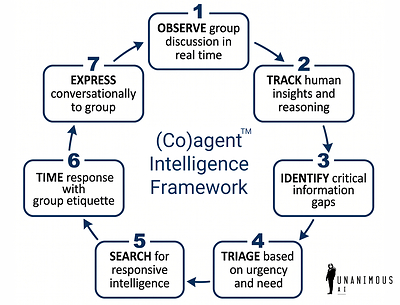
Each team solved the problems in two ways: (A) by traditional group chat, as used in many settings with tools like Slack and Microsoft Teams, and (B) by using a novel hyper-communication framework called Hypercom AI in which each team member engages only with a dedicated AI agent. These agents, called Conversational Surrogates, are tasked with passing relevant information to other human team members via their dedicated AI agents. These AI agents are there to coordinate communication – they do not inject new information into the conversation or generate deductions of their own.
What the study found
Teams using Hypercom AI converged on the correct solutions in an average of 11.6 minutes, compared with 14.3 minutes in traditional group chat. The 19% reduction was statistically significant and held after controlling for which "mock terror plot" each team solved. Accuracy was essentially identical: 93% for hyper-connected teams and 92% for traditional ones. The researchers describe these results as the first demonstration that a distributed human team can solve a complex collaborative problem together while communicating entirely through a network of intervening AI agents. The performance benefits are likely to increase with group size, especially among multi-tasking team members.
Where it matters
The researchers see immediate applications wherever people must share information while doing their jobs under pressure, including emergency response, disaster relief, cybersecurity, and military command. A first responder in the field, for example, could keep working while her agent shares her observations with the other team members and brings back relevant updates from others in the field. The same approach applies to the critical operations across large organizations.
"When multi-tasking teams need to collaborate under pressure, traditional communication channels can create significant bottlenecks and distractions," said Dr. Louis Rosenberg, Chief Scientist of Unanimous AI. "Hypercom technology solves this, enabling each member to engage at their own pace, interacting with a dedicated AI agent that intelligently shares their insights with other members. Nobody waits for airtime and nobody drowns in stacked up messages. This is a new form of communication."
"Leveraging AI technology to integrate distributed expertise offers significant benefits to many organizations, particularly when decisions need to be made quickly," adds Professor Anita Williams Woolley, Professor of Organizational Behavior at CMU's Tepper School of Business, and a co-author on the research. "There could be additional opportunities to facilitate completely asynchronous coordination, and dramatically reduce the need for meetings that currently clog everyone's calendars and slow down progress."
The research study, "Evaluating an Agentic Hyper-Communication Framework for Optimized Human Deliberation Across Distributed Teams," is available as a preprint. Its authors are Louis Rosenberg, Hans Schumann, and Gregg Willcox of Unanimous AI and Anita Williams Woolley and Ganesh Mani of Carnegie Mellon University. Hypercom AI is available within Unanimous AI's Thinkscape® platform.
The views expressed are those of the author and do not necessarily reflect the official policy or position of the Department of the Air Force, the Department of Defense, or the U.S. government.
About Unanimous AI
Unanimous AI develops hyper-communication technologies that make large teams smarter, faster and significantly more productive. Modeled on the dynamics of biological swarms, its patented Swarm AI®, Hyperchat AI™, and Hyperlingual™ technologies turn networked "hyperswarms" of humans and AI agents into superintelligent systems. Its award-winning Swarm® and Thinkscape® platforms have been validated by dozens of academic studies and are used by large organizations around the world
About AFWERX
As the innovation arm of the Department of the Air Force and a division within the Air Force Research Laboratory, AFWERX brings American ingenuity from small businesses and startups to solve the most pressing challenges facing Airmen and Guardians. Headquartered at Wright-Patterson Air Force Base, Ohio, AFWERX strengthens the defense industrial base by expanding access to nontraditional vendors, building new defense partnerships and accelerating the transition of critical technologies to operational capability. In fiscal year 2025, AFWERX awarded more than 1,000 contracts totaling $1.37 billion and achieved 438 Phase III transitions valued at $8.1 billion, supercharging the industrial base that supports U.S. military readiness and battlefield advantage.
About AFRL
The Air Force Research Laboratory is the Department of the Air Force's primary scientific research and development center and one of six centers within Air Force Materiel Command. AFRL leads the discovery, development and delivery of technologies for air, space and the multidomain. With a workforce spanning seven mission areas at more than 40 locations worldwide, AFRL conducts research ranging from basic science to advanced technology development.
Media Contact:
Julian Cohen
773-336-2112
[email protected]
SOURCE Unanimous AI




Share this article