


Over 800 New Generation Projects Seek To Connect Under PJM's Reformed Process
First-ready, first-served Cycle ends backlog and offers a faster, more predictable path for resources to join the grid
VALLEY FORGE, Pa., April 29, 2026 /PRNewswire/ -- PJM Interconnection today announced that 811 new generation projects, capable of generating 220 gigawatts of electricity, have applied to connect to the grid through the first Cycle of PJM's reformed interconnection process. This marks the first major intake under a redesigned approach focused on improving the certainty, speed and discipline of project review.
The application window closed April 27, and PJM now begins a validation phase to confirm which projects have submitted the required technical and financial information to move forward. All projects in this Cycle are being processed under the new framework, with no remaining backlog from prior queues.
The reformed process replaces PJM's prior first-come, first-served model with a first-ready, first-served approach, prioritizing projects that are more advanced and better positioned to move forward. Projects must demonstrate they are viable before entering the queue, including meaningful up-front financial commitments and proof of site control. These requirements are designed to reduce speculative projects, improve predictability and increase the overall pace of interconnection.
"PJM and our stakeholders have created a process that gets as many projects approved as quickly and safely as possible," stated Interim President and CEO David Mills. "These numbers represent significant interest from developers resulting from strong market signals, and our reformed process is designed to prioritize viable projects that can move to construction and operations with greater speed and certainty."
PJM is also using advanced tools and pathways it has implemented in recent years to improve efficiency at scale. This includes HyperQ, the AI-enabled tool developed by Google's Tapestry to help review large volumes of application data more quickly and efficiently. HyperQ is already helping with these reviews by identifying and helping to assess sections of documents for further review. PJM expects the efficiencies offered by HyperQ to reduce study times and will be evaluating the tool's impact throughout Cycle 1.
The volume of applications reflects strong developer interest and growing electricity demand across the PJM region, driven by data centers, advanced manufacturing and broader electrification trends. Bringing new generation online is critical to maintaining grid reliability as demand continues to increase. With the start of this Cycle, all generation seeking to connect to the PJM grid is now being processed.
The applications include a diverse mix of generation resources:
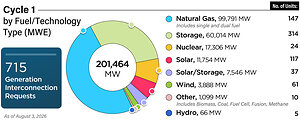
- 811 total projects, led by storage (349), natural gas (157), solar (142), wind (65), solar-storage hybrids (45), nuclear (27), other (15) and hydro (11).
- 220 GW of nameplate capacity, led by natural gas (105.8 GW), storage (66.5 GW), nuclear (17.9 GW), solar (14.8 GW), solar-storage hybrid (8.9 GW), wind (4.7 GW), hydro (0.15 GW) and other (0.5 GW).
The "other" category includes biomass, coal, methane, and for the first time, fusion energy.
"We are encouraged by the diversity of generation types that are seeking to join the PJM generation fleet," said Mills. "That includes first-time innovative technologies such as small nuclear reactors and fusion, more storage projects than any other technology, a resurgence in natural gas and continued strong participation by renewables and hybrids. This is good news because we need all the generation we can get."
Between 2024 and 2030, PJM expects electricity demand to increase by more than 30 GW, driven largely by data centers. Demand growth is outpacing the addition of new supply, risking reliability and making the timely interconnection of new resources critical to keeping the lights on for 67 million people in 13 states and the District of Columbia.
The gigawatt and megawatt figures represent the maximum potential output of a resource into the system. Based on historical performance, only a percentage of projects that apply for interconnection will sign interconnection agreements. Details on specific projects seeking interconnection are confidential until the application is officially accepted.
The opening of the new interconnection Cycle represents the culmination of PJM's successful interconnection process reform that was first implemented in July 2023. Since 2020, PJM has processed more than 300 GW of projects, resulting in 103 GW worth of projects with signed interconnection agreements. Many of these projects, however, are either not being built at all or are being slowed by hurdles such as state permitting and supply chain backlogs.
PJM is working with stakeholders in the public and private sectors to help projects get built once they clear PJM's process and to manage the reliable integration of data centers while new generation resources are being developed. Projects will be reviewed in the Cycle in what is designed to be a one- to two-year process, depending on the impact of an individual project.
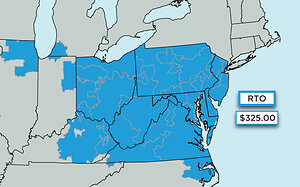
PJM Interconnection, founded in 1927, ensures the reliability of the high-voltage electric power system serving 67 million people in all or parts of Delaware, Illinois, Indiana, Kentucky, Maryland, Michigan, New Jersey, North Carolina, Ohio, Pennsylvania, Tennessee, Virginia, West Virginia and the District of Columbia. PJM coordinates and directs the operation of the region's transmission grid, which includes 88,417 miles of transmission lines; administers a competitive wholesale electricity market; and plans regional transmission expansion improvements to maintain grid reliability and relieve congestion. PJM's regional grid and market operations produce annual savings of $5 billion. For the latest news about PJM, visit PJM Inside Lines at insidelines.pjm.com.
SOURCE PJM Interconnection





Share this article