


Pilot Photonics Secures €1M ESA Contract for Space Photonics Development
DUBLIN, June 4, 2026 /PRNewswire/ -- Pilot Photonics, the leading Irish developer of integrated photonic engines, announces a new €1M contract with the European Space Agency (ESA) for space-proofing the company's Optical Frequency Generator Unit (OFGU). This effort aims to meet the demands of new satellite constellations, providing higher frequency bands, payload reconfigurability, and lower size, weight, power, and cost (SWaP-C).
Current satellite systems make use of electronic frequency generation units (FGUs). However, data-intensive applications, such as live streaming, remote working, and AR/VR are driving existing satellite communications infrastructure to its limits. Meanwhile, the increasing number of satellites in orbit also results in crowded traditional frequency bands. This status quo puts three distinct demands on satcom infrastructure: higher frequency bands, to avoid crowding; flexible payloads, so satellite assets may be rededicated on the fly; and lower SWaP-C, to enhance the scalability and sustainability of orbital networks.
Pilot's OFGU uses the optical domain in lieu of standard RF electronics, to deliver frequencies from 8GHz – 220GHz with low noise and high-power efficiency from a single source, all in a highly integrated compact module. In one configuration, it delivers stable and low phase noise RF carriers. This configuration can be used as a local oscillator in traditional satellite payloads, feeder link transponders, and ground stations. In a second configuration, optical outputs can be delivered for on-board signal distribution to enhance the performance and flexibility of new RF photonic satellite architectures. The new undertaking funded by ESA builds on earlier work completed under EU projects PICOMB, ACTPHAST 4.0, and PhotonHub Europe.
"This project will accelerate the OFGU's readiness for space, culminating in space-environment validation after which early demonstrations in orbit can commence," said Dr. Amol Delmade, OFGU Product Lead at Pilot Photonics.
"Photonic technologies are becoming increasingly important for space," said Dr. Nikos Karafolas, Technical Officer at the European Space Agency. "There is a need for technologies like the OFGU to offer higher Q, stable, local oscillator for existing RF and for future Photonic RF architectures."
"This significant ESA contract is further evidence of Ireland's growing capability in the space economy," said Barry Jennings, National Delegate to ESA at Enterprise Ireland. "Pilot Photonics is developing highly specialised technology that addresses a real and urgent need in next-generation satellite infrastructure — and doing so at the frontier of what's possible in integrated photonics. The Irish Delegation to ESA is committed to supporting companies like Pilot Photonics as Ireland continues to build a strong and distinctive presence in the European space sector."
Pilot Photonics has recently published a whitepaper on the OFGU, detailing its comb source technology and application areas. The whitepaper can be found on its website.
About Pilot Photonics
Pilot Photonics is a leading innovator in integrated photonics sources. Its portfolio includes tuneable and multi-wavelength lasers, optical combs, and frequency generators. Its innovative technologies drive cutting edge solutions in high-speed optical communications, AI data centres, 5G/6G telecom networks, space systems, and test & measurement applications. Founded by pioneers in optical comb technology, the company is driving the transition to the Everything over Optical™ era.
Learn more about Pilot Photonics at www.pilotphotonics.com
About ESA
The European Space Agency (ESA) provides Europe's gateway to space.
ESA is an intergovernmental organisation, created in 1975, with the mission to shape the development of Europe's space capability and ensure that investment in space delivers benefits to the citizens of Europe and the world.
ESA has 23 Member States: Austria, Belgium, the Czech Republic, Denmark, Estonia, Finland, France, Germany, Greece, Hungary, Ireland, Italy, Luxembourg, the Netherlands, Norway, Poland, Portugal, Romania, Slovenia, Spain, Sweden, Switzerland and the United Kingdom. Latvia, Lithuania and Slovakia are Associate Members.
ESA has established formal cooperation with other four Member States of the EU. Canada takes part in some ESA programmes under a Cooperation Agreement.
By coordinating the financial and intellectual resources of its members, ESA can undertake programmes and activities far beyond the scope of any single European country. It is working in particular with the EU on advancing the Galileo and Copernicus programmes as well as with EUMETSAT for the development of meteorological missions.
Learn more about ESA at www.esa.int
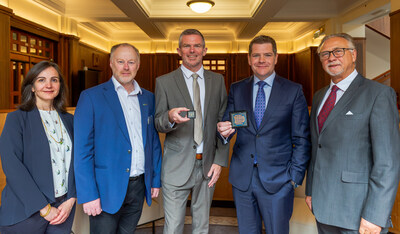
Photo: https://mma.prnewswire.com/media/2994921/Optical_FGU_Space_Pilot_Photonics.jpg
Logo: https://mma.prnewswire.com/media/2994920/Pilot_Photonics_Logo.jpg
SOURCE Pilot Photonics





Share this article