


Sedai Launches the First Autonomous Platform for AI Agent Optimization
The platform intelligently routes AI agents to models from OpenAI, Anthropic, VertexAI, Bedrock and more, optimizing token costs across every AI agent and LLM call.
SAN FRANCISCO, June 9, 2026 /PRNewswire/ -- Sedai, the self-driving cloud™, today launched AI Agent Optimization: the first platform that autonomously optimizes the cost, performance, and accuracy of running AI agents. The platform gives enterprise engineering teams centralized governance, real-time observability, and intelligent model routing across every AI agent and LLM call.
The average large enterprise now spends $11.6 million annually on AI models — up from $4.5 million in 2024, and some Fortune 500 companies are exceeding $100 million per year when cloud infrastructure costs are included. Yet most organizations lack any centralized visibility or control over how those models are being selected, used, or optimized across their teams.
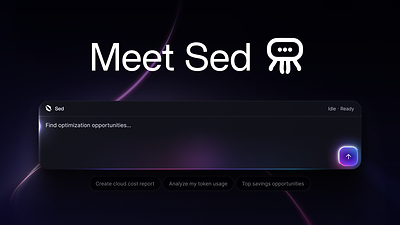
Sedai for AI Agent Optimization sits transparently between an organization's agents and LLM providers. The platform deploys with minimal disruption to existing code and integrates directly with the tools engineering teams already use. Organizations like GSK, KnowBe4, and Informed are already using Sedai to optimize their AI agent strategy.
The release includes:
- Governance: Two-tier model access control at the org and project level, per-model fallback routing including cross-provider, and API key management, enforced automatically without relying on developer self-governance.
- Observability: Consolidated cost, token, and latency visibility across every provider, project, and model in real time, with cross-provider drill-down, anomaly detection, and usage attribution by team and project.
- Smart Routing: Automated, traffic-aware model routing tailored to each agent's actual production queries, delivering latency and token cost optimization without sacrificing accuracy.
- Reliability: Automatic retries, cross-provider fallbacks, and load balancing, built in by default, without requiring teams to rebuild this infrastructure independently.
"Most engineering teams are picking AI models based on intuition, not data," said Suresh Mathew, CEO and Founder of Sedai. "The result is that teams can't control their skyrocketing AI costs or keep pace as models continue to change. Sedai solves this at the infrastructure level, autonomously, and without requiring engineering teams to change how they work. It dramatically reduces both the cost and the headache of operating AI agents at enterprise scale."
The Critical Challenge at the Heart of Enterprise AI
While enterprises now depend on AI to build and run their products, they struggle to govern their AI usage to ensure costs don't spiral out of control. Engineering teams independently select models and manage their own reliability logic, often without any centralized oversight of what is being used or what it costs. The result is fragmented LLM usage, uncontrolled spend, and duplicated work across the organization.
Compounding the problem, the model landscape moves faster than any team can track. New models ship every week. A model that delivered the best performance-per-dollar last quarter may cost twice as much, or score significantly lower on accuracy, today. Manual re-evaluation at the scale of dozens of agents simply isn't feasible.
"AI agents are now table stakes for the enterprise. The real differentiator is how well you optimize them," said Mohamed Khalid, Senior Director of Engineering at GSK. "Today, model selection is still a manual process — but we're looking to Sedai to change that. By automatically routing each agent to the right foundational model for the task, we stop burning budget on over-engineered solutions for simple work, and ensure our most critical workflows always have the best tools available. This is how we stay ahead, and Sedai is the partner helping us get there."
How Sedai Approaches the Problem
Most model routing tools rely on generic public benchmarks to decide which model to use. Sedai takes a different approach. It analyzes each organization's actual production traffic, automatically groups queries by type and task, and finds the best model for each group, so a customer service agent, for example, might use one model for complex billing inquiries and a faster, cheaper model for routine lookups.
To measure model quality, Sedai trains a custom AI judge on human feedback from each organization. This means model performance is evaluated against each company's own standards, not a one-size-fits-all benchmark that may have little relevance to their actual workloads. Sedai then continuously repeats the evaluation process as new models enter the market, so agents stay optimized over time without any manual effort.
"As an engineering executive in 2026, it's my job to make sure we're ahead of the curve when there are advances in AI," said Matt Duren, VP of Engineering at KnowBe4. "The problem is, we have agents across the entire KnowBe4 platform, with each agent having its own set of goals, and it's incredibly time-consuming for human engineers to pick the optimal model for each use case. Meanwhile, the maintenance of keeping up with new model versions at scale can quickly monopolize a teams' time and stifle innovation. That's where Sedai comes in. The platform analyzes how each model performs on our specific queries — in terms of token cost, latency, and accuracy. The result is a better experience for our customers, and more control over our budget."
Sedai is also the only platform that addresses both sides of the AI cost equation. In addition to optimizing how AI calls are routed, Sedai optimizes the underlying cloud infrastructure the agents run on. This means companies get lower AI inference costs and lower compute costs from a single platform.
"If you're serious about controlling your AI costs, you need to optimize both the AI models and the underlying infrastructure, like your cloud, your Kubernetes clusters, and your GPUs," said Ethan Andyshak, SVP of Product at Sedai. "Sedai is the first solution that does all of that, autonomously. This launch extends Sedai's proven optimization engine to the AI agents running on that cloud, giving customers one platform to govern and optimize everything."
Sedai for AI Agent Optimization is available today in early access. General availability is planned for later in 2026. The platform supports OpenAI, AWS Bedrock, Vertex AI, and Azure Foundry at launch, with others being added over time.
To optimize your AI agents, please schedule a demo at sedai.io/demo.
About Sedai
Sedai is the world's first self-driving cloud.™ Our platform optimizes your cloud resources to reduce costs, boost performance, & improve availability. All on autopilot. Under the hood, Sedai uses patented ML models to learn how your apps actually behave — from traffic patterns to dependencies to golden signals. This application intelligence lets Sedai make safe changes to achieve your SLOs. With zero IaC drift. Zero toil. And 100% confidence.
Ready to build a cloud that's fast, reliable, & doesn't burn your entire budget? See how at sedai.io.
Media Contact
Logan Goldberg
Sr. Director of Brand
[email protected]
SOURCE Sedai




Share this article