


SIGGRAPH 2026 Experience Hall Invites Attendees to Step Inside the Future of Interaction and Storytelling
The Experience Hall returns with five interactive programs, each offering hands-on discovery with the tools and techniques shaping tomorrow
LOS ANGELES, July 10, 2026 /PRNewswire/ -- The SIGGRAPH Experience Hall has always been more than a show floor. At SIGGRAPH 2026, the world's premier conference on computer graphics and interactive techniques, it opens again as a place to step inside the future of creation, connection, and discovery from 19–23 July 2026 at the Los Angeles Convention Center. This year's Experience Hall will showcase five distinct programs: Spatial Storytelling, the Immersive Pavilion, the Art Gallery, and Emerging Technologies, along with the in-person Hands-On Courses track of the Courses program, each delivering hands-on discovery with the boundary-pushing tools and techniques shaping tomorrow.
In this interactive environment, the lines blur between audience and artist, prototype and performance, and machine and mind. Throughout the hall, attendees can pick up a paper-and-water instrument, co-parent a pair of robot dogs, descend through the ocean's living memory, run a quantum teleportation program, or hand a virtual character a cue, often within the span of a single afternoon. Together, the programs and courses make the case for why the most radical ideas in computer graphics have to be experienced in person to be understood.
Spatial Storytelling: Stories You Can Step Inside
Now in its second year at SIGGRAPH, Spatial Storytelling is a creator-centric showcase that treats space itself as the narrative medium. "Spatial storytelling is a practice of using space as the medium," said Esen K. Tütüncü, SIGGRAPH 2026 Spatial Storytelling Chair. "Rather than presenting a story in a fixed frame such as a page or a screen, we allow the audiences to navigate, participate, and also inhabit the story itself."
Curation prioritized the reasoning behind each project's use of technology rather than spectacle alone, asking how a spatial, embodied approach gives the audience agency. "It really is about giving the audience the agency to wrap their minds around the story itself and to experience it firsthand," Tütüncü said. "It's democratizing the storytelling itself."
Several highlighted presentations span memory, identity, and the boundaries of human-machine relationships. "Dog Walk: Narrating Human-AI Alignment through Companion Robots", by Robert Twomey, University of California, San Diego, and Jesse Fleming, The Awareness Lab, both involved with the Arthur C. Clarke Center for Human Imagination, follows the co-parenting of two robot dogs whose onboard language models evolve through everyday life, probing intimacy, embodiment, and synthetic companionship. "Flashover: Spatial Storytelling of Wildfire from Memory to Spatial Experience", by Phillip Wilkinson, Robert Ellis Walton, SeungWon Jeong, and Taehyun Rhee, University of Melbourne, uses multi-zone installation design and point-based volumetric imagery to turn the memory of wildfire into an embodied encounter. "Ancestral Craft and Emerging Technologies: Designing Futures from Place", by Gabriela Bila Advincula and Jonny Cohen, MIT Media Lab, draws on XR installations and robotic artworks developed in the Amazon rainforest to ground new futures in local knowledge. "Cheap and Cheerful: Low-Fidelity Prototyping for Spatial Stories", by Ethan Shaftel, easyAction, traces how no-code, low-fidelity methods shaped a VR narrative horror project from first idea to funding. And "Visual Instruments for Live Cinema: Turning Process into Performance", by Kevin Peter He, stages the usually hidden labor of virtual production, calibration, mapping, and real-time control as a live cinema performance.
Immersive Pavilion: An Arcade of New Realities
The Immersive Pavilion is where the physical and digital worlds intersect, and this year it widens that definition well beyond the headset. "It's almost like you're walking into an arcade or walking into someone's workshop," said Luke Tannenbaum, SIGGRAPH 2026 Immersive Pavilion Chair. "The pavilion accommodates larger and larger definitions of immersive experiences year to year." By adopting a platform-agnostic approach, the program now accommodates eye-tracking, multisensory inputs, and AI agents alongside augmented and virtual reality.
Interactivity remains central, with attendees free to spectate, participate, and talk directly with the creators behind each piece. "It becomes this collaborative museum where it's less of a corporate, manicured message and more of creators being in a collaborative setting to bounce ideas off of each other," Tannenbaum explained.
Highlights this year run from social play to practical training. "Landmine/Garden", from a team at NYU ITP, casts visitors as deminers who clear a hidden minefield and uncover the stories buried within, transforming a landscape of danger into one of remembrance. "Impulse: Dawn of the Digital Dance Studio", by Brandon Powers and Whitt Sellers, Pulse & Pixel, pairs hands-on motion capture with an Unreal Engine tool for choreographing multiple digital dancers in real time. "Smileoyed: Embodied Virtual Pet for Behavioral Affective Synchrony with Multisensory and Biofeedback", from teams at National Taipei University of Technology and National Taiwan University, uses a cushion-like device whose virtual pet responds to a user's breathing and facial expressions. And "Goo Goo Clash: A Co-located Mixed Reality VE-Sport Experience", by Fortal Interactive, NDF Dev, and Bitkub Capital Group, reimagines the arcade classic Snake as a physical, co-located mixed-reality sport. The pavilion also shares a cross-program highlight with Spatial Storytelling in "Roll for Reality: Virtual Production Improvised D&D Show", a Dungeons & Dragons-inspired show that motion-captures players onto characters performed by stunt actors against an LED wall.
Art Gallery: The Art of the In-Between
The Art Gallery continues a lineage that reaches back to SIGGRAPH's earliest frame buffer shows, presenting digital art that questions, provokes, and inspires. This year's 12 works, drawn from 211 submissions, are organized around a single-word theme. "The theme of the Art Gallery this year is one word: 'In-Betweens,'" said Everardo Reyes, SIGGRAPH 2026 Art Gallery Chair. "We wanted to call for artworks that explicitly tell their own story about how they are made and how they make the visitor establish a relationship with the work or the world." Rather than a linear path, the gallery will present the works as a network of the technologies, materials, places, schools, and people that made them possible.
Four of this year's works press directly on that in-between space, exploring memory, identity, and our shifting relationship with AI. "A Walled City", by Weidi Zhang, Arizona State University, and Rodger Luo, Minus AI, uses a custom multi-agent AI system to turn participants' uploaded images into architectural chambers, assembling an ever-evolving monument to memory and collective digital presence modeled on Hong Kong's Kowloon Walled City. "Are We Gazing at the Same Moon?", by Jeyun Cloud and Ziqian Yin, reimagines a moon-gazing ritual across parallel realities, using generative AI to question where personal memory ends and collective memory begins across audio-visual work, sculpture, and public installation. "SOMA: In Search of Somatic Intelligence", by Pinyao Liu, is a multisensory robotic sculpture that treats bodily memory as a form of human-AI communication: Visitors re-enact a remembered movement through a wearable device, and the machine listens, interprets, and answers with its own mechanical choreography. And "Stuck in the Middle", by Avital Meshi, University of California, Davis, is a participatory installation in which shoulder-mounted wearables voice two clashing AI perspectives, drawn from familiar cultural binaries, that argue in real time over what the wearer should do, asking whether personal agency can survive constant algorithmic nudging.
Emerging Technologies: Innovation You Can Touch
The Emerging Technologies program brings advanced research out of the abstract and into attendees' hands. "Interactivity and engagement are at the very core of the Emerging Technologies venue," said Jesse Barker, SIGGRAPH 2026 Emerging Technologies Chair. "All of our contributors are bringing something that attendees must be present to experience."
For Barker, the program's value is in what visitors can see and feel for themselves. "Whether it is an advancement in the state of the art in haptics, a system for training or rehabilitation, or a new display technology, attendees will literally be able to see how these technologies will affect their future," he said. He also points to immersion as a quality that does not depend on photorealism: "We've long known that visuals do not need to be photorealistic to grab you and allow you to commit to an experience. Haptics, robotics, and other aspects of Emerging Technologies help make these experiences more immediately accessible and compelling."
This year's featured projects turn research into something tactile. "A MIDI-Controlled Water-Droplet Interface for Generating Droplet Impact Sounds", by Taisei Kato and Tetsuaki Baba, Tokyo Metropolitan University, performs music from the precisely timed collisions of falling water droplets. "Shall We Dance? Resonance of Intentions with an Embodied Agent based on the Free Energy Principle", by Takeru Hashimoto and Shunichi Kasahara, Sony Computer Science Laboratories Inc. and the Okinawa Institute of Science and Technology Graduate University (OIST), with Jun Tani of OIST, presents an agent that negotiates movement and synchronizes with a human dance partner. "EmerFlux: A Two-Layer Liquid Surface Display for Organic Pixel-Based Aesthetic Representation of Information", by Kaito Shimizu and Toshitaka Amaoka, Meisei University, raises organic, pixel-like patterns at the boundary of water and oil. "Pinlight AR Near-Eye Display with Large FOV and Expanded Eyebox through Eye Tracking", led by creators from Shanghai University, Singapore Institute of Technology, University of North Carolina Chapel Hill, and Nanyang Technological University, widens an augmented-reality display's field of view through dynamic eye tracking. And "Katakko: Embodiment of Modular Robots through Automatic Motion Mapping", by Sotaro Yokoi, Naoki Shitanda, Kento Matsuo, and Takuji Narumi at The University of Tokyo, lets users assemble personalized social robots that automatically map to the body's movements.
Hands-On Courses: Learning by Doing
This year, the program formerly known as Labs joins the Courses program as one of its three tracks. Presented in the Experience Hall and configured with provided hardware, Hands-On Courses let participants engage directly with research and creative projects, writing code, running tools, and building scenes for themselves rather than watching from their seats.
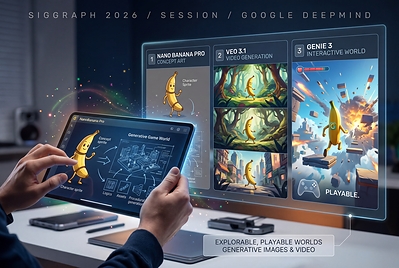
This year's slate ranges from quantum computing to real-time graphics. In "Hands-on Programming and Running Quantum Teleportation", led by Andrew Glassner, participants write and run quantum computing code, then program the quantum teleportation algorithm on a high-quality simulator to transfer a quantum bit's state to a partner who decodes the hidden message. "Dreaming in 4 Dimensions: Generating Media With Gemini, Genie, and Veo", led by Paige Bailey, DeepMind and Google, puts Google DeepMind engineers alongside attendees to generate concept art, video, and playable interactive worlds with NanoBanana Pro, Veo 3.1, and Genie 3. "Introduction to Slang: The Next-Generation Shading Language", led by Nia Bickford and Chris Hebert, NVIDIA, introduces Slang, an open-source, Khronos-hosted shading language that simplifies cross-platform graphics development while keeping high performance on current GPUs. "Debugging USD Composition", led by Pallav Sharma and Joan Panis, Autodesk, and Nick Porcino, Pixar Animation Studios, gives participants hands-on practice authoring data across composition arcs and diagnosing issues in complex production scenes with modern debugging and visualization tools. And "Advance World Simulation With 3D Gaussian Splatting for Large-Scale Environment Reconstruction", led by Zoë LaLena, NVIDIA, walks through reconstructing a large scene for robotics testing with NVIDIA Omniverse NuRec Gaussian-based technologies, including multi-GPU training, object segmentation, and integration for simulation in NVIDIA Isaac Lab.
Taken as a whole, the Experience Hall offers more than spectacle. It offers a chance to touch, try, and learn from the people building what comes next, and to engage with computer graphics and interactive techniques as something to step into rather than something to watch. As Barker put it, the work of emerging technology is never finished: "The beauty of emerging technologies is that there are always more problems to be solved."
Across its programs and hands-on courses, the Experience Hall demonstrates how SIGGRAPH continues to celebrate bold storytelling and interaction while advancing the future of computer graphics and interactive techniques. To explore this year's conference and offerings, visit the website to see where interaction and storytelling are headed, and register now to experience everything the Experience Hall has to offer at SIGGRAPH 2026.
About ACM, ACM SIGGRAPH, and SIGGRAPH 2026
ACM, the Association for Computing Machinery, is the world's largest educational and scientific computing society, uniting educators, researchers, and professionals to inspire dialogue, share resources, and address the field's challenges. ACM SIGGRAPH is a special interest group within ACM that serves as an interdisciplinary community for members in research, technology, and applications in computer graphics and interactive techniques. The SIGGRAPH conference is the world's leading annual interdisciplinary educational experience showcasing the latest in computer graphics and interactive techniques. SIGGRAPH 2026, the 53rd annual conference hosted by ACM SIGGRAPH, will take place live 19–23 July at the Los Angeles Convention Center.
SOURCE SIGGRAPH 2026




Share this article