


ALBANY, Ga., Jan. 13, 2026 /PRNewswire/ -- A new year is often the catalyst for positive change. In 2026, as the prevalence of Alzheimer's continues to increase, The Peanut Institute is encouraging everyone to embrace brain-healthy habits.
"The brain benefits from quality sleep, regular exercise, low stress and healthy foods, and those actions can't be emphasized enough," says Dr. Samara Sterling, a nutrition scientist and research director for The Peanut Institute. "It's important to take care of the brain so it can operate at peak performance and continue to efficiently control and regulate the body."
Sleep
In terms of "down time," experts recommend seven to nine hours each night for adults. Consistent sleep supports memory, attention, problem-solving and protects against cognitive decline and Alzheimer's.
"Recent research has found that the brain does vital housekeeping during the night," explains Sterling. "While the body is at rest, the brain recharges, reorganizes and removes toxic waste that has accumulated throughout the day."1
Exercise
For exercise, the World Health Organization advises at least 150 minutes of moderate-intensity aerobic exercise (like a brisk walk or swimming) every week for adults, as well as muscle-strengthening activities on two or more days.2 For the maximum benefit, aim for 300 minutes weekly.
Relax
Stress isn't just difficult to handle, it also impacts the brain. Prolonged exposure to stress hormones can cause inflammation and dysfunction in the brain that affect memory, cognition, attention and mood.
Deep breathing, meditation, exercise, outdoor walks and healthy foods are tools to bring down stress levels.
Eat Healthy
Fueling the body with a variety of nutrient-dense foods is imperative.
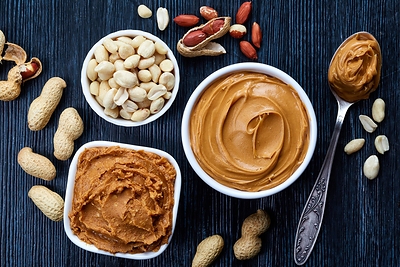
Beneficial brain foods include nuts and seeds, salmon, beans, blueberries, dark leafy greens, avocados and red cabbage, to name a few. Packed with 19 vitamins and minerals, peanuts and peanut butter fall into the nuts category and contain several nutrients that power the brain, including:
- Protein – a macronutrient that supports everything from repairing and creating cells to hormone production and immune response3. With seven grams per serving, peanuts have more protein than any other nut.
- Arginine – helps promote healthy blood flow throughout the body, including the brain. Peanuts contain more per serving than any other whole food.4
- Copper and choline – are involved in brain processes related to focus and concentration. Choline is also associated with better verbal fluency and memory.5
- B vitamins – folate, niacin and thiamin, along with B3, which supports healthy brain development.6
Peanuts also containresveratrol, a bioactive that is believed to be beneficial in fighting against Alzheimer's and other nerve degenerating diseases. Lab tests in 2018 showed resveratrol has the ability to reverse cognitive defects, as well as restore cognitive function in mice with neurological disorders.7
In addition, 2025 research from the Netherlands found that healthy older adults who ate peanuts experienced positive, physiological changes in their brain that were measurable by MRI (magnetic resonance imaging). The study observed that consuming 60 grams (approximately a half cup) of peanuts daily for 16 weeks increased global cerebral blood flow (CBF) by 3.6% and verbal memory by 5.8%.8 That's important because a strong flow of blood to the brain contributes to its health.
Meanwhile, a study of college students found that eating 32 grams (two tablespoons) of peanuts and peanut butter was associated with decreases in anxiety and depression levels, as well as improved memory.9 Researchers believe that an antioxidant in peanuts (p-coumaric acid) may help regulate stress and anxiety. They even noted that it could have similar stress-reducing effects as leading anti-anxiety drugs.10
"There isn't one 'magic bullet' to combat Alzheimer's and cognitive decline but there are scientifically identified actions people can take to help prevent or slow these conditions," says Sterling. "Adopting and maintaining brain healthy habits is a first step to positive change."
For more health news and recipe ideas that incorporate peanuts and peanut butter, visit PeanutInstitute.com. The Peanut Institute also provides news and updates on Facebook, Twitter, Instagram, LinkedIn and Pinterest.
Based in Albany, Ga., The Peanut Institute is a non-profit organization supporting nutrition research and developing educational programs to encourage healthful lifestyles that include peanuts and peanut products. The Peanut Institute pursues its mission through research programs, educational initiatives and the promotion of healthful lifestyles to consumers of all ages. As an independent forum, The Peanut Institute is uniquely positioned to work with all segments of the food industry, the research community, academia, consumer organizations and governmental institutions.
Sources:
- Eugene AR, Masiak J. The Neuroprotective Aspects of Sleep. MEDtube Sci. 2015 Mar;3(1):35-40. PMID: 26594659; PMCID: PMC4651462.
- World Health Organization. Physical activity. 2023. Available from: https://www.who.int/initiatives/behealthy/physical-activity. Accessed onDec 18, 2025.
- UHHospitals.org. "Dietary Protein: Why, When and How Much?" 5 May 2022, www.uhhospitals.org/blog/articles/2022/05/dietary-protein-why-when-and-how-much. Accessed on December 17, 2025.
- K van Vught, A.J.A.H., et al., Dietary arginine and linear growth: the Copenhagen School Child Intervention Study. British Journal of Nutrition, 2013. 109(6): p. 1031- 1039.
- Ylilauri MPT, Voutilainen S, Lönnroos E, Virtanen HEK, Tuomainen TP, Salonen JT, Virtanen JK. Associations of dietary choline intake with risk of incident dementia and with cognitive performance: the Kuopio Ischaemic Heart Disease Risk Factor Study. Am J Clin Nutr. 2019 Dec 1;110(6):1416-1423. doi: 10.1093/ajcn/nqz148. PMID: 31360988.
- Kennedy D. O. (2016). B Vitamins and the Brain: Mechanisms, Dose and Efficacy--A Review. Nutrients, 8(2), 68. doi:10.3390/nu8020068.
- Velmurugan BK, Rathinasamy B, Lohanathan BP, Thiyagarajan V, Weng CF. Neuroprotective Role of Phytochemicals. Molecules. 2018 Sep 27;23(10):2485. doi: 10.3390/molecules23102485. PMID: 30262792; PMCID: PMC6222499. https://www.ncbi.nlm.nih.gov/pmc/articles/PMC6222499/
- Longer-term skin-roasted peanut consumption improves brain vascular function and memory: A randomized, single-blind, controlled crossover trial in healthy older adults. Kerkhof, Lucia et al. Clinical Nutrition, Volume 55, 170 - 179
- Parilli-Moser, I., et al., Consumption of peanut products improves memory and stress response in healthy adults from the ARISTOTLE study: A 6-month randomized controlled trial. Clinical Nutrition, 2021.https://doi.org/10.1016/j.clnu.2021.09.020.
- Shayganfard M. Molecular and biological functions of resveratrol in psychiatric disorders: a review of recent evidence. Cell Biosci. 2020 Nov 7;10(1):128. doi: 10.1186/s13578-020-00491-3. PMID: 33292508; PMCID: PMC7648996.
SOURCE The Peanut Institute






Share this article